Top 10 crypto stocks to watch in 2026

Miners earn block rewards priced in bitcoin, so the asset's price determines their revenue. Electricity costs move independently, making power prices as consequential as bitcoin for mining profitability.
Crypto stocks group companies whose businesses are built around digital assets – through mining, exchange infrastructure, payments platforms, or holding bitcoin on the balance sheet. The ten names here sit across very different parts of that chain, from Coinbase Global ($COIN), which runs exchange and prime brokerage infrastructure, to Riot Platforms ($RIOT), which pairs bitcoin mining with an engineering business that makes power distribution equipment.
How we built this list: We selected these companies based on their industry and relevance to the theme, then ordered them by market capitalisation. Prices are updated daily, and the list and supporting content are reviewed roughly every quarter. All data is sourced from Stake. This list isn't a recommendation and isn't ordered by suitability.
Company Name | Ticker | Share Price | Market Cap | In Watchlists |
|---|---|---|---|---|
Robinhood | $62.17 | $61.82B | 8924 | |
Strategy | $77.80 | $37.05B | 11752 | |
Block | $69.66 | $44.87B | 19547 | |
Coinbase Global | $101.97 | $28.82B | 19234 | |
Hut 8 | $45.95 | $6.83B | 1354 | |
TeraWulf | $9.85 | $5.81B | 1248 | |
Riot Platforms | $16.23 | $6.65B | 7406 | |
Core Scientific | $11.33 | $4.31B | 872 | |
MARA Holdings | $5.09 | $2.42B | 7095 | |
CleanSpark | $4.89 | $1.50B | 2284 |
Past performance is not a reliable indicator of future performance.
Source: Stake market data. Figures in US$. Data updated as of 20 November 2026.
✅ Learn more: Top 7 crypto ETFs to watch in 2026→
Sign up in minutes and get access to a CHESS-sponsored platform, where you can explore Crypto stocks and more.
1. Robinhood ($HOOD)
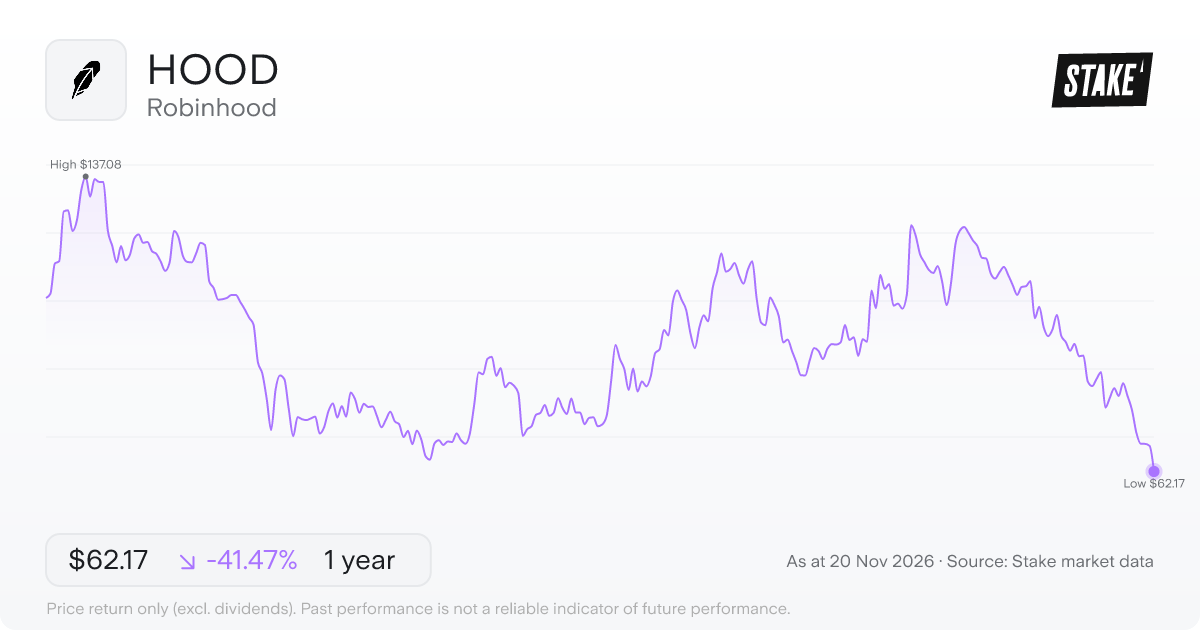
Price: US$62.17 · Daily: -9.4% · Market cap: US$61.82B · Sector: Technology · Industry: Fintech
Robinhood Markets ($HOOD) runs a retail financial services platform covering brokerage, crypto, digital banking, and private markets access. CEO Vlad Tenev heads the company, which employs 2,900 people across those businesses.
Robinhood Crypto handles in-app retail trading, while $HOOD also owns and operates regulated crypto exchanges Bitbuy and Coinsquare. A self-custody wallet, Robinhood Wallet, rounds out the crypto product set.
The brokerage product covers options, fractional shares, margin investing, retirement accounts, and a 24-hour market. $HOOD processes and clears trades through its own internal systems rather than outsourcing those functions to a third party.
2. Strategy ($MSTR)
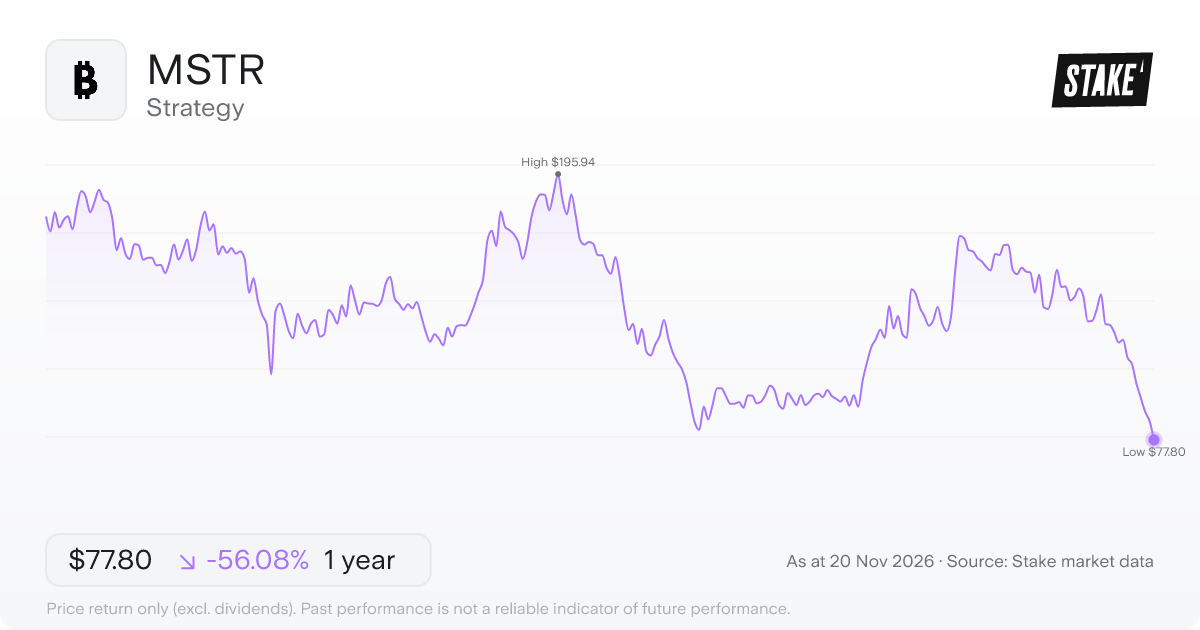
Price: US$77.80 · Daily: -9.7% · Market cap: US$37.05B · Sector: Technology · Industry: Software & IT
Strategy ($MSTR) operates as both an enterprise software company and a bitcoin treasury. The software business is built around the Strategy ONE platform, which gives organisations AI-powered tools for data visualisation, reporting, and embedded analytics. Customers include companies across retail, banking, healthcare, manufacturing and insurance, among other sectors.
Strategy Mosaic works as a governance layer over the software stack, intended to provide enterprises with consistent data definitions across sources and tools, regardless of where that data lives. CEO Phong Le leads 1,539 employees across both sides of the business. Because $MSTR holds bitcoin directly on its balance sheet, the company's financial position moves with that asset's price – an exposure that operates separately from its software revenue.
3. Block ($XYZ)
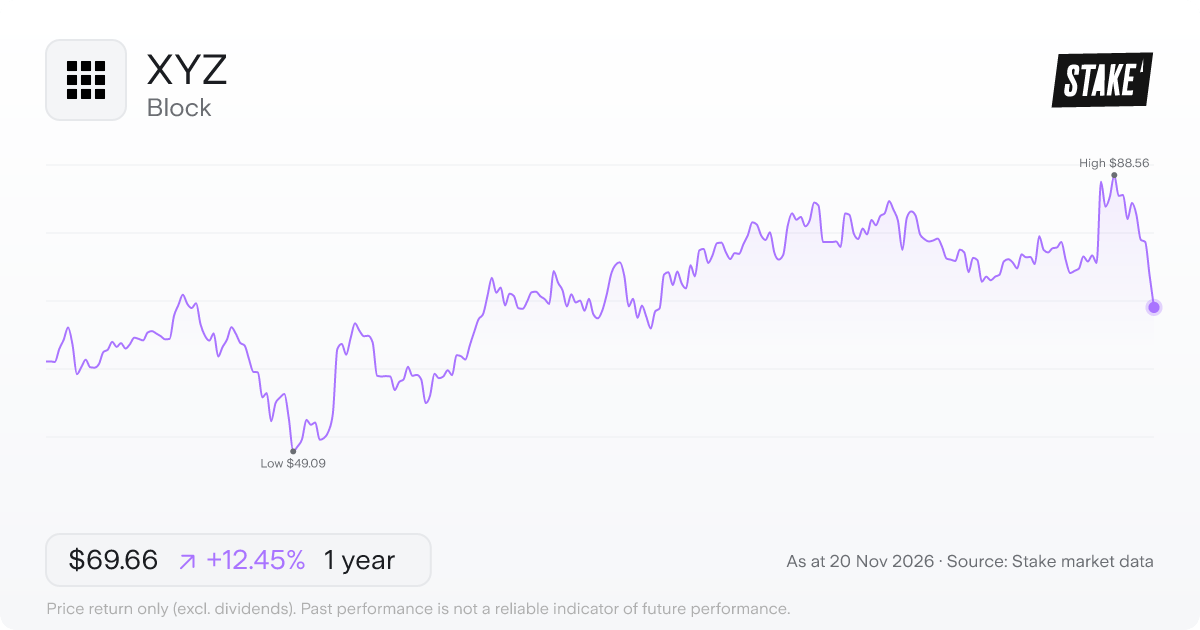
Price: US$69.66 · Daily: -6.2% · Market cap: US$44.87B · Sector: Industrials · Industry: Commercial Services
Block, Inc. ($XYZ) runs two distinct but connected businesses under one roof. Square handles the merchant side – payment processing, point-of-sale hardware, software, and financial services aimed at small businesses. Cash App sits on the consumer side, letting individuals send money, invest in stocks, borrow through a buy now, pay later platform, and buy bitcoin directly from the app.
The bitcoin piece is what earns $XYZ a place in this list. Cash App has offered bitcoin purchases to its users for years, making it one of the more consumer-facing on-ramps to crypto in the U.S. market. The company also operates TIDAL, a music platform positioned as a toolkit for independent artists.
4. Coinbase Global ($COIN)
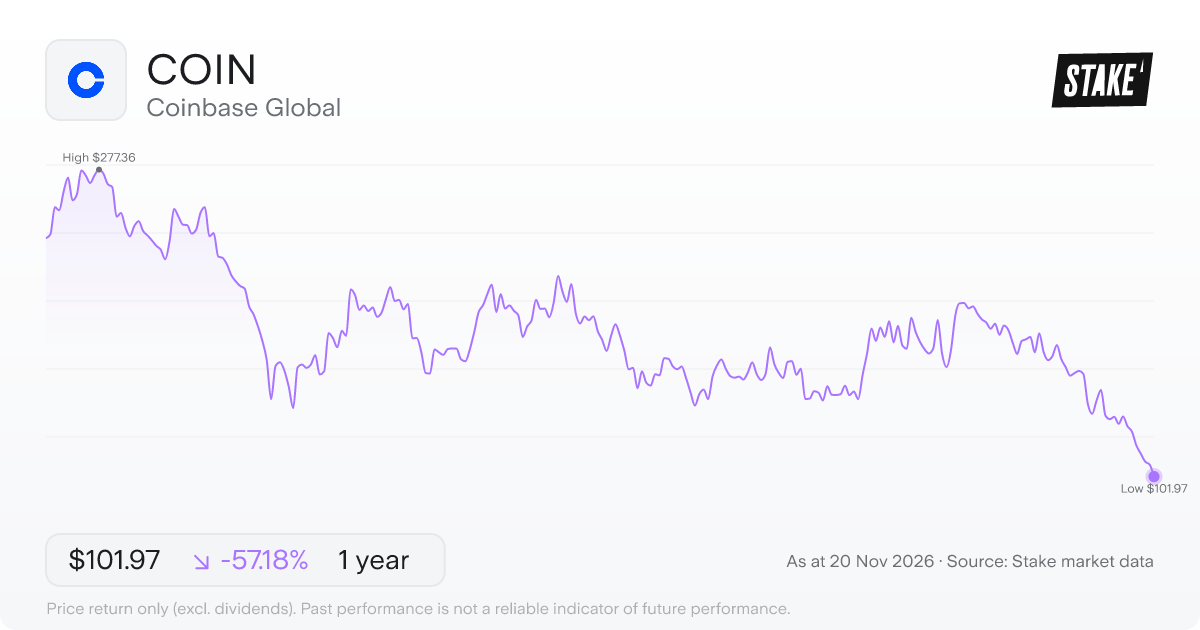
Price: US$101.97 · Daily: -6.3% · Market cap: US$28.82B · Sector: Technology · Industry: Fintech
Coinbase Global ($COIN) runs the infrastructure that connects people, businesses and institutions to the crypto economy. On the consumer side, $COIN acts as a trading and custody platform for digital assets. For institutions, it offers a prime brokerage service with access to liquidity across crypto markets, and for developers it provides the tools to build directly onchain.
Brian Armstrong leads the company, which employs around 4,951 people. Its transaction products cover consumer trading, prime trading, spot and derivatives markets, and its own Base protocol – alongside the Coinbase wallet.
5. Hut 8 ($HUT)
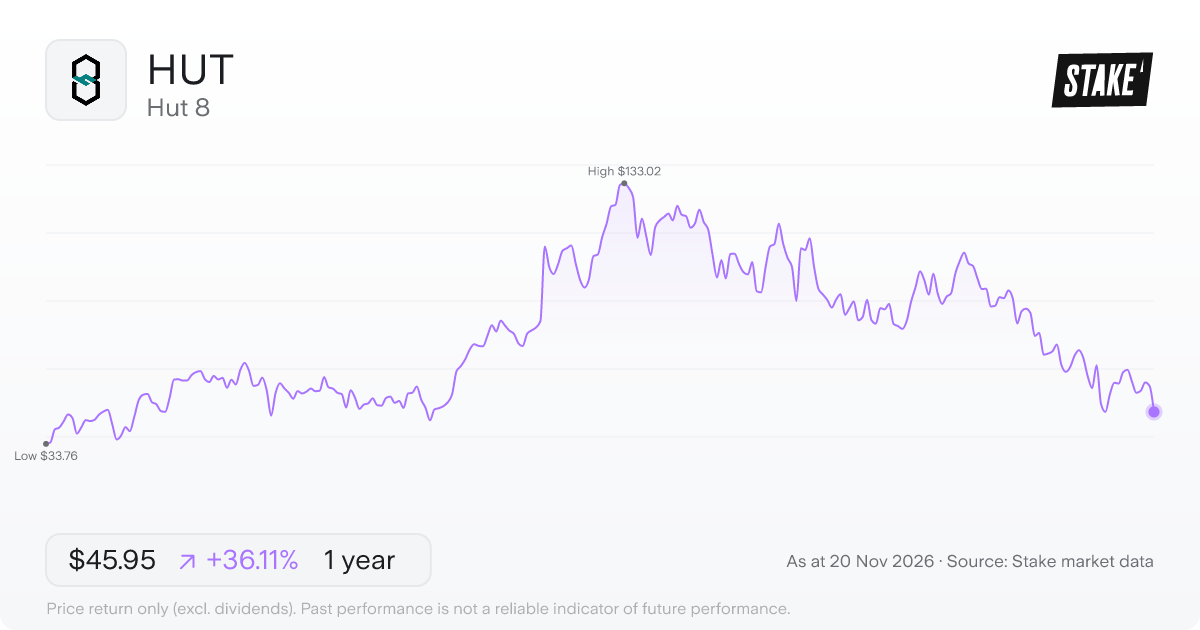
Price: US$45.95 · Daily: -17.7% · Market cap: US$6.83B · Sector: Technology · Industry: Fintech
Hut 8 Corp ($HUT) sits further back in the crypto supply chain than a typical exchange or mining company. Its core business is energy infrastructure – acquiring and managing powered land, substations, and electrical interconnects that underpin energy-intensive computing at scale.
Under CEO Asher Genoot, $HUT runs three main segments across its 248-person team: Power, Digital Infrastructure, and Compute. The Digital Infrastructure segment provides colocation services for both general-purpose processors and application-specific integrated circuits (ASICs), which are chips purpose-built for tasks like bitcoin mining. The Compute segment then deploys those assets across ASIC mining, traditional cloud, and AI cloud workloads.
Join 1M+ on Stake
Effortless investing in U.S. shares & ETFs
6. TeraWulf ($WULF)
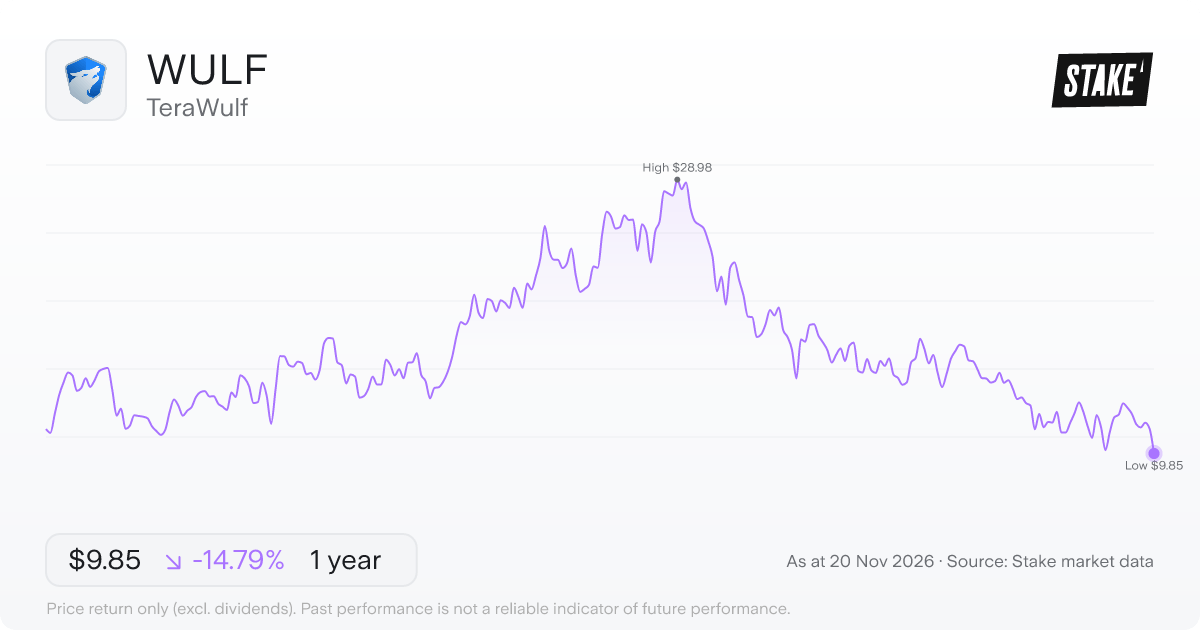
Price: US$9.85 · Daily: -14.9% · Market cap: US$5.81B · Sector: Technology · Industry: Fintech
TeraWulf ($WULF) builds and operates digital infrastructure across the United States, with power grid connectivity and data centre capacity at the core of its business. Under CEO Paul Prager, the company runs two segments. One provides bitcoin mining capacity, using application-specific integrated circuit (ASIC) miners to compute transaction hashes for a mining pool operator. The other leases high-density colocation space to third parties running AI and high-performance computing (HPC) workloads – a 141-person operation supporting both sides of that infrastructure.
7. Riot Platforms ($RIOT)
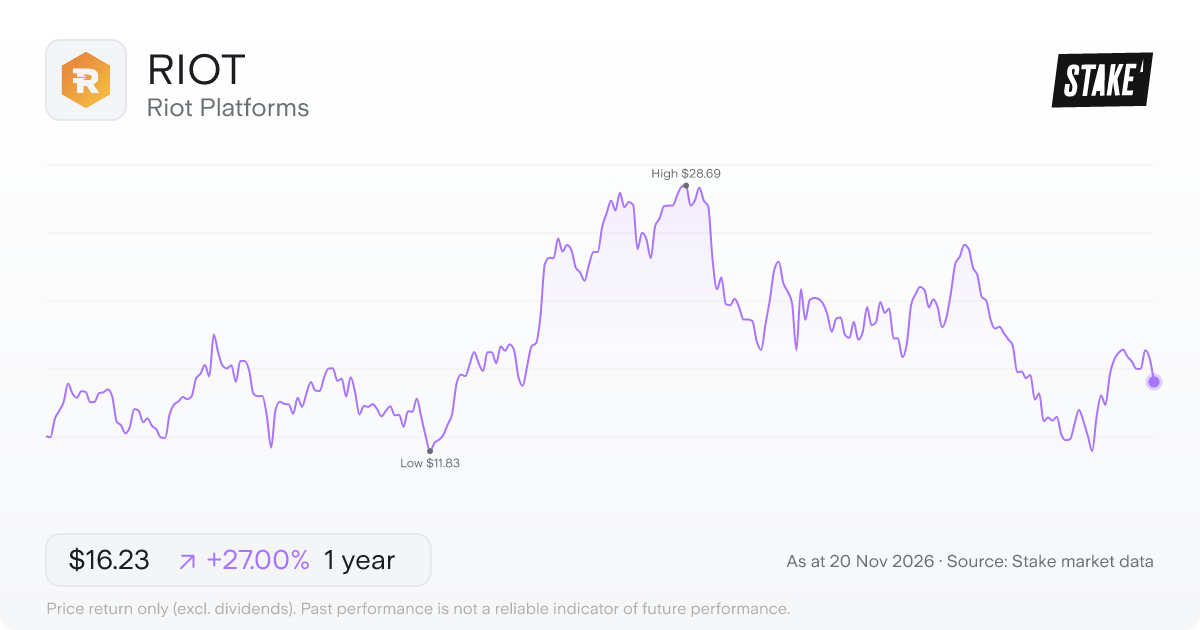
Price: US$16.23 · Daily: -8.5% · Market cap: US$6.65B · Sector: Technology · Industry: Fintech
Riot Platforms ($RIOT) runs two distinct businesses under one roof. Its Bitcoin Mining segment operates large-scale mining infrastructure, while its Engineering segment designs and manufactures power distribution equipment for data centres, utilities, and industrial customers.
Chief executive Jason Les leads a company of 816 employees that's also developing capacity for artificial intelligence and high-performance computing uses. That pivot reflects how closely power infrastructure and compute demand have become intertwined across $RIOT's customer base.
8. Core Scientific ($CORZ)
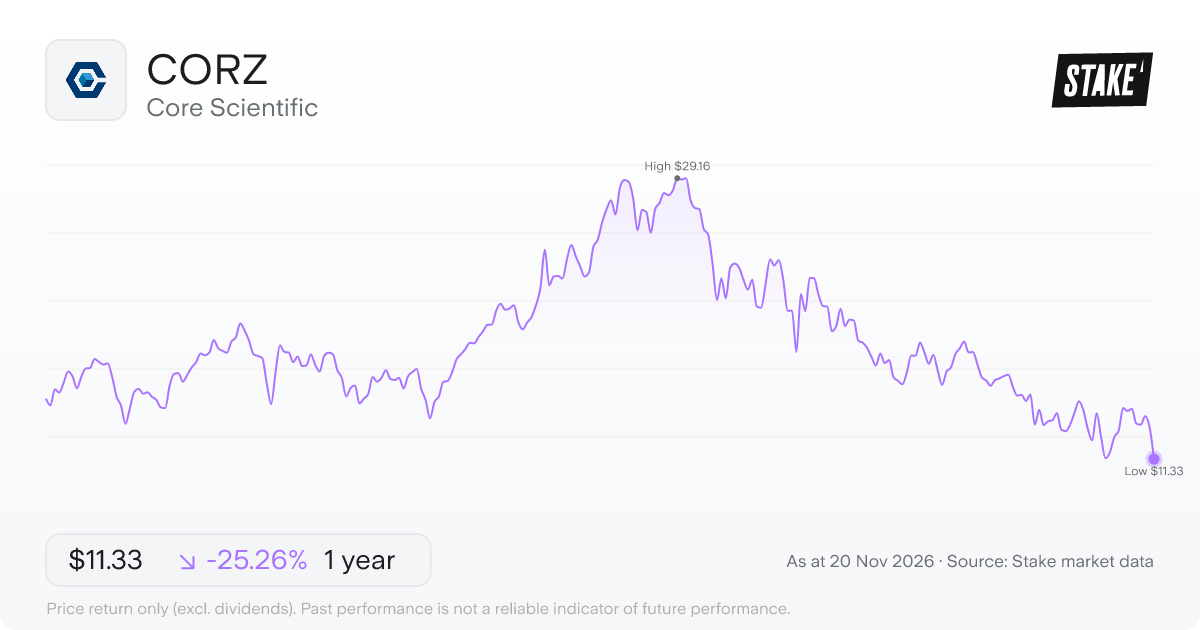
Price: US$11.33 · Daily: -15.2% · Market cap: US$4.31B · Sector: Technology · Industry: Fintech
Core Scientific ($CORZ), led by CEO Adam Sullivan, builds and runs large-scale data centres purpose-built for power-intensive work. The business runs across three segments: colocation services, digital asset mining for its own account, and hosted mining for third parties.
The colocation side houses infrastructure for machine learning and artificial intelligence workloads, supplying the space, power, cooling and security that high-density computing demands. With 325 employees, $CORZ keeps a lean headcount relative to the scale of physical infrastructure it manages.
9. MARA Holdings ($MARA)
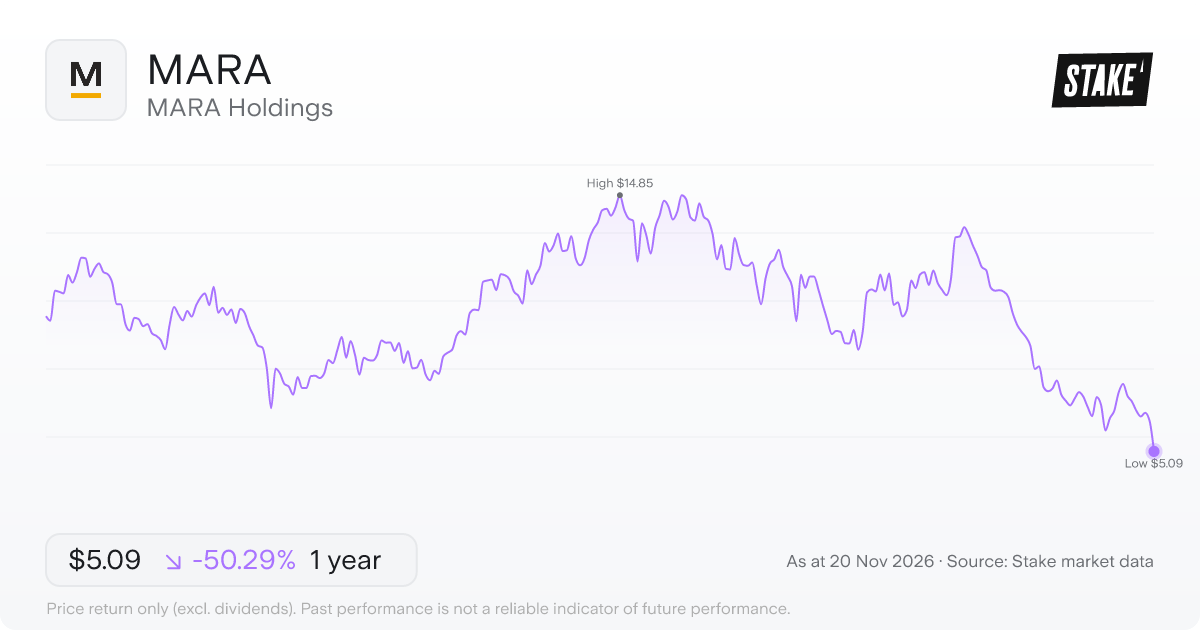
Price: US$5.09 · Daily: -18.6% · Market cap: US$2.42B · Sector: Technology · Industry: Fintech
Bitcoin mining sits at the core of MARA Holdings ($MARA), with the company operating 19 data centres across four continents. Those sites serve both $MARA's own mining operations and institutional-scale crypto miners that need colocation and managed services – space, power, cooling, and connectivity. The company describes its model as converting excess energy into digital capital.
$MARA is also pushing its infrastructure into adjacent workloads, including artificial intelligence and high-performance computing. Total capacity across all sites reaches approximately 1.9 gigawatts. Fred Thiel leads the company as CEO, with a team of 266 employees behind the operation.
10. CleanSpark ($CLSK)
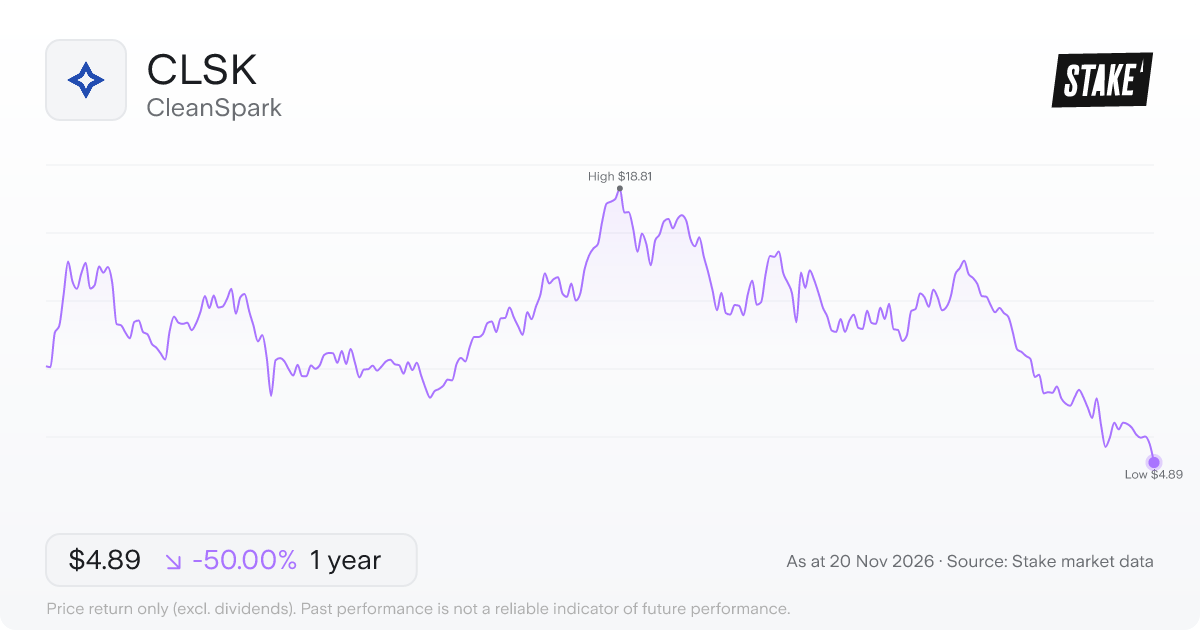
Price: US$4.89 · Daily: -16.3% · Market cap: US$1.50B · Sector: Technology · Industry: Fintech
CleanSpark ($CLSK) runs bitcoin mining operations out of its own data centres across four U.S. states – Georgia, Mississippi, Tennessee and Wyoming. Those facilities hold around 188,500 mining machines and carry a contracted power capacity of roughly 853 megawatts.
That fleet has a hashrate capacity of approximately 27.6 exahashes per second (EH/s). Fleet efficiency sits at 21.94 joules per terahash, a figure that reflects how much energy each machine consumes relative to the work it performs.
$CLSK employs 314 people to run that infrastructure, so the operation is capital-intensive rather than headcount-heavy. The company owns its data centre assets through a series of property subsidiaries rather than leasing capacity from third parties.
➡️ Top 10 U.S. data centre stocks to watch in 2026→
Common questions
How do I invest in crypto stocks in Australia?
Every company in this list trades on U.S. exchanges, so you'll need a share trading platform with access to U.S. markets. From there, buying shares in a bitcoin miner, a crypto exchange, or a company that holds bitcoin on its balance sheet works the same way as buying any other U.S.-listed stock. Search the ticker, check the current price, and place your order.
What are the key risks of crypto stocks?
Some of the key risks include bitcoin price volatility, which directly affects miners' revenues and treasury-heavy companies alike; regulatory uncertainty, as the legal framework for crypto differs across jurisdictions and is subject to change as governments respond to the asset class; and the AUD/USD exchange rate, which affects what Australian investors pay for U.S.-listed shares and what their proceeds are worth when converted back. Energy-intensive businesses also face power cost risk – electricity prices can move independently of bitcoin's price, squeezing mining margins when both move in the wrong direction. Companies concentrated heavily on a single asset like bitcoin carry limited insulation if that asset falls sharply.
How do the types of companies in this list differ?
The companies here fall into a few distinct categories. Bitcoin miners like $CLSK and $MARA run computing hardware that validates transactions on the bitcoin network, earning newly minted bitcoin as a reward for doing so. $COIN operates a trading and custody platform that earns fees on transaction volume, while $MSTR holds bitcoin directly on its corporate balance sheet as a treasury asset alongside its enterprise software business. $HOOD and $XYZ offer crypto trading as part of broader consumer financial platforms, where it sits as one product among many rather than the centre of the business.
What drives revenue for bitcoin mining companies?
Bitcoin miners earn newly issued bitcoin by validating transaction blocks on the network. How much those rewards are worth depends on two things: the bitcoin price, and the miner's share of total computing power on the network, which influences how frequently they win a block reward. Power costs are the primary operating expense, so the gap between electricity prices and bitcoin's price is the key driver of profitability. When bitcoin falls or energy costs rise, that margin can compress quickly.
More resources
✅ Top 10 SaaS stocks to watch in 2026→
Disclaimer
Past performance is not a reliable indicator of future performance. When you invest, your capital is at risk. You should consider your own investment objectives, financial situation, and particular needs before making an investment decision. The value of your investments can go down as well as up and you may receive back less than your original investment. As always, do your own research and consider seeking appropriate financial advice before investing.
This is not personal financial advice nor a recommendation to invest in the securities listed. Any advice provided by Stake is of general nature only and does not take into account your specific circumstances. Trading and volume data from the Stake investing platform is for reference purposes only, the investment choices of others may not be appropriate for your needs and is not a reliable indicator of performance.
Please refer to hellostake.com/pricing for the fees that apply. When you trade securities priced in another currency, currency conversion fees may apply and movements in the exchange rate may affect your returns.

Stake Desk
The freshest market insights
This article combines AI and human review from our analysts to bring you accurate, informative investing content at speed. For questions or suggestions, contact stakedesk@stake.com.au.
Subscribe
By subscribing, you agree to our Privacy Policy.