Top 10 U.S. REITs to watch in 2026

U.S. REITs own warehouses for goods in transit, towers carrying wireless signals and buildings where older adults live. Each property type has its own tenant base and demand drivers.
A real estate investment trust, or REIT, owns income-producing property and trades on a stock exchange like any other listed company. The 10 names on this list – ranked by market capitalisation – span a wide range of property types, from senior housing communities and retail malls to cell towers, logistics warehouses and data centres.
How we built this list: We selected these companies based on their industry and relevance to the theme, then ordered them by market capitalisation. Prices are updated daily, and the list and supporting content are reviewed roughly every quarter. All data is sourced from Stake. This list isn't a recommendation and isn't ordered by suitability.
Company Name | Ticker | Share Price | Market Cap | In Watchlists |
|---|---|---|---|---|
Welltower | $249.69 | $180.60B | 405 | |
Prologis | $126.95 | $120.74B | 818 | |
Equinix | $984.87 | $96.83B | 1886 | |
American Tower | $184.93 | $85.61B | 1260 | |
Simon Property Group | $235.27 | $75.45B | 1338 | |
Digital Realty | $167.16 | $62.96B | 1329 | |
Public Storage | $338.20 | $63.15B | 298 | |
Realty Income | $60.51 | $57.30B | 5416 | |
Ventas | $88.59 | $46.20B | 232 | |
Iron Mountain | $104.36 | $30.99B | 926 |
Past performance is not a reliable indicator of future performance.
Source: Stake market data. Figures in US$. Data updated as of 27 November 2026.
✅ Learn more: Top 10 dividend ETFs in Australia to watch in 2026→
Sign up in minutes and get access to a CHESS-sponsored platform, where you can explore REITs and more.
1. Welltower ($WELL)
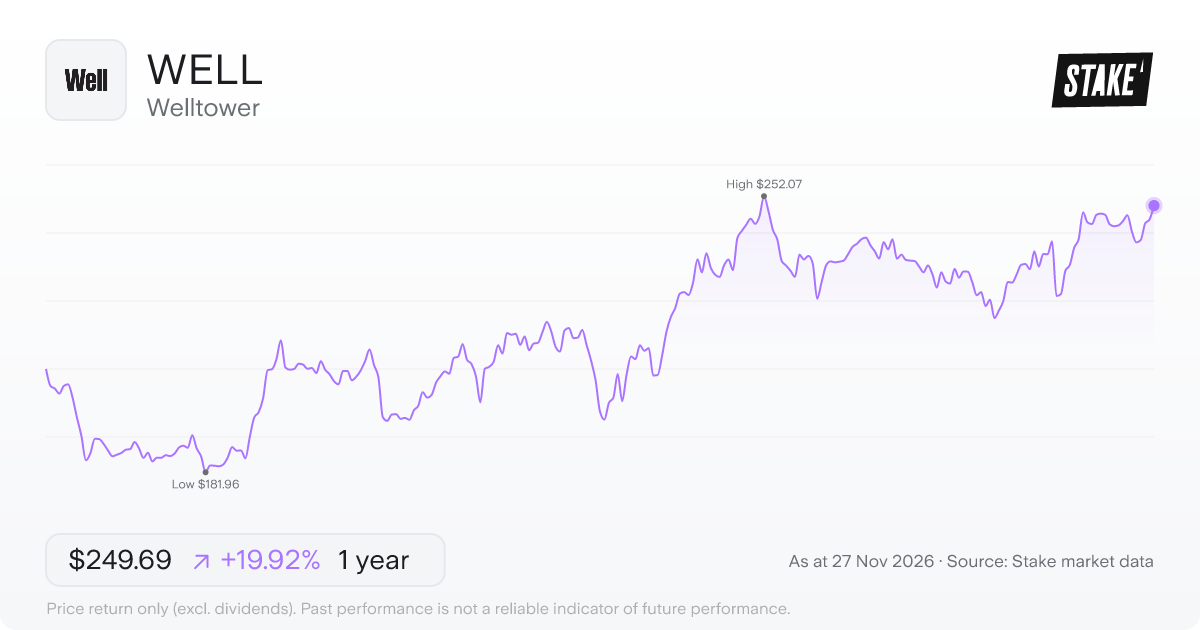
Price: US$249.69 · Daily: 1.4% · Market cap: US$180.60B · Sector: Real Estate · Industry: REITs
Senior housing sits at the core of Welltower Inc.'s ($WELL) business. The company owns and operates a portfolio of more than 2,500 communities for older adults across the United States, the United Kingdom and Canada. Those communities cover a wide range of living arrangements – from independent and assisted living to continuing care retirement communities and, in the UK, care homes with and without nursing.
$WELL runs two segments. Its Seniors Housing Operating segment manages communities directly. The Triple-net segment acquires single-tenant seniors housing and healthcare properties and leases them to operators – under that structure, $WELL holds the real estate but stays out of day-to-day property management. CEO Shankh Mitra leads a corporate team of 712 employees.
2. Prologis ($PLD)
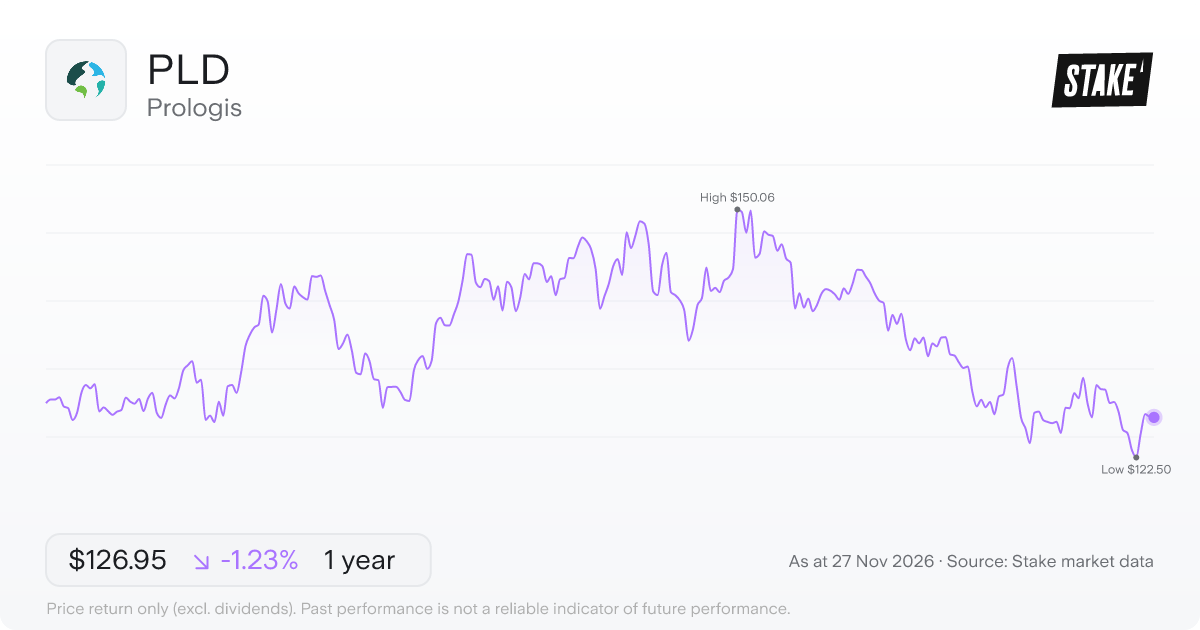
Price: US$126.95 · Daily: -0.06% · Market cap: US$120.74B · Sector: Real Estate · Industry: REITs
Prologis ($PLD) owns and develops logistics facilities – the warehouses and distribution centres that sit between manufacturers and end consumers. Its Real Estate segment covers both rental operations and active development, including land held for future projects and properties under construction. The portfolio also takes in renewable energy assets tied to those properties.
A second segment, Strategic Capital, manages co-investment ventures with external partners, where $PLD acts as general partner but doesn't own the assets outright. That structure lets the company extend its reach without putting every property on its own balance sheet. Altogether, $PLD operates across roughly 20 countries on four continents, under CEO Dan Letter, with a workforce of 2,802 people.
3. Equinix ($EQIX)
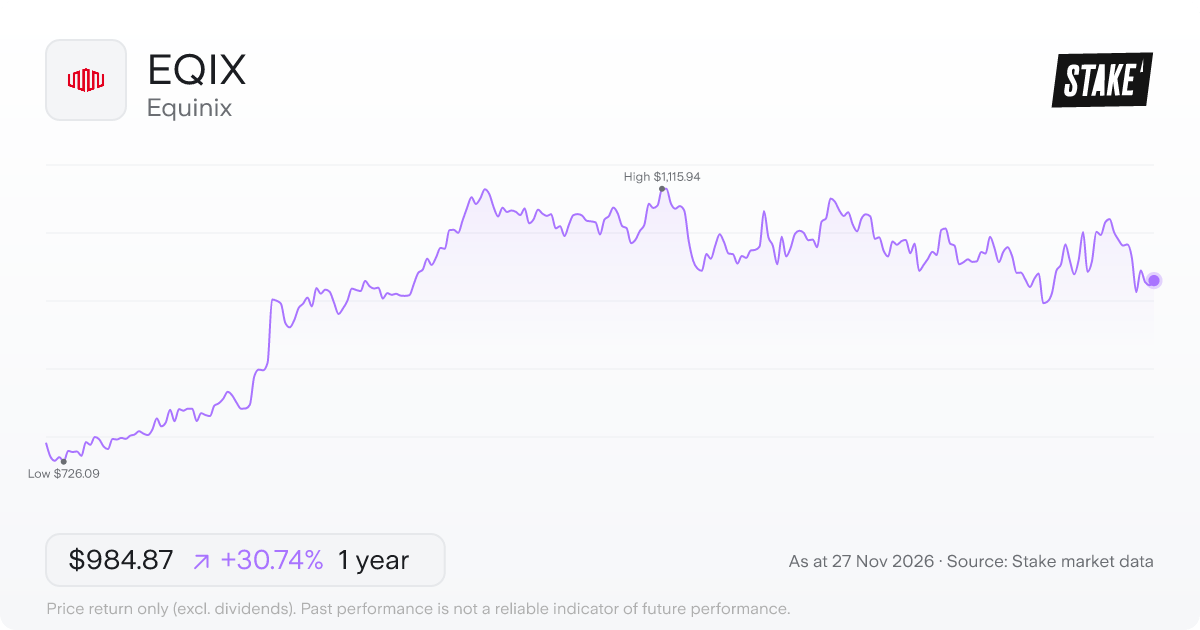
Price: US$984.87 · Daily: 0.7% · Market cap: US$96.83B · Sector: Real Estate · Industry: REITs
Housing other companies' servers and networking equipment is the core of what Equinix ($EQIX) does. Its network of International Business Exchange and xScale data centres gives businesses a place to physically locate that equipment – a model called colocation – across the Americas, Asia-Pacific, and Europe, the Middle East and Africa (EMEA). $EQIX also connects customers directly within and between those facilities through interconnection products like Equinix Fabric and Fiber Connect. CEO Adaire Fox-Martin heads a team of 13,716 employees.
4. American Tower ($AMT)
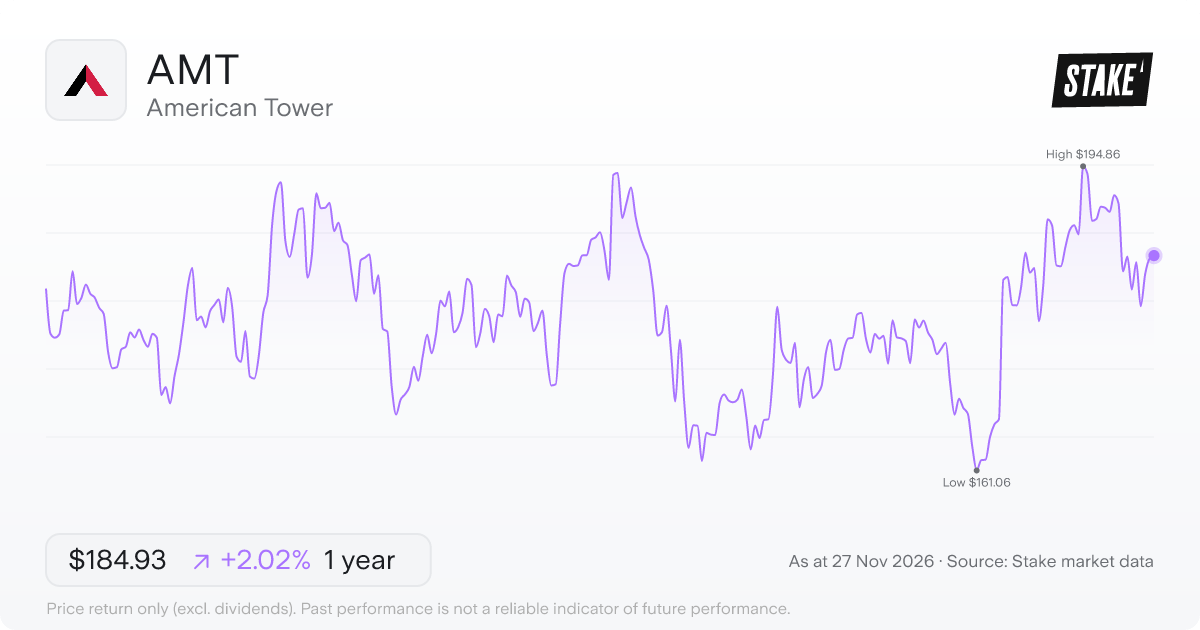
Price: US$184.93 · Daily: 0.2% · Market cap: US$85.61B · Sector: Real Estate · Industry: REITs
More than 148,000 communications sites sit within the portfolio of American Tower Corporation ($AMT), leased to wireless carriers, broadcasters, data providers and government agencies. Property segments cover the U.S. and Canada, Latin America, Europe, and Africa and the Asia-Pacific region.
$AMT also owns and operates data centre facilities in the U.S. through a dedicated segment, alongside a Services arm that handles structural analyses, mount analyses and construction management for tower-related work. CEO Steve Vondran leads a team of 4,866 employees across the business.
5. Simon Property Group ($SPG)
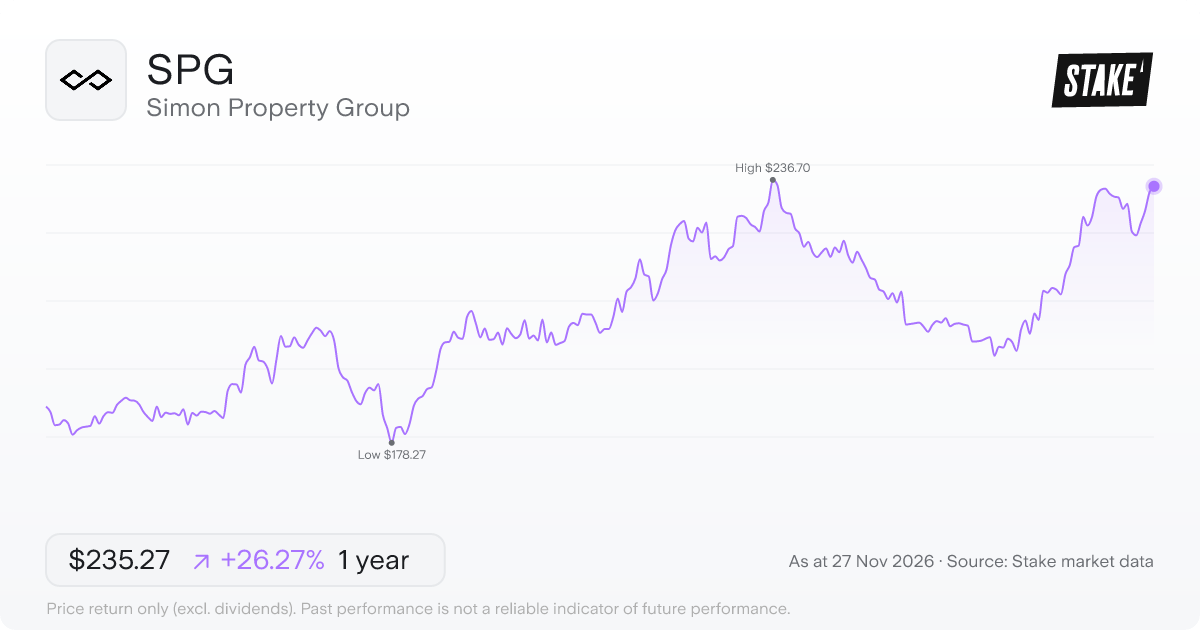
Price: US$235.27 · Daily: 0.6% · Market cap: US$75.45B · Sector: Real Estate · Industry: REITs
Simon Property Group ($SPG) owns, develops and manages shopping, dining, entertainment and mixed-use destinations across a portfolio of more than 250 properties globally. The mix includes traditional malls, Premium Outlets and The Mills centres – formats that bring together retail, food and leisure under one roof.
The company is self-administered and self-managed, meaning it handles both ownership decisions and day-to-day operations in-house. Chief executive Eli Simon leads a team of 3,100 employees across the portfolio. As a REIT, $SPG is required to distribute most of its taxable income as dividends to shareholders.
Join 1M+ on Stake
Effortless investing in U.S. shares & ETFs
6. Digital Realty ($DLR)
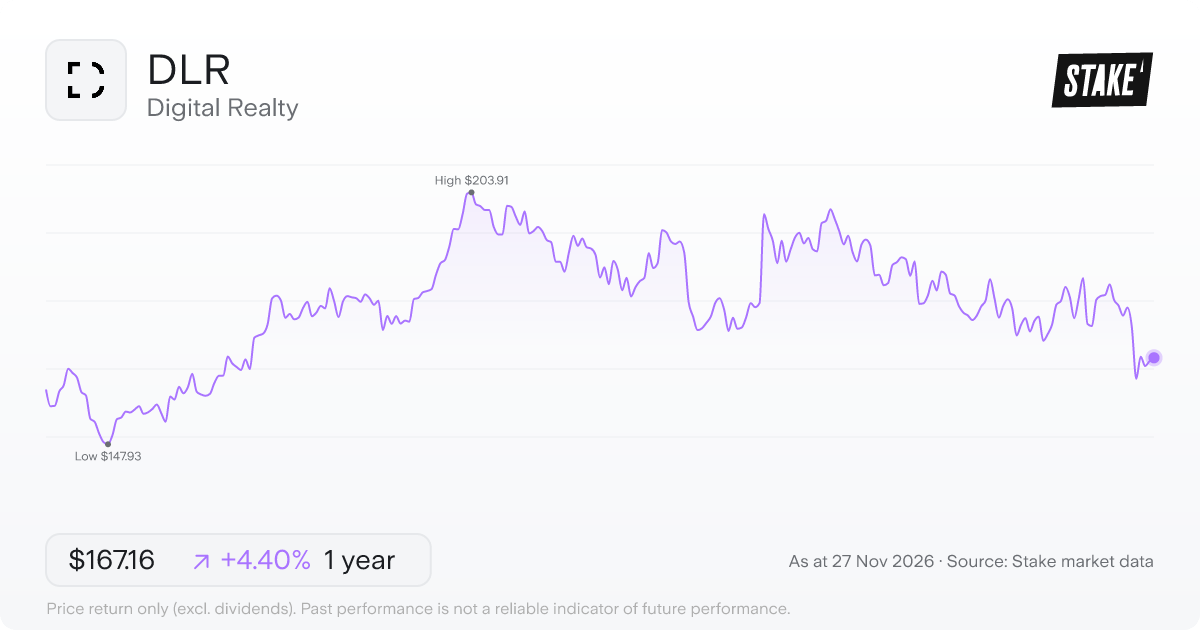
Price: US$167.16 · Daily: 0.4% · Market cap: US$62.96B · Sector: Real Estate · Industry: REITs
Digital Realty Trust ($DLR) owns, develops and operates data centres – the physical facilities where cloud platforms, financial institutions and other businesses run their computing infrastructure. $DLR's footprint covers more than 300 facilities across 55+ metros in 30+ countries on six continents.
The company's PlatformDIGITAL is a global data centre platform intended to give customers a way to deploy critical infrastructure consistently across those locations. Its customer base reaches across cloud and IT services, communications, financial services, healthcare, energy and manufacturing.
7. Public Storage ($PSA)
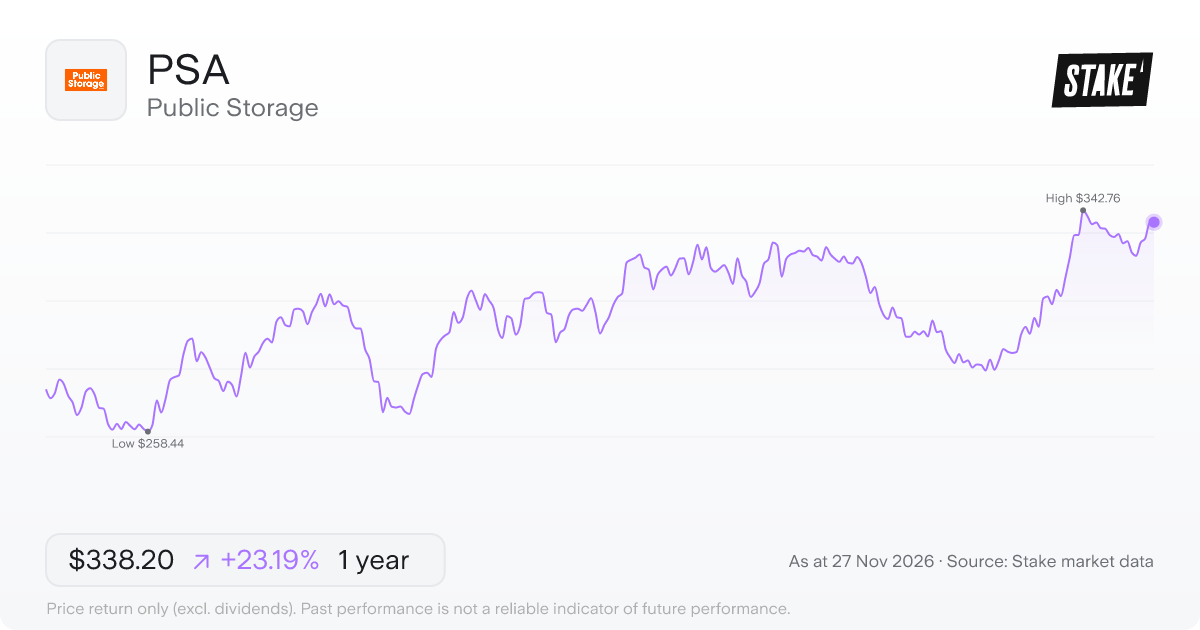
Price: US$338.20 · Daily: 0.07% · Market cap: US$63.15B · Sector: Real Estate · Industry: REITs
Public Storage ($PSA) owns and operates self-storage facilities across 40 U.S. states, leasing spaces to personal and business customers mostly on a month-to-month basis. The company held interests in over 3,085 facilities at last count, with a workforce of 5,770 employees under chief executive H. Thomas Boyle.
Beyond renting out units, $PSA runs a handful of adjacent businesses: tenant reinsurance, merchandise sales, third-party property management, and bridge lending to other self-storage operators. Those ancillary lines sit alongside the core rental operations, which cover everything from long-held same-store facilities to newly developed and expanded sites.
8. Realty Income ($O)
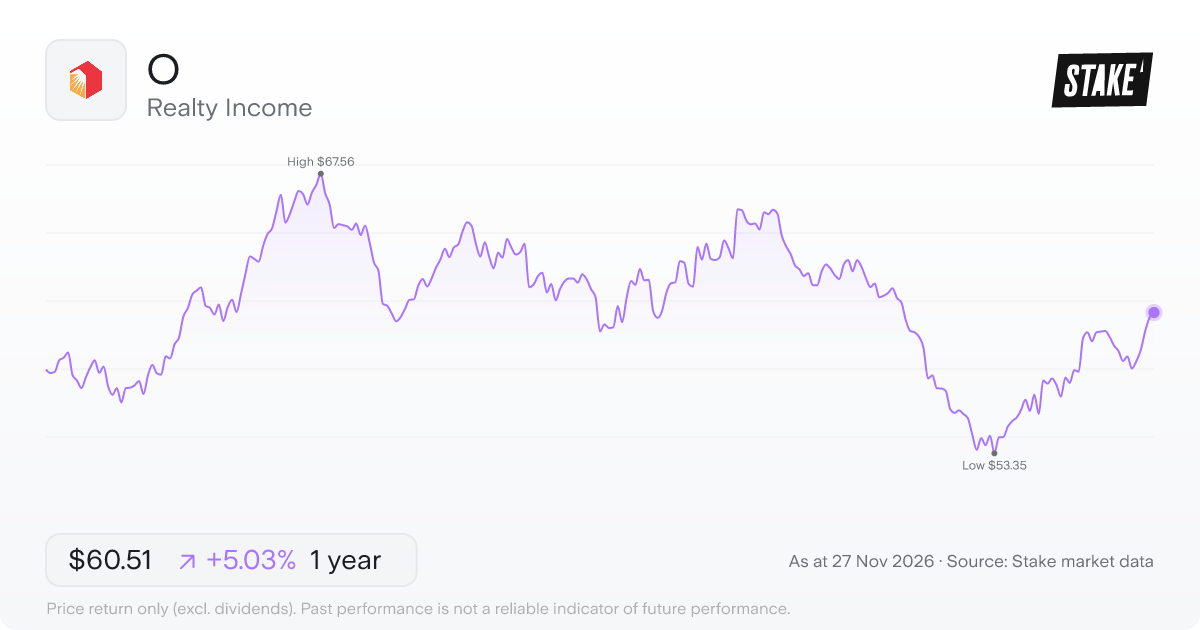
Price: US$60.51 · Daily: 0.4% · Market cap: US$57.30B · Sector: Real Estate · Industry: REITs
Realty Income Corporation ($O) owns more than 15,500 freestanding commercial properties across all 50 U.S. states, the United Kingdom, and eight other countries in Europe. The leases run on a net basis, meaning tenants generally cover property taxes, insurance and maintenance costs rather than the landlord. Property types include retail, industrial and gaming, with tenant concentrations spanning grocery stores, convenience stores, drug stores, quick-service restaurants and automotive service centres. Sumit Roy serves as chief executive, leading a team of 544 employees.
9. Ventas ($VTR)
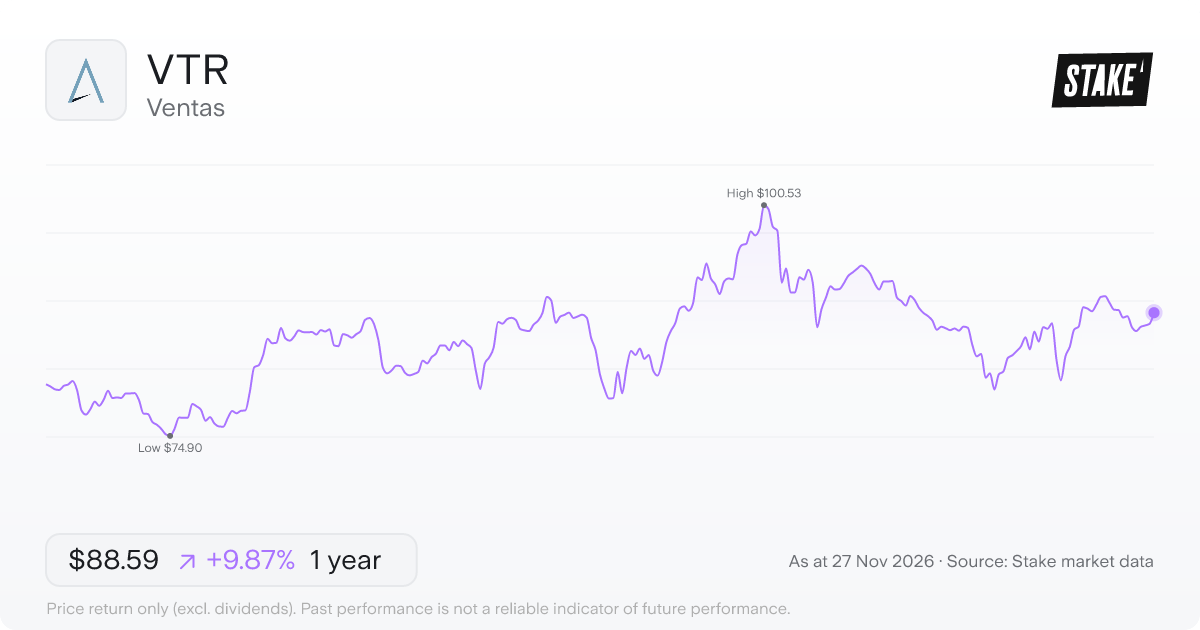
Price: US$88.59 · Daily: 1.4% · Market cap: US$46.20B · Sector: Real Estate · Industry: REITs
Ventas, Inc. ($VTR) concentrates almost entirely on healthcare real estate, holding around 1,450 properties across North America and the United Kingdom. The portfolio covers senior housing communities, outpatient medical buildings, research centres, hospitals and skilled nursing facilities.
$VTR runs three distinct operating segments. The senior housing operating portfolio, known as SHOP, owns senior communities and brings in third-party managers to run day-to-day operations. The outpatient medical and research segment acquires, develops and manages medical office buildings and research centres. The triple-net leased segment covers senior housing, skilled nursing facilities and inpatient rehabilitation facilities, where tenants typically bear most of the operating costs under long-term lease arrangements.
Debra Cafaro serves as CEO, and the company operates with 542 employees – a relatively lean headcount given the scale of the portfolio, which reflects how much of the operational work sits with third-party managers and tenants.
10. Iron Mountain ($IRM)
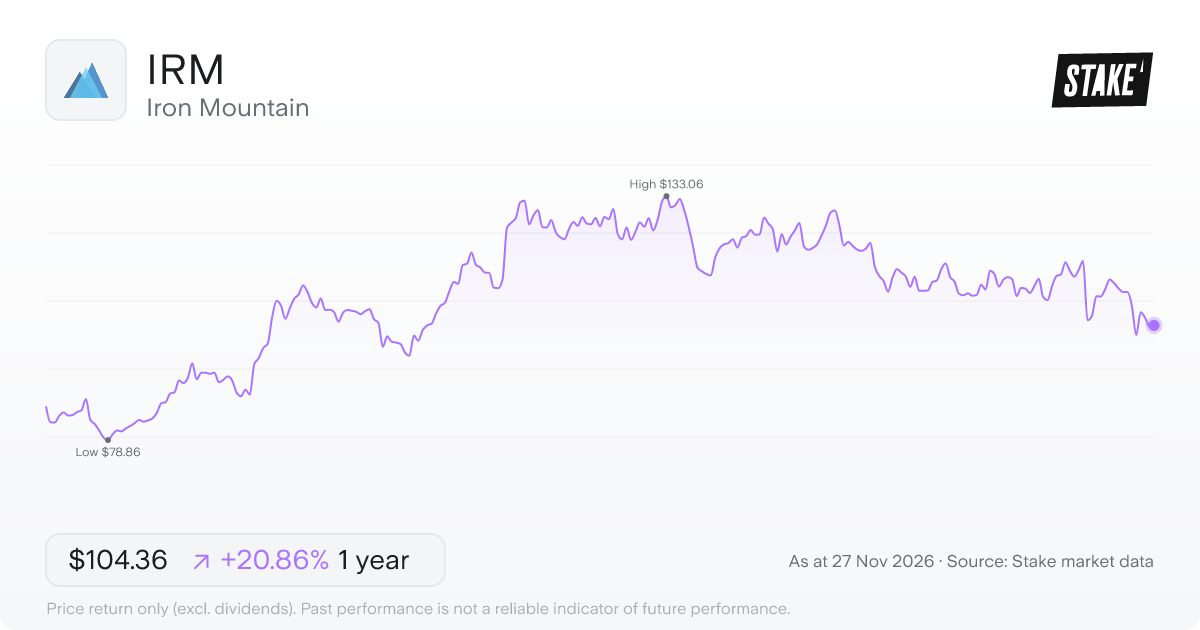
Price: US$104.36 · Daily: 0.3% · Market cap: US$30.99B · Sector: Real Estate · Industry: REITs
Iron Mountain Incorporated ($IRM) sits at an unusual intersection for a REIT: it stores physical paper records in secure vaults and runs data centre facilities for businesses that need to keep their IT infrastructure running. The company operates two distinct segments – the Global Records and Information Management business and the Global Data Center business – and both revolve around helping organisations manage assets they can't afford to lose.
The records side covers physical storage, secure shredding, media archiving and digital solutions services. That last piece matters because $IRM describes itself as a partner in digital transformation, helping companies extract value from stored documents and data rather than just keeping them on a shelf.
The data centre segment provides physical facilities where businesses house the servers and hardware that run their operations. Under CEO Bill Meaney, $IRM employs around 29,400 people to run this infrastructure across both sides of the business.
Because regulated industries – finance, healthcare, legal – tend to hold onto records for years or decades, the records management side carries relatively long-duration contracts. The data centre segment adds a different demand profile, tied to the growing need for secure physical space to run computing workloads.
➡️ Top 10 ASX REITs to watch in 2026→
Common questions
How do I invest in U.S. REITs in Australia?
Every company in this list trades on U.S. exchanges, so you'd buy shares through a share trading platform that provides access to U.S. markets. Each one trades like a regular stock – search the ticker, place an order and the shares settle in the usual way. U.S.-listed ETFs that hold baskets of REITs are another route, giving exposure across multiple property types in a single trade.
What are the key risks of U.S. REITs?
Some of the key risks include interest rate sensitivity – REITs typically carry significant debt, and changes in interest rates can affect borrowing costs and the relative attractiveness of their income distributions. Property-type concentration matters too: a retail mall REIT faces different pressures than a data centre operator or a senior housing owner, so each company here carries risks tied to its specific tenant mix and demand drivers. Tenant credit quality affects income stability, since a REIT depends on lessees meeting their obligations over time. For Australian investors, these are USD-priced assets, and movements between the Australian dollar and the U.S. dollar affect what a purchase costs and what any proceeds are worth in AUD.
What is a REIT and how does it work?
A real estate investment trust (REIT) is a company that owns income-producing real estate and is structured to distribute most of its taxable income to shareholders as dividends. In the U.S., REITs must meet distribution requirements to maintain that tax status, which is why they tend to pay regular dividends. They trade on stock exchanges like ordinary shares, so they can be bought and sold through a trading platform without directly purchasing property.
How do the different types of REITs in this list compare?
The ten companies cover genuinely different corners of real estate, which means each one's income and risks are shaped by different tenant types and demand drivers. Some focus on physical infrastructure – $PLD on logistics warehouses, $EQIX and $DLR on data centres, $AMT on communications towers. Others are defined by who occupies the space: $WELL and $VTR own senior housing and healthcare properties, $SPG runs shopping malls and outlet centres, and $PSA owns self-storage facilities. $O holds net-leased freestanding commercial properties across retail, industrial and gaming, while $IRM combines physical records storage with data centre operations – a structure unlike the rest of the list.
More resources
✅ Top 7 ASX data centre stocks to watch in 2026→
Disclaimer
Past performance is not a reliable indicator of future performance. When you invest, your capital is at risk. You should consider your own investment objectives, financial situation, and particular needs before making an investment decision. The value of your investments can go down as well as up and you may receive back less than your original investment. As always, do your own research and consider seeking appropriate financial advice before investing.
This is not personal financial advice nor a recommendation to invest in the securities listed. Any advice provided by Stake is of general nature only and does not take into account your specific circumstances. Trading and volume data from the Stake investing platform is for reference purposes only, the investment choices of others may not be appropriate for your needs and is not a reliable indicator of performance.
Please refer to hellostake.com/pricing for the fees that apply. When you trade securities priced in another currency, currency conversion fees may apply and movements in the exchange rate may affect your returns.

Stake Desk
The freshest market insights
This article combines AI and human review from our analysts to bring you accurate, informative investing content at speed. For questions or suggestions, contact stakedesk@stake.com.au.
Subscribe
By subscribing, you agree to our Privacy Policy.