
Bonds are a way for investors to add diversification to portfolios by investing in lower risk assets issued by governments and leading companies that deliver income streams. Bonds are in the spotlight as global central banks cut interest rates as inflation has fallen. The Reserve Bank of Australia will lower interest rates in 2025 as inflation nears its 2%-3% target. Elevated inflation has supported higher bond yields, but lower interest rates and falling inflation will steer bond yields lower. Commonwealth Government, State Government and corporate bonds offer investors a way to gain exposure to changing inflation and interest rate dynamics in Australia.
What are bonds?
The Commonwealth Government, State Governments and corporations issue bonds when they need to raise funds.
Bond investors receive a regular coupon, or interest payment, and receive their initial investment back once the bond matures. Funds raised by the Commonwealth Government and State Governments are used to fund government agencies and programs.
Corporations will use funds for working capital, capex and acquisitions.
How do bonds work in Australia?
The Commonwealth Government issues bonds through the Australian Office of Financial Management (AOFM).
The AOFM issues Treasury Notes, which have maturities of less than 12 months. Treasury Notes assist with the Australian government’s short-term funding requirements. Treasury Bonds are medium to long-term debt securities that carry an annual rate of interest fixed over the life of the security. Interest is paid semi-annually.
State governments issue bonds - known as semi-government bonds - through financing agencies. In NSW, TCorp provides domestic and international investors access to bonds and other debt instruments issued on behalf of the state of NSW. Other funding agencies include Treasury Corporation of Victoria and Queensland Treasury Corporation.
Companies will issue corporate bonds through a banking syndicate and fixed income fund managers will buy these bonds. Corporate bonds are priced on the perceived creditworthiness of the issuer. This is determined by an issuer’s credit rating. Companies can sell fixed interest securities that are senior (less risky with lower returns) or subordinated (higher returns but more risky). They can also issue debt at a fixed rate or floating rates.
🏛️ Related: How to buy government bonds in Australia→
How is the price of a bond determined?
When a bond is issued, it is sold into the ‘primary market’. The initial price an investor pays for the bond depends on the size of the coupon (or interest payments), the term of the bond and the price of similar bonds already issued into the market. Credit ratings also play an important role in pricing a bond issue.
All this data is used to calculate the bond’s initial yield. Once a bond is issued, investors can trade that bond in the ‘secondary market’ and its price and yield will change with market conditions.
A bond’s price and yield move in opposite directions. When prices fall, yields go higher. A bond’s price will fall if inflation or interest rates increase as it lowers the present value of future cash flows from the coupon payments.
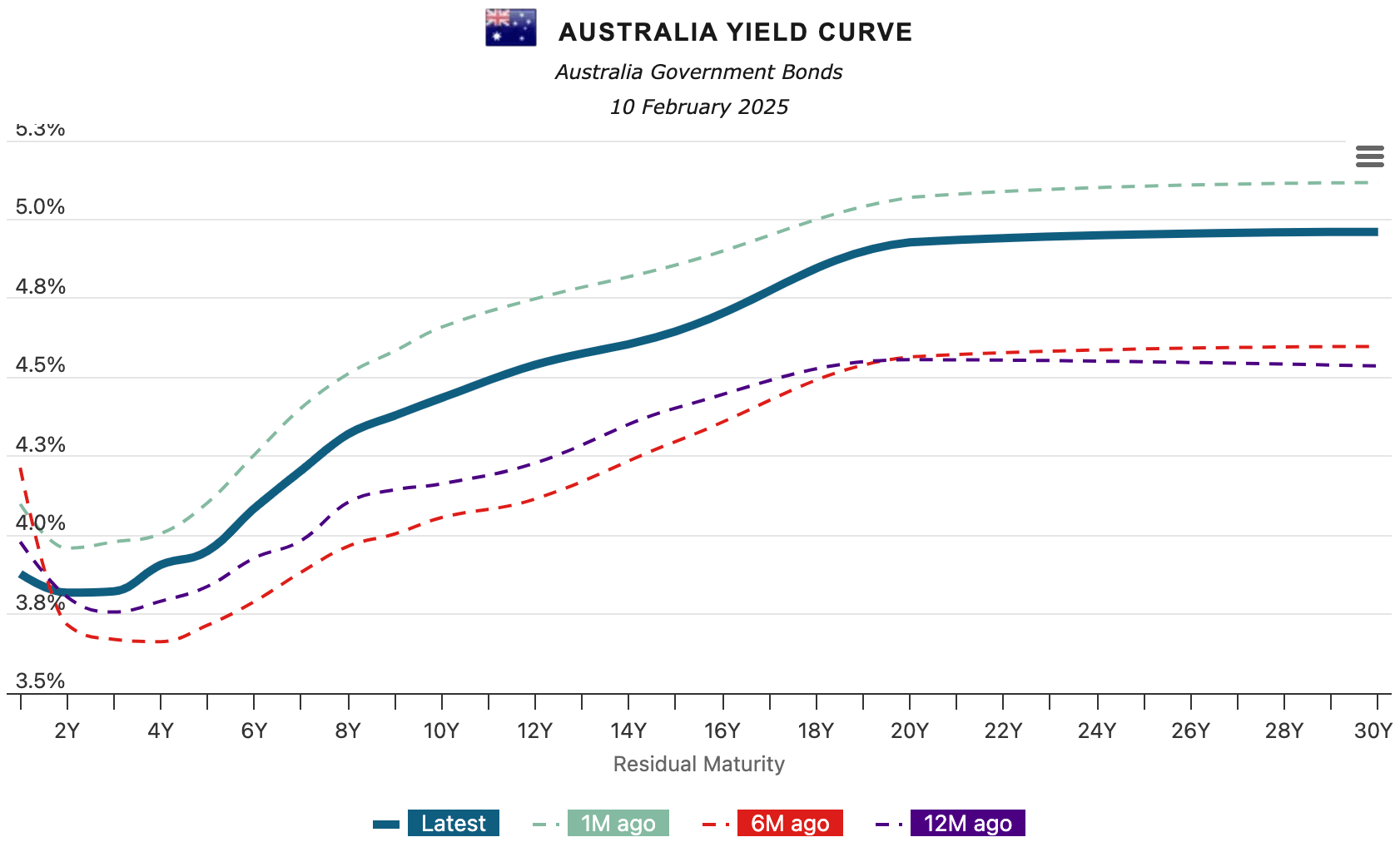
What is the meaning of bond duration?
Duration is a measurement of a bond’s interest rate risk that considers a bond’s maturity, yield and coupon. These factors are combined into one number that measures how sensitive a bond’s value is to interest rate changes.
The higher a bond’s duration, the more its value will fall as interest rates rise. When rates go up, bond values fall and vice versa. If interest rates are expected to fall while the bond is held, a bond with a longer duration would be appealing because the bond’s value would increase more than similar bonds with shorter durations.
What factors should you consider when buying a bond?
Investors should first consider the proportion of their portfolio they want allocated to bonds. Typically the weighting towards bonds increases as investors get older.
Consideration should be given to the different levels of risk and returns offered by Commonwealth Government, State Government and corporate bonds.
How many types of bonds are there?
In Australia, the three main types of bonds are Federal Government bonds, state - or semi-government - bonds and corporate bonds.
How to incorporate bonds into your investment portfolio?
ETFs provide a convenient and low cost way to invest in Australian bonds.
Vanguard offers three fixed interest ETFs:
- The Vanguard Australian Government Bond Index ETF ($VGB) which invests in high quality Commonwealth and State government bonds. It has an annual management fee of 0.16%.
- The Vanguard Australian Corporate Fixed Interest Index ETF ($VACF) invests in around 400 investment grade securities. Its annual fee is 0.20%.
- The Vanguard Australian Fixed Interest Index ETF ($VAF) invests in Australian government and corporate bonds and charges 0.10%. Distributions are paid quarterly.
Betashares offers an Australian Government Bond ETF ($AGVT) and Australian Investment Grade Corporate Bond ETF ($CRED). It also offers the Australian Major Bank Subordinated Debt ETF ($BSUB) and the Australian Bank Senior Floating Rate Bond ETF ($QPON), which charge annual fees of 0.29% and 0.22%, respectively, and pay monthly distributions.
BlackRock offers the iShares 15+ Year Australian Government Bond ETF ($ALTB), which invests in Commonwealth and State Government bonds with maturities above 15 years. It has an annual management fee of 0.15%.
VanEck offers ETFs that enable investors to target particular parts of the yield curve. Both the 1-5 Year Australian Government Bond ETF ($1GOV) and the 5-10 Year Australian Government Bond ETF ($5GOV) charge a 0.22% annual fee. The 10+ Year Australian Government Bond ETF ($XGOV) also charges a 0.22% fee.
Russell Investments offers an ETF focused on State Government bonds. The Russell Investments Australian Semi Government Bond ETF ($RSM) tracks the performance of the DBIQ 0-5 year Australian Semi-Government Bond Index. The annual management fee is 0.26%.
💡Related: Discover the best bond ETFs in Australia→
What are the advantages and disadvantages of bonds?
Bonds, as a fixed-income investment, offer a unique set of advantages and disadvantages for investors, which are outlined in the table below.
Advantages | Disadvantages |
|---|---|
Lower risk than equities | Lower returns than equities |
Capital preservation | Limited capital gains |
Fixed income | Interest rate, inflation risk |
Bonds FAQs
This article was written by Robert Guy - Senior Markets Writer at Stake.
Disclaimer
The information contained above does not constitute financial product advice nor a recommendation to invest in any of the securities listed. Past performance is not a reliable indicator of future performance. When you invest, your capital is at risk. You should consider your own investment objectives, financial situation and particular needs. The value of your investments can go down as well as up and you may receive back less than your original investment. As always, do your own research and consider seeking appropriate financial advice before investing.
Any advice provided by Stake is of general nature only and does not take into account your specific circumstances. Trading and volume data from the Stake investing platform is for reference purposes only, the investment choices of others may not be appropriate for your needs and is not a reliable indicator of performance.
$3 brokerage fee only applies to trades up to $30k in value (USD for Wall St trades and AUD for ASX trades). Please refer to hellostake.com/pricing for other fees that are applicable.
Subscribe
By subscribing, you agree to our Privacy Policy.