
Top private equity stocks to watch in 2026

These companies are the managers, not the funds themselves. Their revenue is management fees on committed capital plus a share of profits when investments are sold.
Private equity firms raise capital from institutional and private investors, deploy it into companies and assets that don't trade on public markets, and earn management fees plus a share of profits when those investments are realised. The six U.S.-listed names here take different approaches to that model – KKR & Co ($KKR) runs a retirement and life insurance business, Global Atlantic, alongside its core asset management arm, while Hamilton Lane ($HLNE) builds private markets portfolios by investing in other managers' funds.
How we built this list: We selected these companies based on their private equity and private markets investment business and ordered them by market capitalisation. Prices are updated daily, and the list and supporting content are reviewed roughly every quarter. All data is sourced from Stake. This list isn't a recommendation and isn't ordered by suitability.
Company Name | Ticker | Share Price | Market Cap | In Watchlists |
|---|---|---|---|---|
Blackstone | $107.09 | $127.35B | 1530 | |
KKR & Co | $87.00 | $77.39B | 659 | |
Ares Management | $113.00 | $37.32B | 168 | |
TPG | $43.10 | $16.35B | 62 | |
Carlyle Group | $36.56 | $12.96B | 167 | |
Hamilton Lane | $82.26 | $4.51B | 24 |
Past performance is not a reliable indicator of future performance.
Source: Stake market data. Figures in US$. Data updated as of 19 October 2026.
✅ Learn more: Top 7 ASX renewable energy stocks to watch in 2026→
Sign up in minutes and get access to a CHESS-sponsored platform, where you can explore private equity stocks and more.
1. Blackstone ($BX)
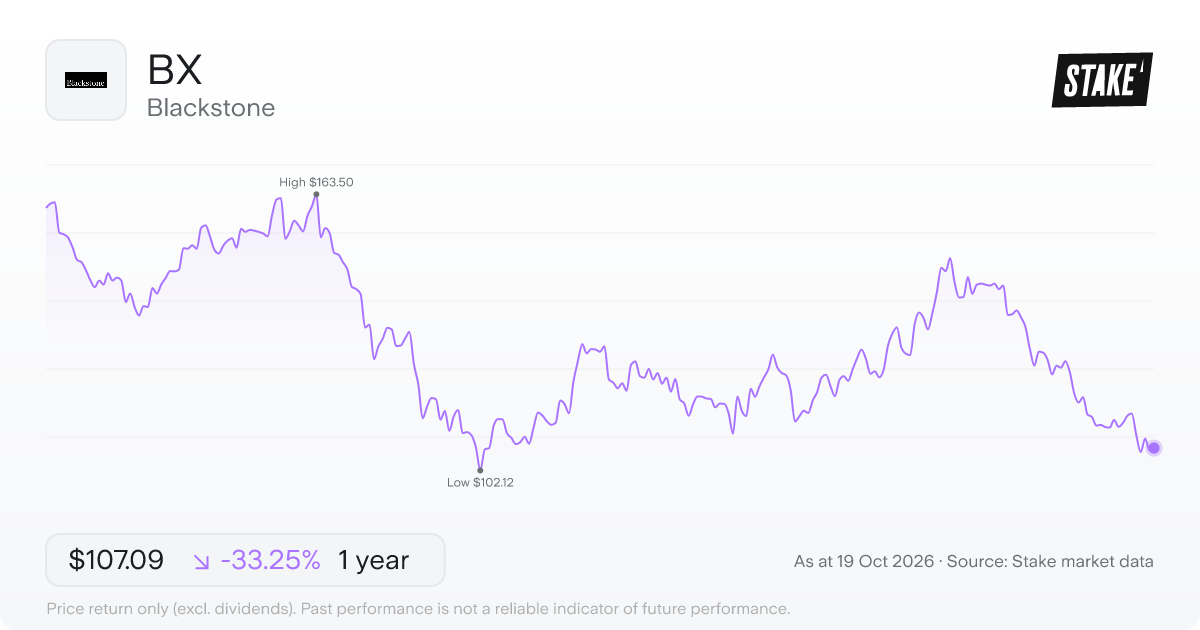
Price: US$107.09 · Daily: 0.5% · Market cap: US$127.35B · Sector: Financials · Industry: Investment Services
Blackstone Inc. ($BX) is an alternative asset manager with strategies covering real estate, private equity, infrastructure, credit, life sciences, growth equity and hedge funds. Steve Schwarzman leads the firm as chief executive, with roughly 5,285 people across the business.
The real estate segment manages opportunistic funds, Core+ real estate funds and real estate debt strategies. The private equity arm runs flagship corporate buyout funds alongside sector-specific and geographically focused strategies, plus a core private equity platform aimed at longer ownership horizons.
The Credit & Insurance segment – Blackstone Credit & Insurance – organises its work into three areas: private corporate credit, liquid corporate credit, and infrastructure and asset-based credit. A fourth segment, Multi-Asset Investing, runs four platforms: Absolute Return, Multi-Strategy, Total Portfolio Management and Public Real Assets.
2. KKR & Co ($KKR)
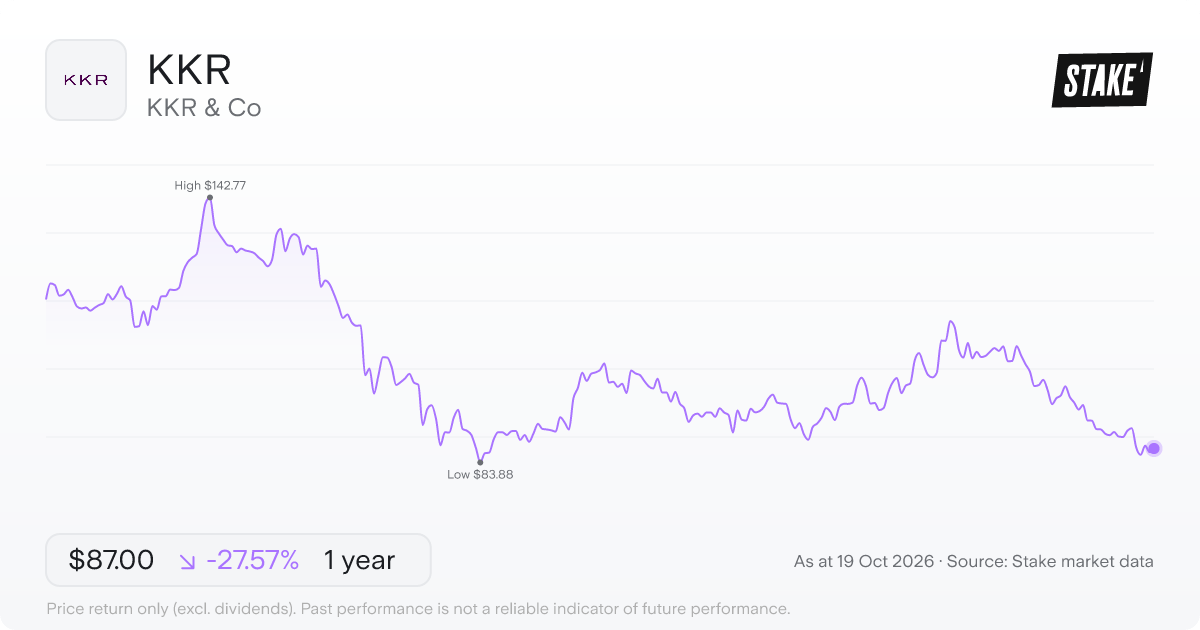
Price: US$87.00 · Daily: 0.9% · Market cap: US$77.39B · Sector: Financials · Industry: Investment Services
KKR & Co ($KKR) runs three distinct businesses under one roof: asset management, insurance and what it calls strategic holdings. The asset management arm covers private equity, real assets, credit strategies and capital markets – essentially raising money from investors and putting it to work in companies and assets that don't trade publicly. The insurance side is Global Atlantic, a U.S. retirement and life insurance business that sells annuities and reinsurance products to individuals and institutions.
The strategic holdings segment represents $KKR's own stake in its core private equity investments, so the firm participates directly in the returns it generates for others. Joseph Bae leads the company, which employs 5,043 people across its operations. That combination of fee income from managing other people's money and direct investment exposure through Global Atlantic and strategic holdings gives the business several different ways to generate revenue.
3. Ares Management ($ARES)
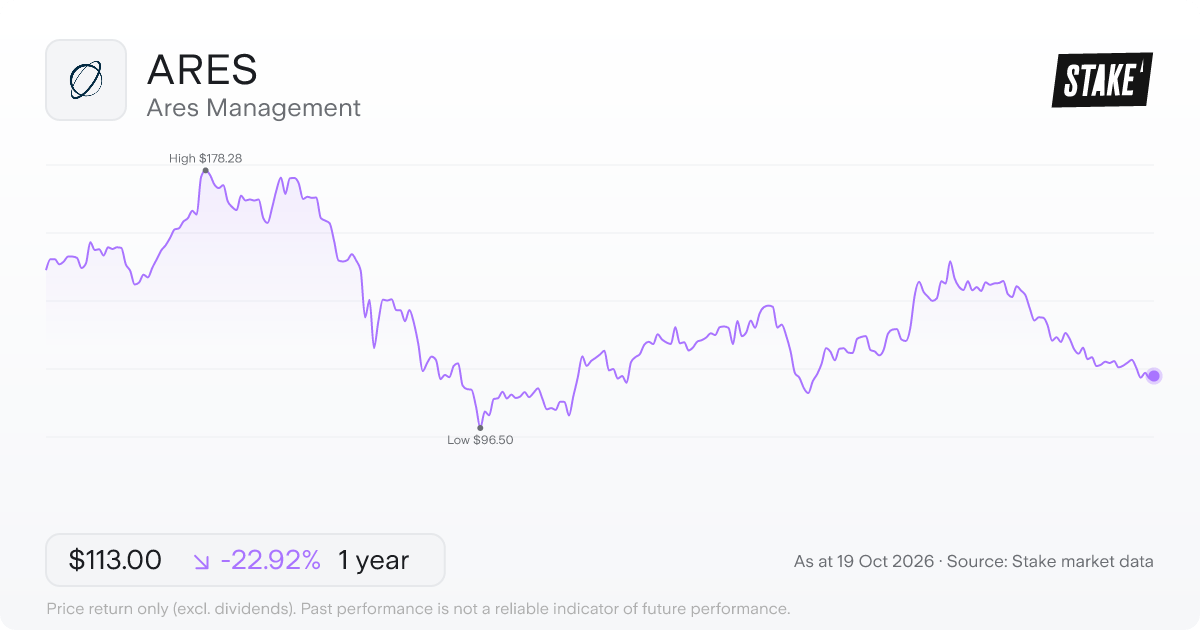
Price: US$113.00 · Daily: 0.7% · Market cap: US$37.32B · Sector: Financials · Industry: Investment Services
Ares Management Corporation ($ARES) runs five distinct investment arms under one roof: credit, private equity, real assets, secondaries and a catch-all that rounds out the group. The Credit Group is the broadest of them, covering everything from liquid credit to direct lending and Asia-Pacific credit strategies. Real assets sits alongside it, managing equity and debt positions across real estate and infrastructure.
The Secondaries Group is worth noting on its own terms – it buys positions in existing private equity, real estate, infrastructure and credit funds from investors who want to exit early, rather than investing directly into companies. Chief executive Michael Arougheti leads a firm with 4,250 employees and operations that reach across North America, South America, Europe, Asia Pacific and the Middle East.
Join 1M+ on Stake
Effortless investing in U.S. shares & ETFs
4. TPG ($TPG)
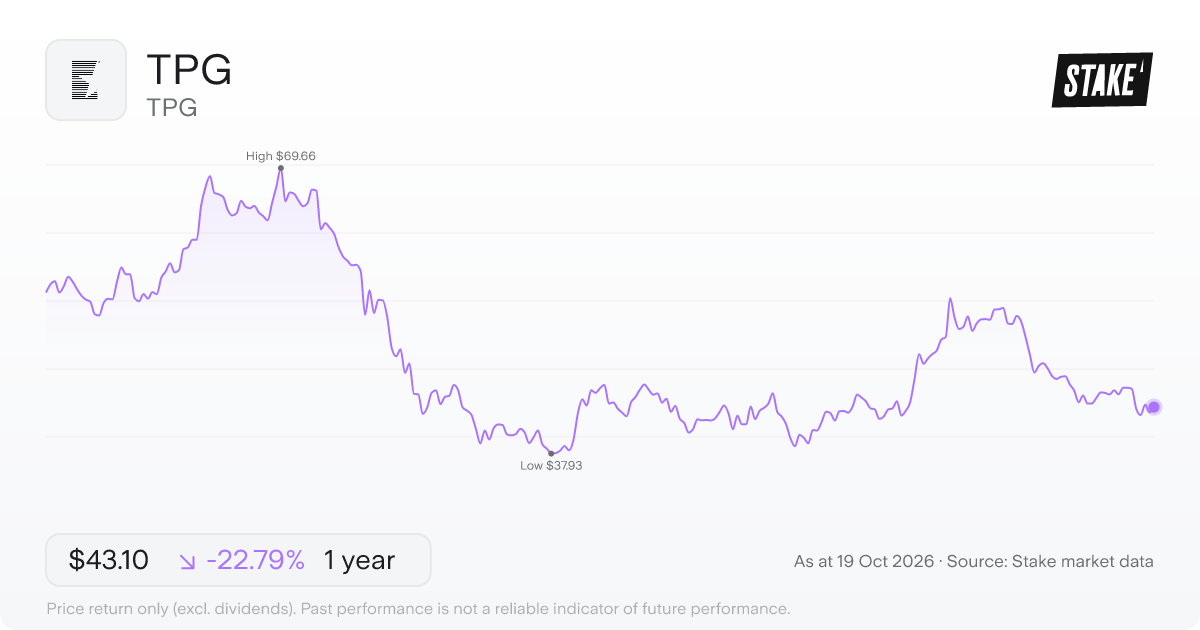
Price: US$43.10 · Daily: 1.4% · Market cap: US$16.35B · Sector: Financials · Industry: Investment Services
TPG Inc. ($TPG) runs six investment platforms under one roof: Capital, Growth, Impact, Credit, Real Estate, and Market Solutions. The Capital platform focuses on control-oriented private equity – buying meaningful stakes in companies and steering their direction. Growth and Impact broaden that into technology, life sciences, and climate-linked strategies, while Credit covers direct lending, asset-based finance and collateralised loan obligations (CLOs), which are pools of corporate loans bundled into tradeable securities.
With roughly 1,900 employees and Jon Winkelried at the helm, $TPG deploys capital across its six investment platforms. The Impact arm in particular – which includes The Rise Funds and TPG Rise Climate – directs money toward businesses with environmental or social goals alongside financial ones.
5. Carlyle Group ($CG)
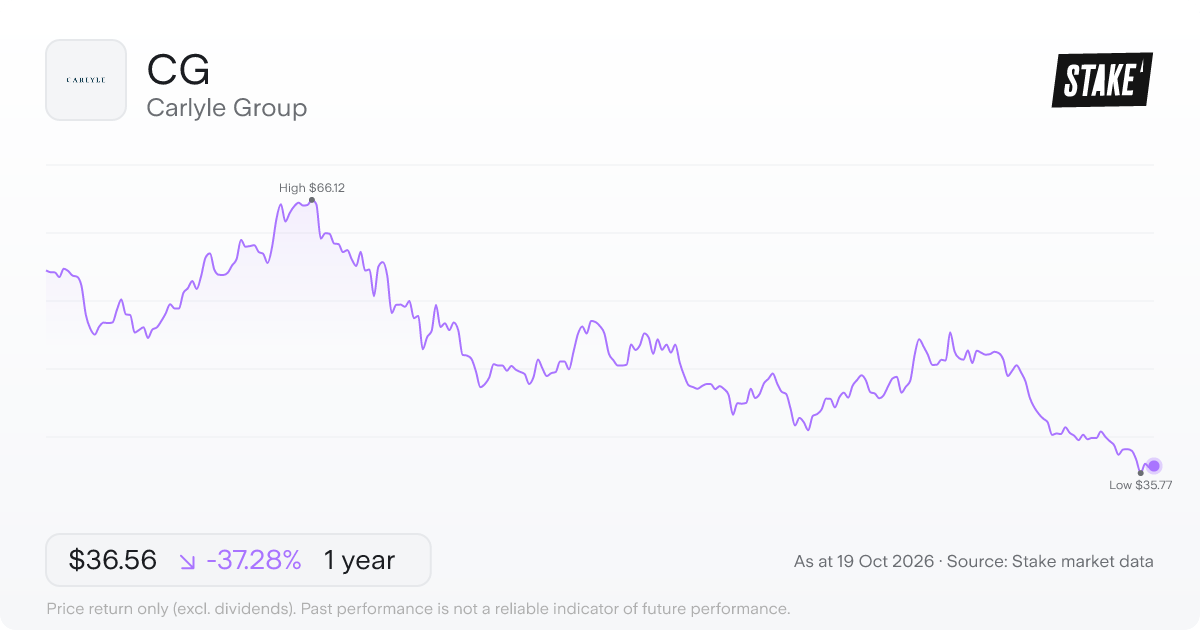
Price: US$36.56 · Daily: 0.5% · Market cap: US$12.96B · Sector: Financials · Industry: Investment Services
Carlyle Group ($CG) runs three private markets businesses under the one firm. The Global Private Equity segment advises funds covering buyout, growth, real estate, infrastructure and natural resources strategies – and it includes the NGP Carry Funds, managed by NGP Energy Capital Management. Global Credit covers direct lending, insurance solutions, aviation finance, asset-backed finance, liquid credit and opportunistic credit, among other strategies. The Carlyle AlpInvest segment focuses on building private equity programs through secondary purchases of existing portfolios, co-investments alongside other managers, and primary fund commitments.
Harvey Schwartz leads as CEO, with around 2,500 people employed across the firm.
6. Hamilton Lane ($HLNE)
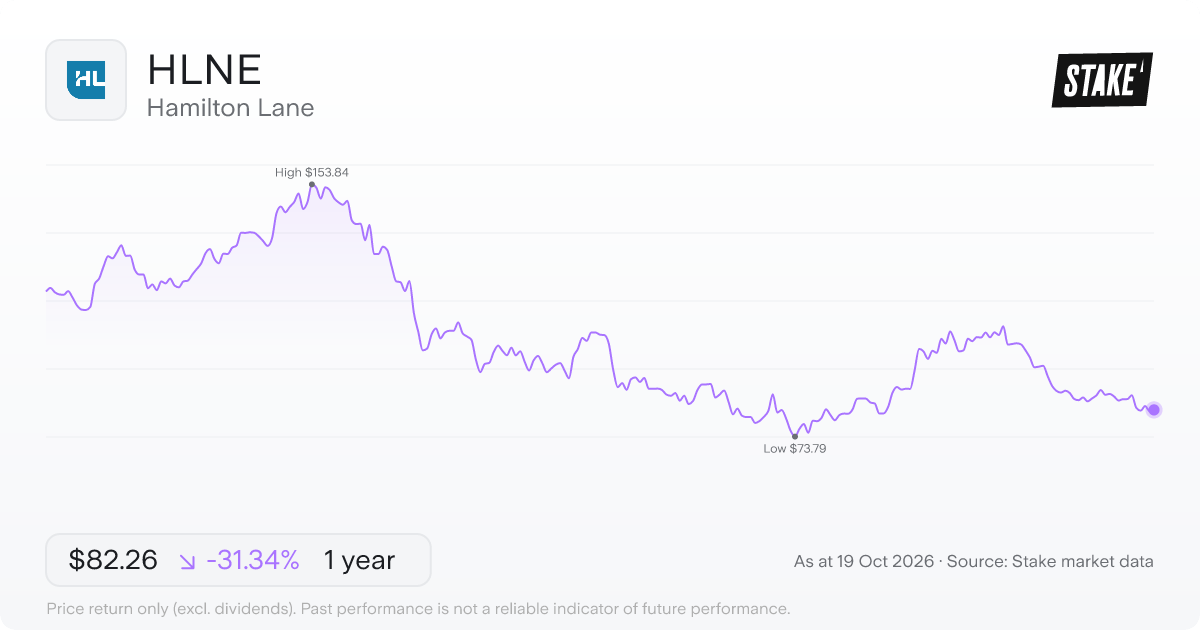
Price: US$82.26 · Daily: 0.5% · Market cap: US$4.51B · Sector: Financials · Industry: Investment Services
Hamilton Lane Incorporated ($HLNE) invests across private markets in three ways. Alongside primary investments in third-party managed funds, it takes direct stakes in companies alongside those funds and acquires secondary positions from investors looking to exit early. That breadth means a single client can access multiple entry points into private markets through one relationship.
The firm's reach across private equity, private credit, real estate, infrastructure, venture capital, growth equity and impact investing means $HLNE is constructing portfolios across most corners of the private markets universe. Clients can engage through customised separate accounts, specialised funds, or advisory and reporting services – so some use $HLNE to run an entire private markets programme, while others plug in only for data, monitoring or distribution management. Chief executive Juan Delgado-Moreira leads a team of 785 people.
Because $HLNE earns fees by managing and advising on other managers' funds rather than deploying capital directly into assets it owns outright, its revenue model is tied to the scale of assets it oversees and the breadth of services it wraps around them.
➡️ Top 7 ASX data centre stocks to watch in 2026→
Common questions
How can Australian investors buy private equity stocks?
All six companies in this list trade on U.S. exchanges, so you'll need a trading platform that offers access to U.S. markets. You buy shares in the listed management company – giving you exposure to the firm's fee income and fund profits, not a direct stake in the underlying private funds themselves. Because shares are priced in USD, movements between the Australian dollar and the USD will affect the value of holdings when converted back to AUD.
What are the key risks of investing in private equity stocks?
Revenue at these firms depends on management fees charged on capital under management and carried interest – a share of fund profits earned above a hurdle rate. Both can compress when fundraising slows or portfolio company valuations fall. Being U.S.-listed, they also carry currency exposure for Australian investors: a softer USD relative to the AUD reduces returns measured in Australian dollars, even if the underlying share price holds steady.
How do alternative asset managers actually make their money?
These firms earn money in two main ways: management fees charged annually on capital under management, and carried interest – a share of profits paid once a fund returns capital to investors above an agreed threshold. Management fees tend to be more predictable because they're tied to committed capital locked in over multi-year fund lifetimes, while carried interest varies with fund performance and the timing of exits. The firms in this list have also built out strategies across credit, real estate and in some cases insurance alongside their private equity work, adding income streams that respond differently to market conditions.
More resources
✅ Top U.S.-listed asset managers to watch in 2026→
Disclaimer
Past performance is not a reliable indicator of future performance. When you invest, your capital is at risk. You should consider your own investment objectives, financial situation, and particular needs before making an investment decision. The value of your investments can go down as well as up and you may receive back less than your original investment. As always, do your own research and consider seeking appropriate financial advice before investing.
This is not personal financial advice nor a recommendation to invest in the securities listed. Any advice provided by Stake is of general nature only and does not take into account your specific circumstances. Trading and volume data from the Stake investing platform is for reference purposes only, the investment choices of others may not be appropriate for your needs and is not a reliable indicator of performance.
Please refer to hellostake.com/pricing for the fees that apply. When you trade securities priced in another currency, currency conversion fees may apply and movements in the exchange rate may affect your returns.

Stake Desk
The freshest market insights
This article combines AI and human review from our analysts to bring you accurate, informative investing content at speed. For questions or suggestions, contact stakedesk@stake.com.au.
Subscribe
By subscribing, you agree to our Privacy Policy.