
These funds hold companies that build software, internet platforms and healthcare products people depend on every day. They differ in how those companies are selected and weighted.
Nasdaq-linked ETFs are designed to track indexes built from companies listed on the Nasdaq Stock Market, one of the major U.S. stock exchanges. The eight funds in this list take different structural approaches – some follow the Nasdaq-100's largest non-financial names by market cap, while Fidelity NASDAQ Composite Index ETF ($ONEQ) covers the full Composite and Invesco NASDAQ Next Gen 100 ETF ($QQQJ) is designed to track the 100 largest Nasdaq companies sitting just outside the Nasdaq-100.
How we built this list: We selected these funds based on their investment category and relevance to the theme, then ordered them by assets under management. Prices are updated daily, and the list and supporting content are reviewed roughly every quarter. All data is sourced from Stake. This list isn't a recommendation and isn't ordered by suitability.
ETF Name | Ticker | Share Price | AUM | Expense Ratio | In Watchlists |
|---|---|---|---|---|---|
Invesco QQQ Trust, Series 1 | $656.95 | $462.85B | 0.20% | 31248 | |
Invesco NASDAQ 100 ETF | $270.42 | $105.25B | 0.15% | 12079 | |
Fidelity NASDAQ Composite Index ETF | $95.93 | $10.16B | 0.21% | 417 | |
Global X NASDAQ 100 Covered Call ETF | $17.13 | $7.92B | 0.60% | 2858 | |
First Trust NASDAQ-100 Select Equal Weight ETF | $142.99 | $1.66B | 0.57% | 121 | |
Direxion NASDAQ-100 Equal Weighted Index ETF | $111.98 | $1.39B | 0.35% | 350 | |
Invesco NASDAQ Next Gen 100 ETF | $41.67 | $1.13B | 0.15% | 635 | |
Invesco Nasdaq Internet ETF | $48.56 | $513.0M | 0.60% | 126 |
Past performance is not a reliable indicator of future performance.
Source: Stake market data. Figures in US$. Data updated as of 17 November 2026.
✅ Learn more: Top 10 U.S.-listed index funds to watch in 2026→
Sign up in minutes and get razor-sharp access to Wall St, where you can explore Nasdaq ETFs and more.
1. Invesco QQQ Trust, Series 1 ($QQQ)
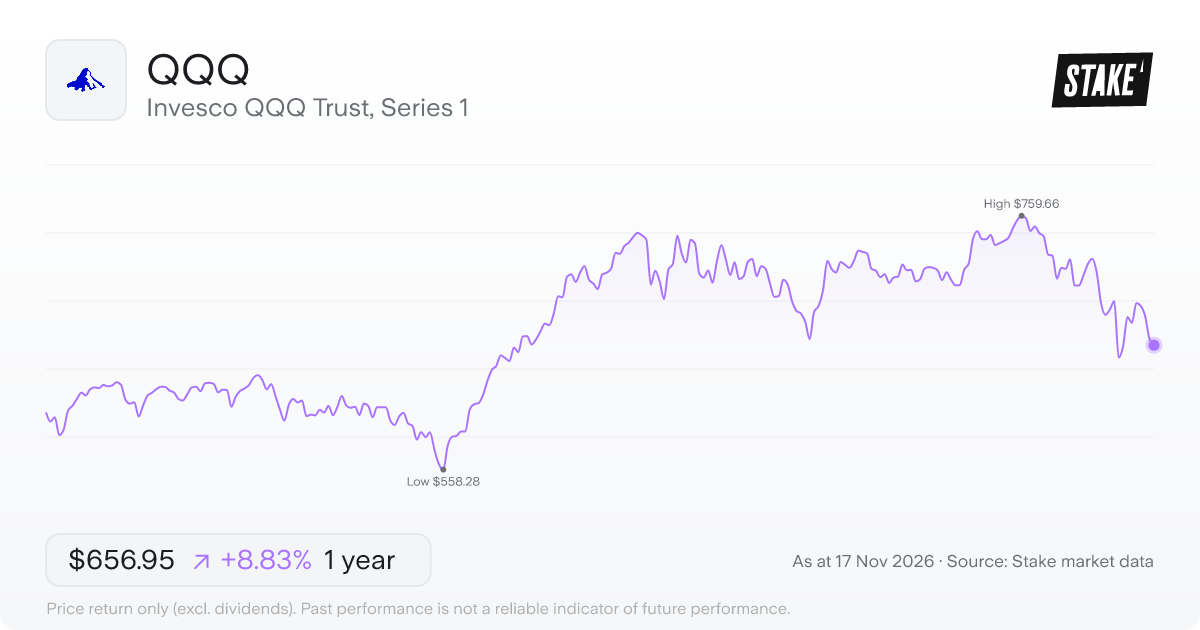
Price: US$656.95 · Daily: -0.7% · AUM: US$462.85B · MER: 0.20%
Invesco QQQ Trust, Series 1 ($QQQ) is designed to track the Nasdaq-100 Index – a benchmark built from 100 of the largest domestic and international non-financial companies listed on the Nasdaq Stock Market. Holdings are weighted by market capitalisation. That construction means the biggest companies by valuation carry the most influence over how the fund moves day to day.
The Nasdaq-100's non-financial screen is a core part of how the index is assembled: banks, insurers and similar companies are excluded regardless of their size. The index also draws from both U.S.-domiciled businesses and international names that qualify by market cap, so the 100 holdings cover a broader geographic base than a purely domestic benchmark would.
2. Invesco NASDAQ 100 ETF ($QQQM)
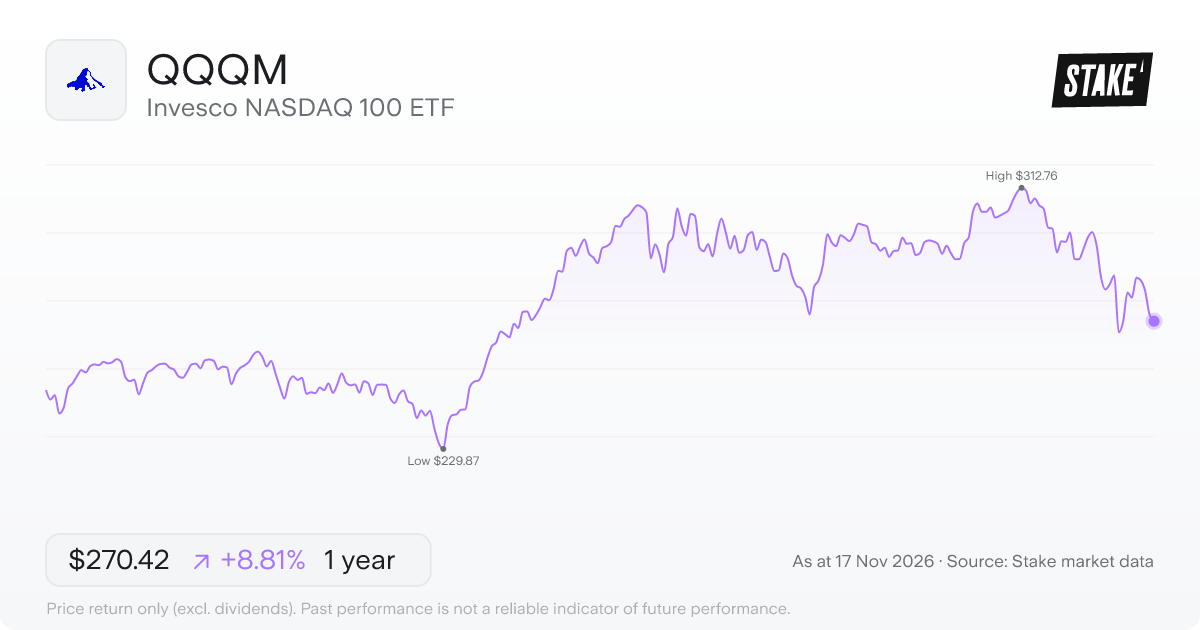
Price: US$270.42 · Daily: -0.8% · AUM: US$105.25B · MER: 0.15%
The Nasdaq-100 is built from 100 of the largest companies listed on the Nasdaq Stock Market, drawing from both domestic and international names and weighted by market capitalisation. Financial sector companies are excluded from the index by design. Invesco NASDAQ 100 ETF ($QQQM) is designed to track that index, with the fund holding at least 90% of its assets in the same securities the index covers.
Because the index weights by market cap, the largest companies carry the most influence over the fund's day-to-day composition. That weighting shifts automatically as company sizes move relative to one another – no active manager is making those calls.
3. Fidelity NASDAQ Composite Index ETF ($ONEQ)
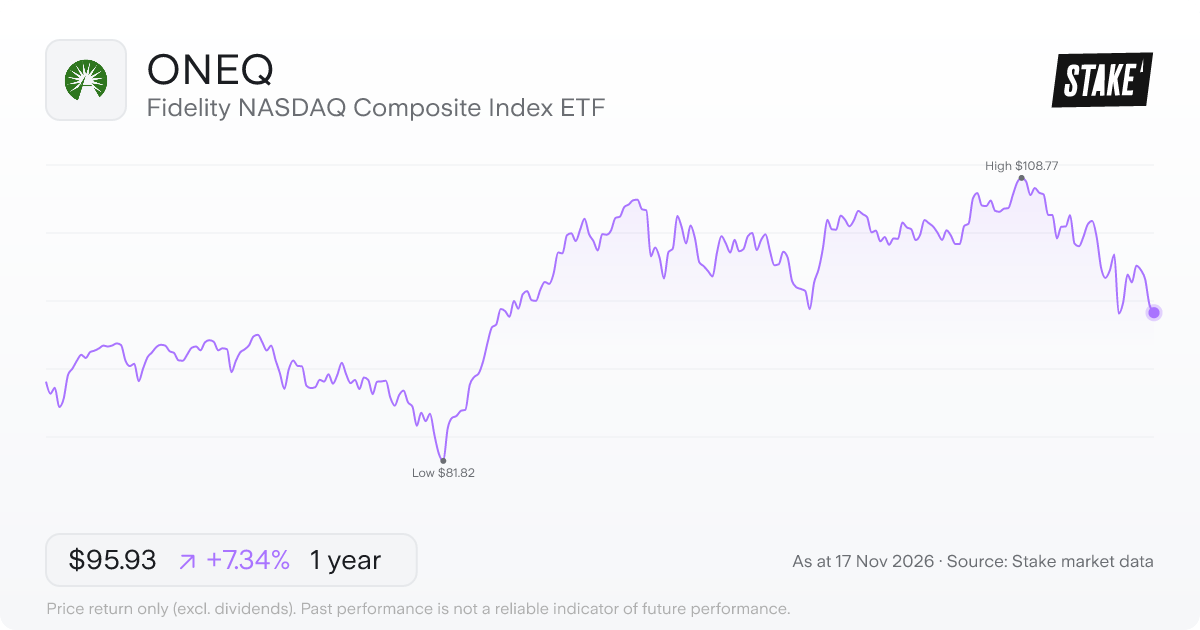
Price: US$95.93 · Daily: -0.7% · AUM: US$10.16B · MER: 0.21%
Fidelity NASDAQ Composite Index ETF ($ONEQ) is designed to track the Nasdaq Composite Index, which covers a far broader slice of Nasdaq-listed companies than the more narrowly focused Nasdaq-100. Rather than holding every stock in the index, $ONEQ uses statistical sampling – a technique intended to replicate the index's returns by holding a representative subset of its constituents.
That broader scope means the fund reaches well beyond the mega-cap technology names that dominate the Nasdaq-100, pulling in mid- and smaller-cap companies listed on the exchange. The result is a wider spread of companies across the Nasdaq universe than most funds in this article are built to cover.
4. Global X NASDAQ 100 Covered Call ETF ($QYLD)
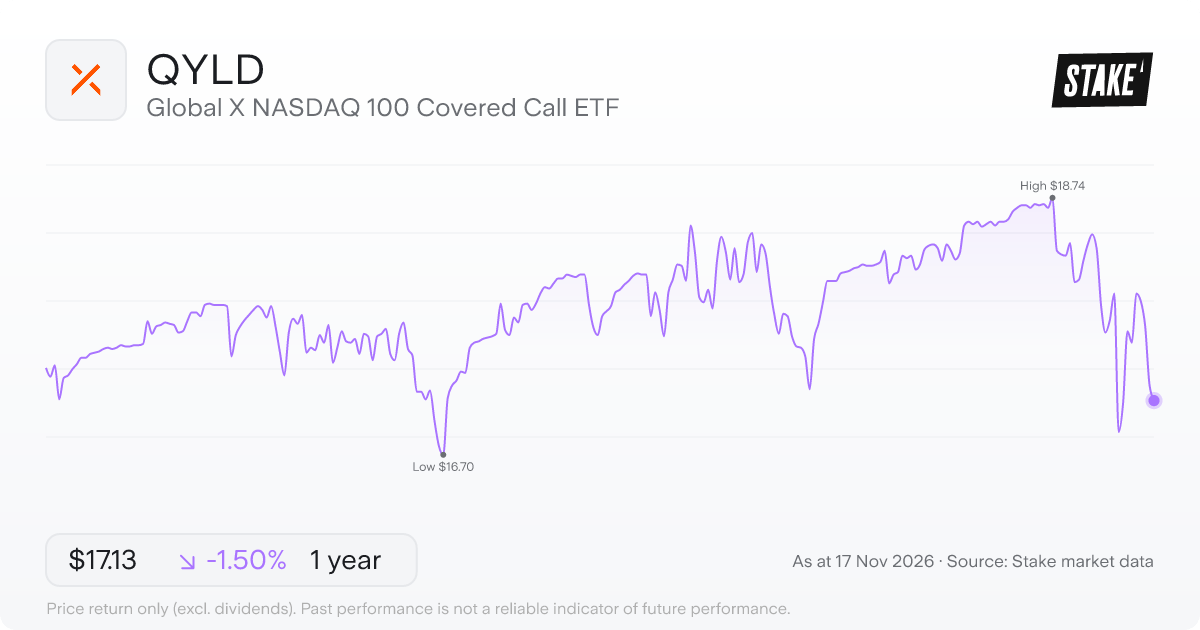
Price: US$17.13 · Daily: -0.7% · AUM: US$7.92B · MER: 0.60%
The CBOE NASDAQ-100 BuyWrite Index sits at the heart of Global X NASDAQ 100 Covered Call ETF ($QYLD). That index runs a covered call, or 'BuyWrite', strategy: it holds Nasdaq-100 stocks and writes (sells) call options against those same positions. Premiums received from those sold calls contribute to the index's yield component alongside the price performance of the underlying stocks. $QYLD uses a replication strategy and aims to hold at least 80% of its assets in stocks from the index.
Join 1M+ on Stake
Effortless investing in U.S. shares & ETFs
5. First Trust NASDAQ-100 Select Equal Weight ETF ($QQEW)
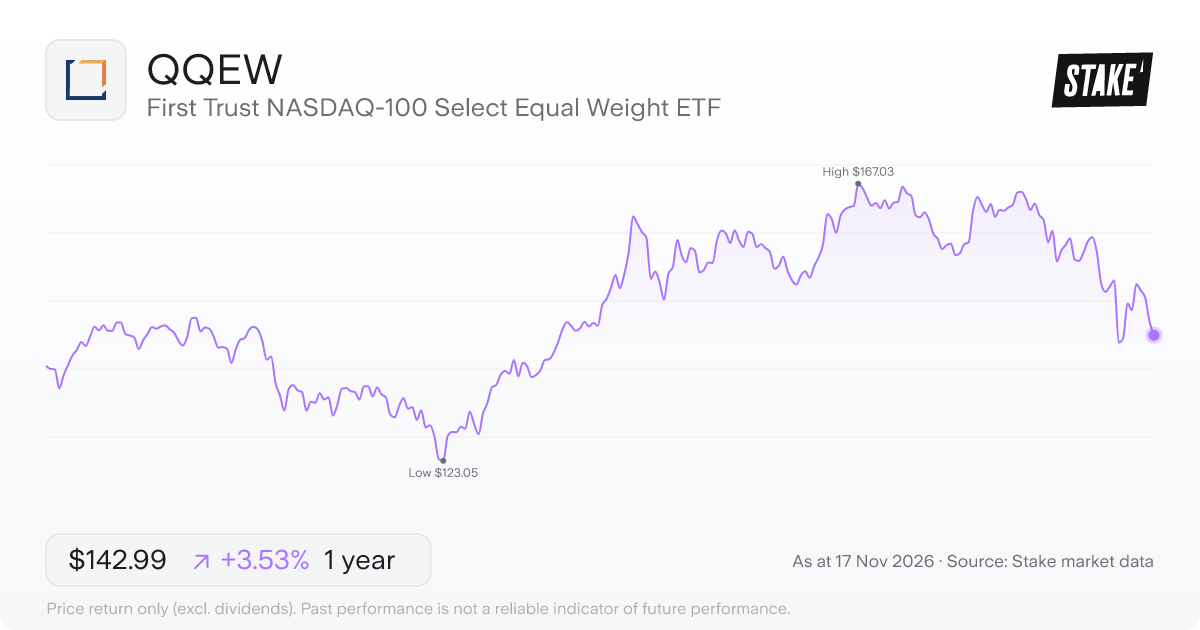
Price: US$142.99 · Daily: -1.4% · AUM: US$1.66B · MER: 0.57%
Built around 50 companies drawn from the Nasdaq-100, First Trust NASDAQ-100 Select Equal Weight ETF ($QQEW) is designed to track the NASDAQ-100 Select Equal Weight Index. The index scores Nasdaq-100 members on combined quality and growth metrics, then takes the 50 highest-ranking names. Each holding carries equal weight in the portfolio, so no single company dominates $QQEW's results the way market-cap-weighted structures can.
6. Direxion NASDAQ-100 Equal Weighted Index ETF ($QQQE)
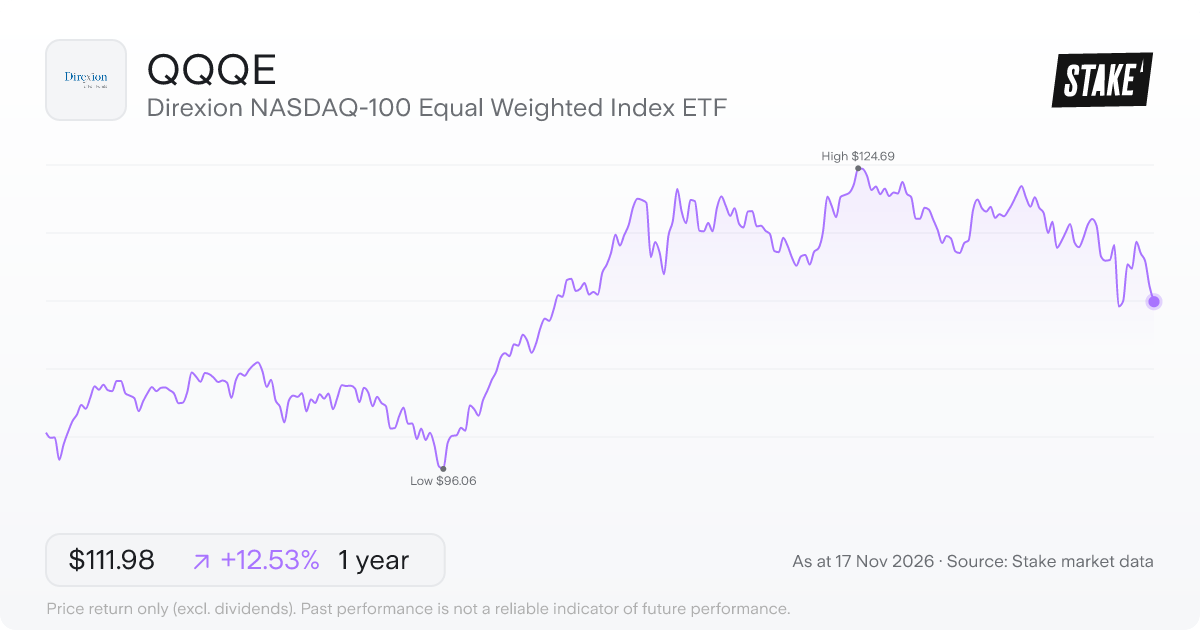
Price: US$111.98 · Daily: -1.3% · AUM: US$1.39B · MER: 0.35%
Direxion NASDAQ-100 Equal Weighted Index ETF ($QQQE) is designed to track the NASDAQ-100 Equal Weighted Index, which covers 100 of the largest domestic and international non-financial companies listed on the Nasdaq Stock Market. The key difference from a standard market-cap approach is that every holding gets the same weight. A single company's performance doesn't pull the whole fund as much as it would in a cap-weighted structure.
That construction means smaller names within the Nasdaq-100 carry as much influence on returns as the largest ones. Whether the index is up or down, the equal-weight methodology means the result reflects a broader spread of the 100 companies rather than a concentration at the top.
7. Invesco NASDAQ Next Gen 100 ETF ($QQQJ)
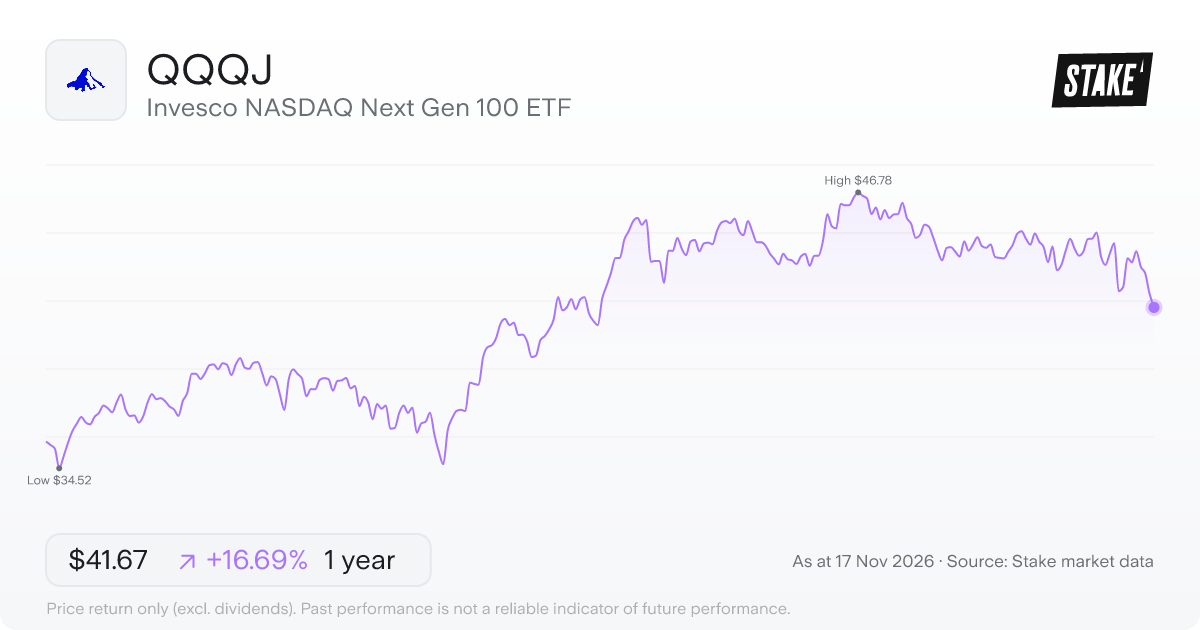
Price: US$41.67 · Daily: -1.4% · AUM: US$1.13B · MER: 0.15%
The NASDAQ Next Generation 100 Index captures the 100 largest Nasdaq-listed companies that sit outside the Nasdaq-100. Invesco NASDAQ Next Gen 100 ETF ($QQQJ) is designed to track that index, with at least 90% of its assets held in the constituent securities. The index occupies a distinct size tier – companies large enough to rank among Nasdaq's bigger names, but not yet included in the Nasdaq-100 itself.
Membership in the index shifts as companies grow into the Nasdaq-100 or fall below the size threshold. That means $QQQJ's holdings can change over time as the index refreshes its composition.
8. Invesco Nasdaq Internet ETF ($PNQI)
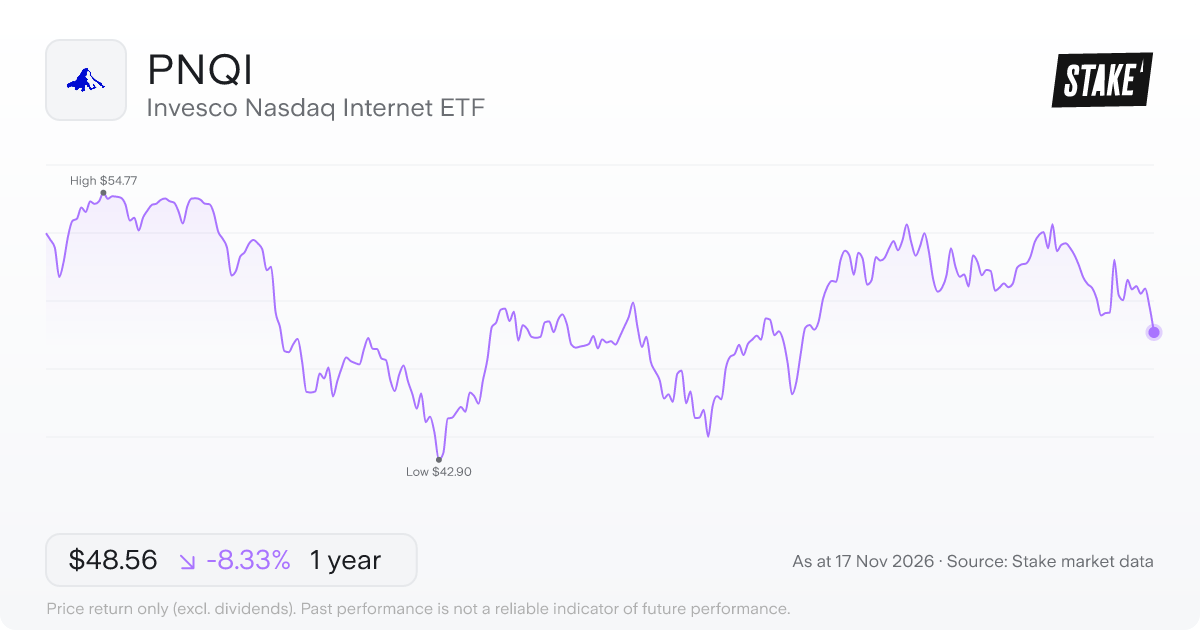
Price: US$48.56 · Daily: -2.3% · AUM: US$513.0M · MER: 0.60%
Invesco Nasdaq Internet ETF ($PNQI) is built around a single slice of the market: internet companies. The fund aims to invest at least 80% of its total assets in common stocks of internet businesses, drawing from the underlying index that shapes its construction. At least 90% of assets are intended to track that index's constituent stocks.
The focus is deliberately narrow. Where broader Nasdaq-linked funds hold technology, healthcare, consumer and industrial names, $PNQI is concentrated on the internet industry specifically. That means the portfolio's performance is closely tied to how that segment moves – which can amplify both gains and losses relative to wider market indexes. Investors in the fund carry the concentrated risk that comes with any single-industry approach.
➡️ Top 8 ARK ETFs to watch in 2026→
Common questions
How do I invest in Nasdaq ETFs in New Zealand?
All eight funds in this article are listed on U.S. exchanges and priced in USD. New Zealand investors can access them through a share trading platform that offers U.S. market access. You search by ticker – $QQQ, $QQQM and so on – and buy shares the same way you would any other U.S.-listed stock.
What are the key risks of Nasdaq ETFs?
Some of the key risks include heavy concentration in large technology and growth-oriented companies, which means these funds can move sharply when that part of the market falls out of favour. The cap-weighted funds add another layer: the largest holdings carry the most influence, so a small number of companies can drive most of a fund's movement in either direction. Because all eight funds here are priced in USD, the NZD/USD exchange rate affects what a purchase costs and what any proceeds are worth back in New Zealand dollars. Funds with narrower focus – such as the internet-only $PNQI or the covered call structure in $QYLD – carry additional concentration or strategy-specific risks beyond those common to the group.
How do these Nasdaq ETFs differ from each other?
Most funds here track the Nasdaq-100 – the 100 largest non-financial companies listed on the Nasdaq – but differ in how they weight holdings. $QQQ and $QQQM use market-cap weighting, $QQQE gives every holding an equal share of the portfolio, and $QQEW screens for quality and growth before equal-weighting its 50 selections. $ONEQ takes a broader approach by tracking the Nasdaq Composite, which covers far more companies than the Nasdaq-100. $QQQJ targets the tier just below the Nasdaq-100, $QYLD layers a covered call strategy on top of Nasdaq-100 stocks, and $PNQI narrows the focus to internet companies specifically.
How does a covered call strategy work in an ETF?
A covered call strategy holds stocks and simultaneously sells – or "writes" – call options against those same positions. The seller receives a premium from the option buyer, and that premium income contributes to the fund's yield alongside the price performance of the underlying stocks. The trade-off is that if the index rises strongly, the fund's participation in that upside is capped by the terms of the options it has sold. $QYLD uses this approach, aiming to track the CBOE NASDAQ-100 BuyWrite Index, which runs the strategy against the Nasdaq-100.
More resources
✅ Top 10 next-gen tech ETFs to watch in 2026→
Disclaimer
Past performance is not a reliable indicator of future performance. When you invest, your capital is at risk. You should consider your own investment objectives, financial situation, and particular needs before making an investment decision. The value of your investments can go down as well as up and you may receive back less than your original investment. As always, do your own research and consider seeking appropriate financial advice before investing.
This is not personal financial advice nor a recommendation to invest in the securities listed. Any advice provided by Stake is of general nature only and does not take into account your specific circumstances. Trading and volume data from the Stake investing platform is for reference purposes only, the investment choices of others may not be appropriate for your needs and is not a reliable indicator of performance.
Please refer to hellostake.com/pricing for the fees that apply. When you trade securities priced in another currency, currency conversion fees may apply and movements in the exchange rate may affect your returns.

Stake Desk
The freshest market insights
This article combines AI and human review from our analysts to bring you accurate, informative investing content at speed. For questions or suggestions, contact stakedesk@stake.com.au.
Subscribe
By subscribing, you agree to our Privacy Policy.