
Under the Spotlight: Shopify ($SHOP)

After a monster quarter, AI could be turning from its biggest threat into its best growth opportunity.
ICYMI: Do your own research and make your own decisions. This article drills down on a specific company, however, it is not a recommendation to invest in the company and should not be taken as financial advice. Got a stock you want covered? Tell us here.
Wall St spent much of 2026 worrying that AI would eat the software industry’s lunch. Shopify ($SHOP) just proved the opposite can happen.
Last week, the commerce platform delivered what president Harley Finkelstein called a ‘monster quarter,’ with revenue, gross profit and free cash flow all growing more than 30%.
The result capped a remarkable turnaround. Shares had fallen almost 50% between October and May as investors fled SaaS stocks. $SHOP has since clawed back most of those losses, having jumped about 30% in the week after reporting.
The firm is beginning to show some blue-chip characteristics: scale, cash generation, entrenched customers and durable growth. Yet it has remained relatively under the radar next to AI mega-caps.
With AI fears fading and Wall St warming again to the stock, is that changing? Let’s put it under the spotlight.
Monster numbers
Shopify is the tech giant behind millions of online stores, though you might not even know you’re using it. Businesses use Shopify to set up their websites, take payments and sell products online.
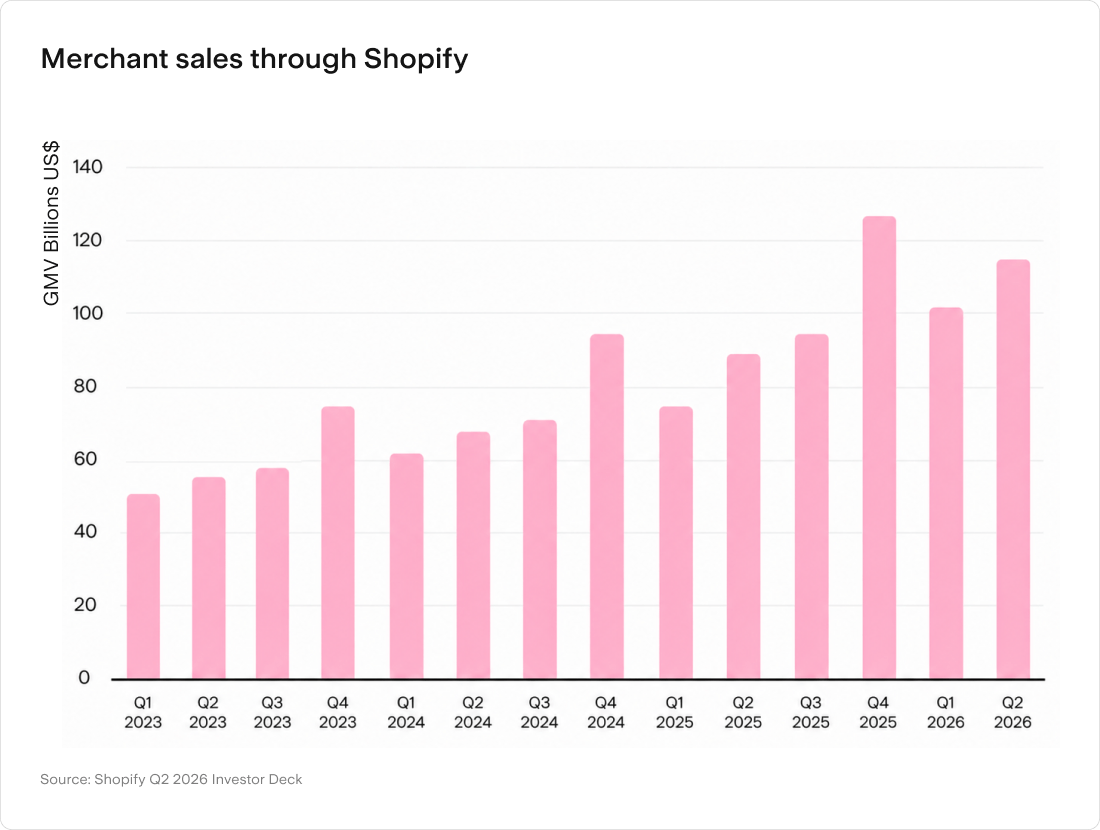
Right now, those businesses are selling a lot of stuff. In the June quarter, US$116B worth of goods were sold online through Shopify, up 32% from a year ago.
Revenue jumped 34% to US$3.6B, while free cash flow rose 55% to US$654M. Shopify expects revenue to keep growing at a low-30% rate this quarter, well ahead of the roughly 26% analysts had been expecting.
More importantly, the results gave investors some of the strongest evidence yet that AI could work in Shopify’s favour, rather than against it.
‘AI-driven traffic and also orders to Shopify stores tripled year-over-year in the second quarter,’ Finkelstein said on the earnings call, adding that ‘conversion from AI search runs nearly 80% higher than traditional organic search.’
More on that below.
.png)
Commerce engine
While Shopify is known as the software behind online stores, most of its revenue comes from payments and merchant services.
Only 22% of Q2 revenue came from software subscription fees. Its Merchant Solutions segment generated the other 78%, or US$2.78B, and grew 37% year-on-year (YoY).
That includes payments, currency conversion, Shopify Capital and shipping. As merchants grow, Shopify gets a bigger opportunity to monetise their success.
International gross merchandise value (GMV) grew 37% YoY in the June quarter, while Shopify Payments processed US$78.1B of that, up 38%.
Merchant Solutions carries lower gross margins than Subscription Solutions because payments cost more to process. But operating and free cash flow margins are still expanding, which is a key trend for investors.
The AI bet
For all Shopify’s talk about AI, its spending has been relatively modest compared to the billions investors are used to seeing on Wall St.
The company spent US$26M on capital expenditure (capex) across all of 2025, and another US$9M in the first half of 2026. Other costs of running AI, such cloud computing and model usage would show up through operating expenses but aren't strictly disclosed.
What it’s getting out of that investment is becoming clearer.
Sidekick, Shopify’s AI assistant for merchants, can analyse sales, create discounts and build parts of an online store. Daily users jumped 3.6 times in the past year, while merchants built 36K custom apps in Q2, up from 12K in the previous quarter, according to management.
The bigger opportunity could be AI shopping. Shopify’s Catalog organises product information so AI systems can understand it, while its Universal Commerce Protocol, developed with Google ($GOOGL), helps AI agents find products and complete purchases.
Its Agentic Storefronts also allow merchants to sell through ChatGPT, Google’s Gemini and Microsoft’s ($MSFT) Copilot, without customers needing to visit their websites.
Growth vs price
Shopify still has plenty of room to grow. More merchants are joining the platform, existing merchants are selling more and Shopify is taking a larger share of those sales. AI could add another leg if shopping increasingly shifts towards agents.
But competition remains fierce. Amazon ($AMZN) dominates product discovery, while Adobe ($ADBE), Salesforce ($CRM), WooCommerce and others compete for merchants. There’s also a longer-term AI risk: OpenAI, Google and Microsoft could eventually demand a bigger slice of each transaction made on their platforms.
At around US$153, Shopify trades at more than 100 times trailing earnings. Even using free cash flow, the multiple is around 80 times. Those are premium numbers, even for a company growing revenue above 30%.
Despite that, Wall St analysts are mostly bullish. Of 18 analysts featured on Stake Black, 78% rate the stock a ‘buy’, with an average price target of US$166.39 – 11% above its current price.
Is it a buy?
Shopify has emerged from the software sell-off with 30%+ growth, improving margins and a potentially valuable role in AI-powered shopping.
The catch is that expectations have risen almost as quickly as the share price.
For investors who believe Shopify can become the commerce layer underneath AI shopping, the long-term case has strengthened. But at more than 100 times trailing earnings, investors are pricing in heavy lifting.
This not financial advice nor a recommendation to invest in the securities listed. The information presented is intended to be of a factual nature only. Past performance and forecasts are not a reliable indicator of future performance. The value of your investments can go down as well as up and you may receive back less than your original investment. The author of this article and other employees of Stakeshop Pty Ltd may hold positions or have financial interests in the company (or companies) discussed above. Stakeshop Pty Ltd does not accept any liability for any decisions you may make if you consider and/or use any of the information contained in this article. As always, do your own research and consider seeking financial, legal and taxation advice before investing. This email is subject to our Disclaimers, Terms and Conditions and Privacy Policy. If you are not the intended recipient of this communication, you are not authorised to read, disclose, reproduce, disseminate or otherwise use this information. While we have taken precautions to ensure that no viruses are present in this email, you should rely on your own virus checking systems and processes. You can contact us at support@hellostake.com.

Senior Markets Commentator
Kylie Purcell is an investments analyst and finance journalist with over a decade of experience covering global markets, investment products and digital assets. Her commentary has been featured in publications including the Australian Financial Review, Yahoo Finance and The Motley Fool. She has a Masters Degree in International Journalism from Cardiff University and a Certificate of Securities and Managed Investments (RG146).
Subscribe
By subscribing, you agree to our Privacy Policy.