Under the Spotlight: SpaceX ($SPCX)
_(1).png&w=3840&q=95)
The biggest IPO in history has touched down. Now it has to prove the price isn’t lost in space.
ICYMI: Do your own research and make your own decisions. This article drills down on a specific company, however, it is not a recommendation to invest in the company and should not be taken as financial advice. Got a stock you want covered? Tell us here.
While most of us slept, the biggest initial public offering (IPO) in history made its trading debut.
SpaceX ($SPCX) closed its first session at US$160.95, up 19% from its US$135 offer price, for a market value of around US$2.1T.
That makes SpaceX the sixth biggest company on Wall St and minted CEO Elon Musk as the world’s first trillionaire, before the rest of us had breakfast.
The scale is hard to overstate. SpaceX has rewritten the economics of space launch, built Starlink into a global internet network, and made reusable rockets a reality.
For investors, the hard part is separating the company from the price.
Let’s put it under the spotlight.
Rocket fuel
Musk founded SpaceX as a rocket maker back in 2002. Today, it's three businesses in one: launch, satellite internet and AI.
The Space segment includes its launch business, Dragon spacecraft, Falcon rockets and Starship, the reusable rocket system built for missions to the Moon, Mars and beyond.
Connectivity is Starlink, and it's doing most of the heavy lifting. It generated US$11.4B in revenue in 2025, up 50% year-on-year. It's currently SpaceX’s only profitable segment.
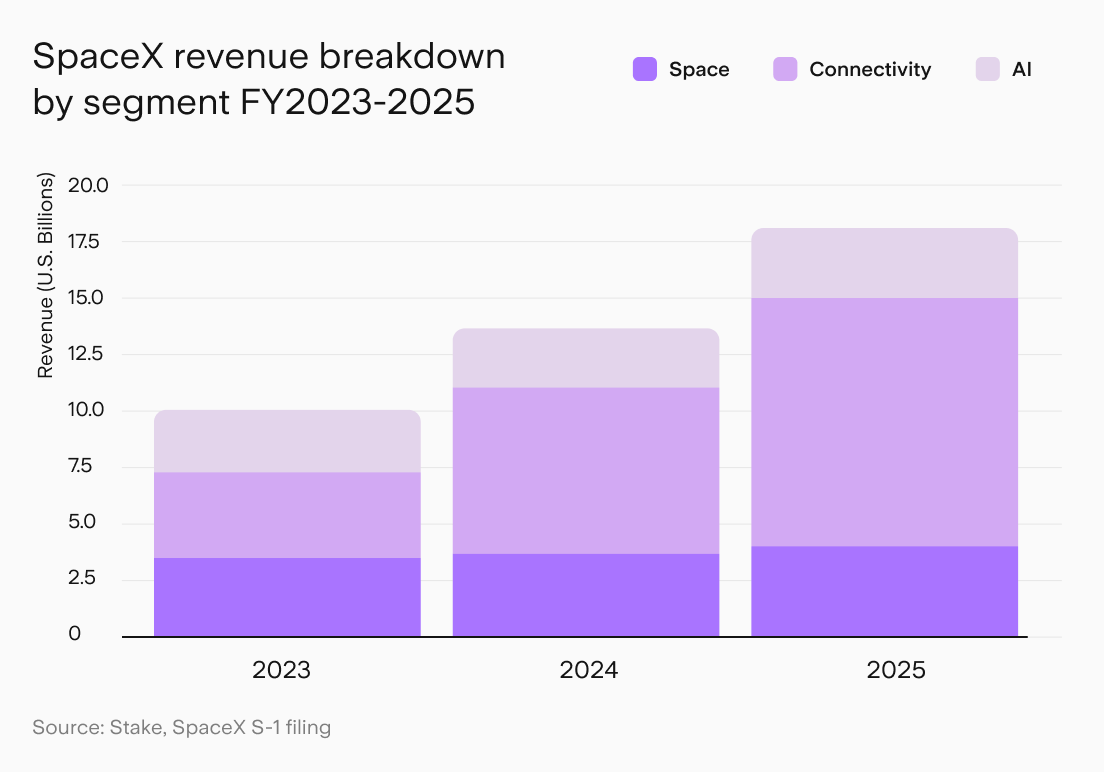
AI is the wild-card. This segment includes xAI, Grok, X, compute infrastructure and the company’s more speculative plan to put data centres in space. It contributed US$3.2B, but also US$6.36B in operating losses and US$12.73B in capital expenditure (capex).
Despite the red ink, that's where the banks see the biggest upside. Both Morgan Stanley and Goldman Sachs expect AI to drive the bulk of SpaceX's revenue beyond 2026, according to Wall Street Journal – with Morgan Stanley pegging it at around US$190B of an estimated US$330B total by 2030.
The bull case is that SpaceX owns the rockets, satellites, model and distribution, plus a founder willing to try what no committee would approve. The bear case is growing competition from the likes of OpenAI, Anthropic, Alphabet ($GOOGL) and Meta ($META).
It’s the biggest growth runway, but also the riskiest part of the business.
Priced for orbit
SpaceX made US$18.7B in revenue in 2025, up 33.2% year-on-year. And after a new multi-year compute deal with Google, reportedly worth US$920M a month, this year’s run rate looks even more impressive.
But on a net basis, SpaceX lost US$4.9B. And at its current valuation, the growth story needs to be enormous.
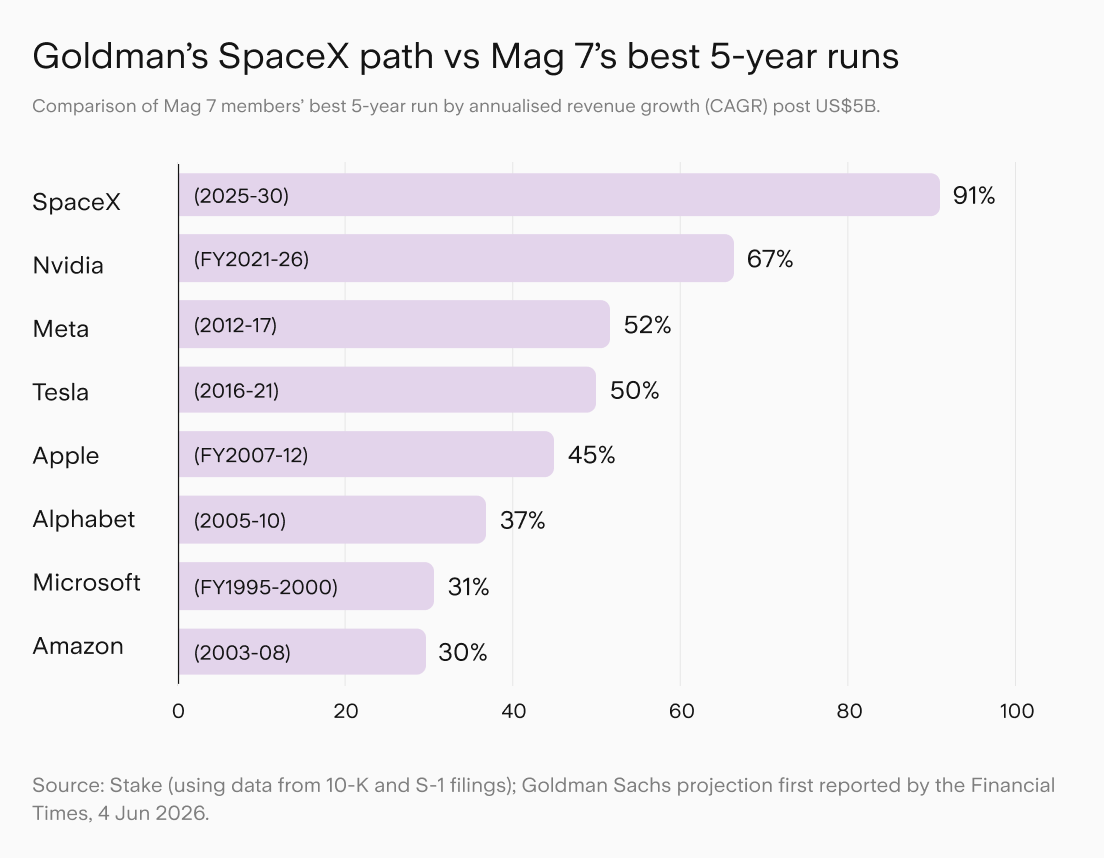
Goldman Sachs, the deal’s lead underwriter, expects SpaceX to generate around US$474B in revenue by 2030, per the Financial Times. That would require revenue to grow at a 91% compound annual growth rate (CAGR) over the next five years.
For context, the highest CAGR achieved by a Magnificent 7 company over any five year period with a revenue base of US$5B is 67%.
Research firm New Constructs calculates SpaceX needs to grow revenue by at least 50% a year for a decade, while transforming its margins almost immediately, just to justify the IPO price. Nvidia’s best decade delivered 46%. Apple’s was 39%.
Such growth would be unprecedented. But then again, nearly everything about this listing is.
Tesla crossover
Part of what makes the valuation so hard to pin down is that SpaceX may not stay in its current shape for long.
Investors have been talking about a potential SpaceX-Tesla merger for about as long as both have existed. A new line in the amended S-1 last week under ‘Acquisitions’ has only added fuel to that theory: ‘We may issue a significant amount of equity in connection with future transactions.’
It doesn’t name Tesla ($TSLA), but it does give SpaceX room to use its new public-market currency for something very large. Analysts are already speculating that a Tesla acquisition could be one of the most likely uses.
It's a consideration for investors because it would likely require SpaceX to issue a substantial amount of new equity. That could dilute existing shareholders and substantially change what they own.
And investors are unlikely to have much of a say in the matter either way. Per the filing, Musk controls the decision-making, with 85% voting power.
Moonshots and flight risks
Some of what SpaceX intends reads like a science fiction syllabus. Asteroid mining. Space tourism. Mars infrastructure. Data centres in orbit.
These ideas are exciting. But they’re also difficult to model with a straight face. That doesn’t mean they’re impossible. SpaceX has built its reputation on doing things that sounded impossible, until they started happening on live streams.
Any one of these could deliver huge revenue streams in the future. But they don’t actually exist yet. Investors are being asked to pay for a lot of future worlds at once.
And the S-1 makes clear that getting there will not be cheap or easy. SpaceX remains heavily dependent on Musk’s leadership and reputation, while its growth depends on Starship, Starlink and AI all scaling successfully.
Competition is also rising across launch, satellite broadband and AI. Add in a complicated financial profile and a governance structure that gives ordinary shareholders little say, and this is clearly not a smooth ride to orbit.
Is it a buy?
SpaceX is one of the most impressive companies ever to hit public markets. It also arrives with a valuation that asks investors to believe an awful lot will go right, across an awful lot of frontiers, at once.
For long-term believers, that premium may be worth paying for a slice of the next few decades of space, connectivity and AI. For everyone else, patience is less glamorous but often useful: hyped IPOs with limited float are volatile early on, and a few quarters of public reporting will show what SpaceX looks like as a listed company.
At this valuation, the share price bundles the rocket together with upfront payment for the Mars colony, the orbital data centres and the asteroid mine that may or may not show up later.
One thing we can say: Elon Musk and SpaceX have a track record of making very unlikely things look obvious in hindsight. The market is now asking investors to decide whether this is another one of those moments.
This is not financial advice nor a recommendation to invest in the securities listed. The information presented is intended to be of a factual nature only. Past performance is not a reliable indicator of future performance. Newly listed securities, including IPOs, may experience significant share price volatility, particularly in the early stages of trading. The author of this article and other employees of Stakeshop Pty Ltd may hold positions or have financial interests in the company (or companies) discussed above. As always, do your own research and consider seeking financial, legal and taxation advice before investing.
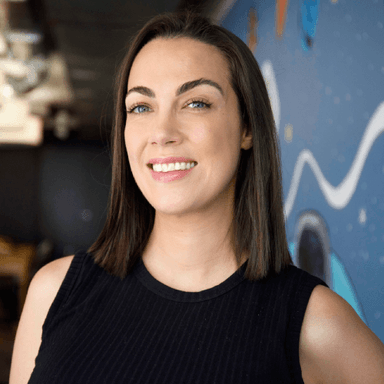
Senior Markets Commentator
Kylie Purcell is an investments analyst and finance journalist with over a decade of experience covering global markets, investment products and digital assets. Her commentary has been featured in publications including the Australian Financial Review, Yahoo Finance and The Motley Fool. She has a Masters Degree in International Journalism from Cardiff University and a Certificate of Securities and Managed Investments (RG146).
Subscribe
By subscribing, you agree to our Privacy Policy.