Top 10 AI stocks to watch in 2026
Chip fabrication plants turn raw silicon into the processors that power AI models. Those models end up embedded in the search results and voice assistants people use daily.
From the chips inside a data centre to the cloud platforms running AI models and the apps people use daily, AI touches these ten companies in very different ways. The list runs from semiconductor and cloud giants down to SoundHound AI ($SOUN), a dedicated voice AI company, with Tesla Inc. ($TSLA) as the one name outside the technology sector.
How we built this list: We selected these companies based on their industry and relevance to the theme, then ordered them by market capitalisation. Prices are updated daily, and the list and supporting content are reviewed roughly every quarter. All data is sourced from Stake. This list isn't a recommendation and isn't ordered by suitability.
Company Name | Ticker | Share Price | Market Cap | In Watchlists |
|---|---|---|---|---|
Apple | $351.90 | $5.13T | 488481 | |
Microsoft | $506.24 | $3.85T | 71844 | |
NVIDIA | $155.46 | $3.76T | 480487 | |
Alphabet | $280.20 | $3.47T | 53516 | |
Taiwan Semiconductor Manufacturing Company | $359.69 | $1.71T | 29094 | |
Meta Platforms | $618.87 | $1.63T | 461583 | |
Tesla | $380.11 | $1.50T | 508974 | |
AMD | $503.41 | $827.06B | 52583 | |
Palantir Technologies | $156.56 | $386.46B | 447321 | |
SoundHound AI | $3.06 | $1.58B | 5060 |
Past performance is not a reliable indicator of future performance.
Source: Stake market data. Figures in US$. Data updated as of 17 November 2026.
✅ Learn more: Top 10 next-gen tech ETFs to watch in 2026→
Sign up in minutes and get razor-sharp access to Wall St, where you can explore AI stocks and more.
1. Apple ($AAPL)
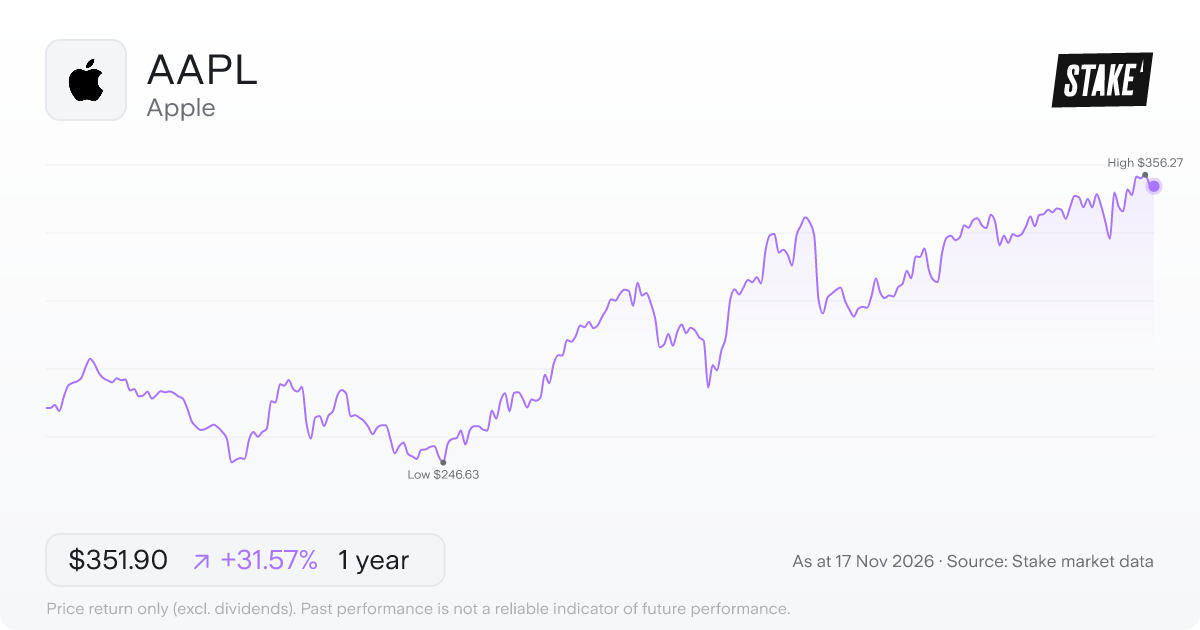
Price: US$351.90 · Daily: -0.2% · Market cap: US$5.13T · Sector: Technology · Industry: Consumer Electronics
Apple Inc. ($AAPL) makes iPhones, Macs, iPads, AirPods and the Apple Vision Pro, a spatial computing headset at the premium end of its hardware range. The device lineup covers most of the computing surfaces people use in daily life.
Alongside the hardware, $AAPL runs a platform and services business that includes the App Store, Apple Music, Apple TV+, Apple Arcade, Apple Fitness+, Apple News+, AppleCare and payment services. The App Store is how applications and digital content – including AI tools – reach the hundreds of millions of devices in its installed base. The company employs 166,000 people across hardware, software and services.
2. Microsoft ($MSFT)
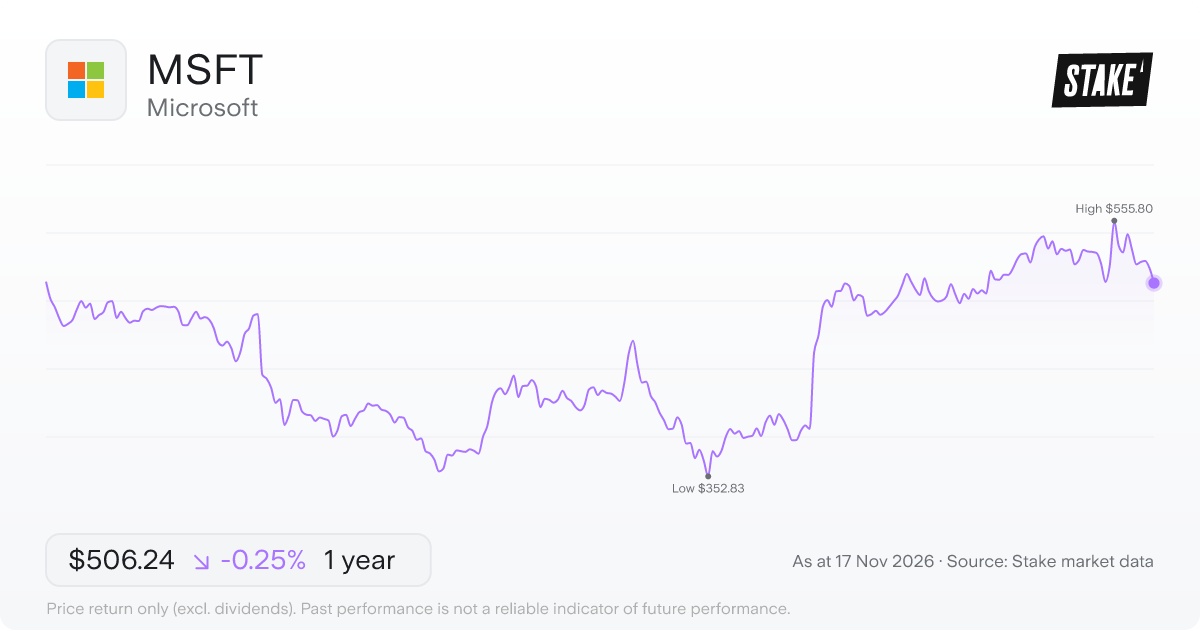
Price: US$506.24 · Daily: -2.3% · Market cap: US$3.85T · Sector: Technology · Industry: Software & IT
Microsoft ($MSFT) runs three distinct parts of a business: productivity software, cloud infrastructure, and consumer computing. Under CEO Satya Nadella, the company has embedded AI across all three rather than treating it as a separate product line.
The Intelligent Cloud segment is where the AI activity is most concentrated. Azure, Microsoft's cloud platform, includes AI consumption-based services alongside developer tools like GitHub. That means every AI model a company runs on Azure, and every code suggestion GitHub Copilot generates, feeds directly into this segment's revenue.
The Productivity and Business Processes segment covers Microsoft 365 – the Office apps, Teams, and cloud services used by businesses daily – as well as LinkedIn and Dynamics. AI features have been added throughout Microsoft 365 under the Copilot branding. The More Personal Computing segment rounds things out with Windows, Xbox and search advertising. Microsoft employs 223,000 people across those operations.
3. NVIDIA ($NVDA)
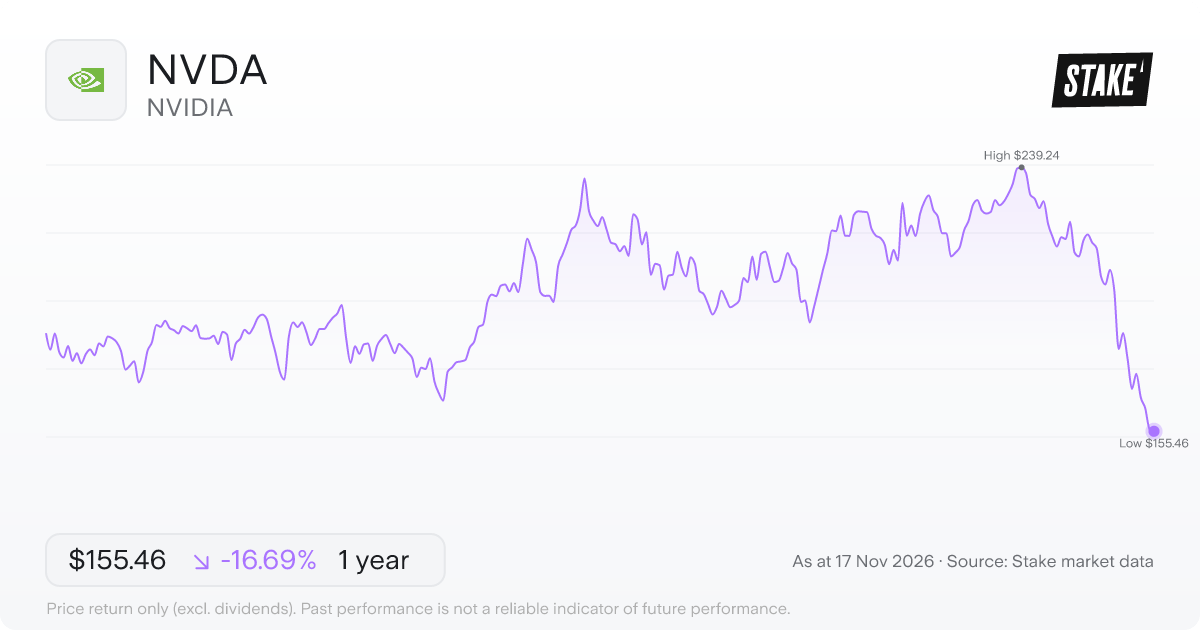
Price: US$155.46 · Daily: -0.4% · Market cap: US$3.76T · Sector: Technology · Industry: Semiconductors
NVIDIA Corporation ($NVDA) makes the chips and software that power accelerated computing – the kind of heavy processing that AI model training and inference demand at scale. Its Compute & Networking segment covers data centre GPUs, networking platforms and automotive systems, while the Graphics segment handles GeForce chips for gaming PCs and professional Quadro and RTX hardware for workstation use.
Underpinning all of it is the CUDA development platform, which runs across every $NVDA GPU and ties into hundreds of software libraries, frameworks and tools that developers use to build AI applications. Jensen Huang has led the company since its founding and oversees a workforce of 42,000 people.
4. Alphabet ($GOOGL)
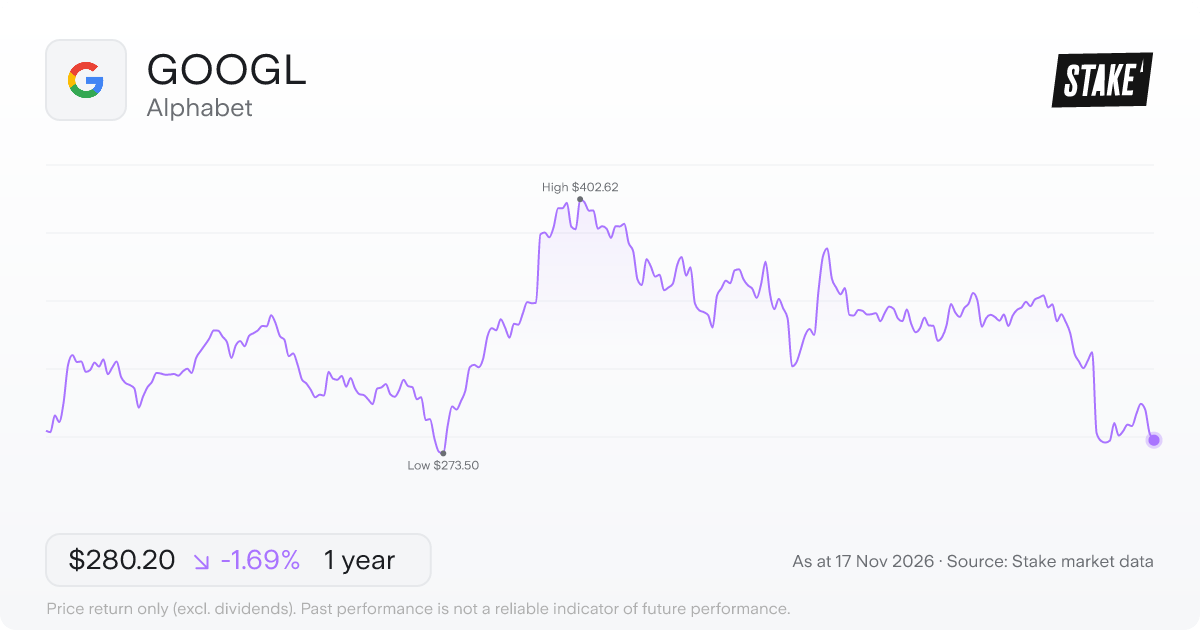
Price: US$280.20 · Daily: -1.2% · Market cap: US$3.47T · Sector: Technology · Industry: Software & IT
Alphabet Inc. ($GOOGL) is structured around three segments: Google Services, Google Cloud, and a collection of early-stage ventures called Other Bets. Google Services covers the products most people use daily – Search, YouTube, Maps, Android, Chrome and the Play store – along with the advertising business that runs across them. AI is woven through all of it, from search results to ad targeting to the Gemini models embedded across Google's products.
Google Cloud is where $GOOGL sells that infrastructure to enterprise customers directly. Through Google Cloud Platform, businesses can access AI tools including the Vertex AI platform, Gemini for Google Cloud and AI infrastructure services, alongside cybersecurity and data analytics. Google Workspace bundles communication and collaboration tools – Gmail, Docs, Drive, Meet and Calendar – into the same cloud offering. CEO Sundar Pichai oversees a company of 190,820 employees.
5. Taiwan Semiconductor Manufacturing Company ($TSM)
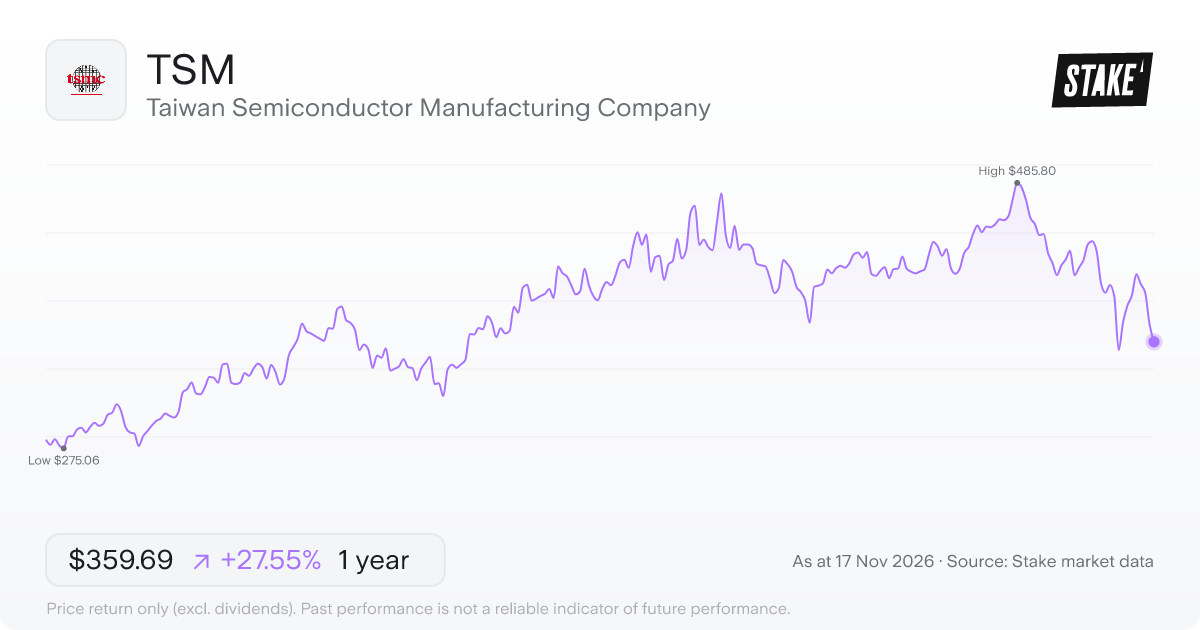
Price: US$359.69 · Daily: -3.7% · Market cap: US$1.71T · Sector: Technology · Industry: Semiconductors
Taiwan Semiconductor Manufacturing Company ($TSM) runs fabrication plants that manufacture integrated circuits designed by other companies. Its foundry model keeps chip design and chip production as separate businesses, with $TSM handling the production side. The process technologies it offers include advanced logic fabrication, silicon stacking and packaging. Those capabilities serve applications across AI, high-performance computing, automotive electronics, communications and consumer devices.
Join 1M+ on Stake
Effortless investing in U.S. shares & ETFs
6. Meta Platforms ($META)
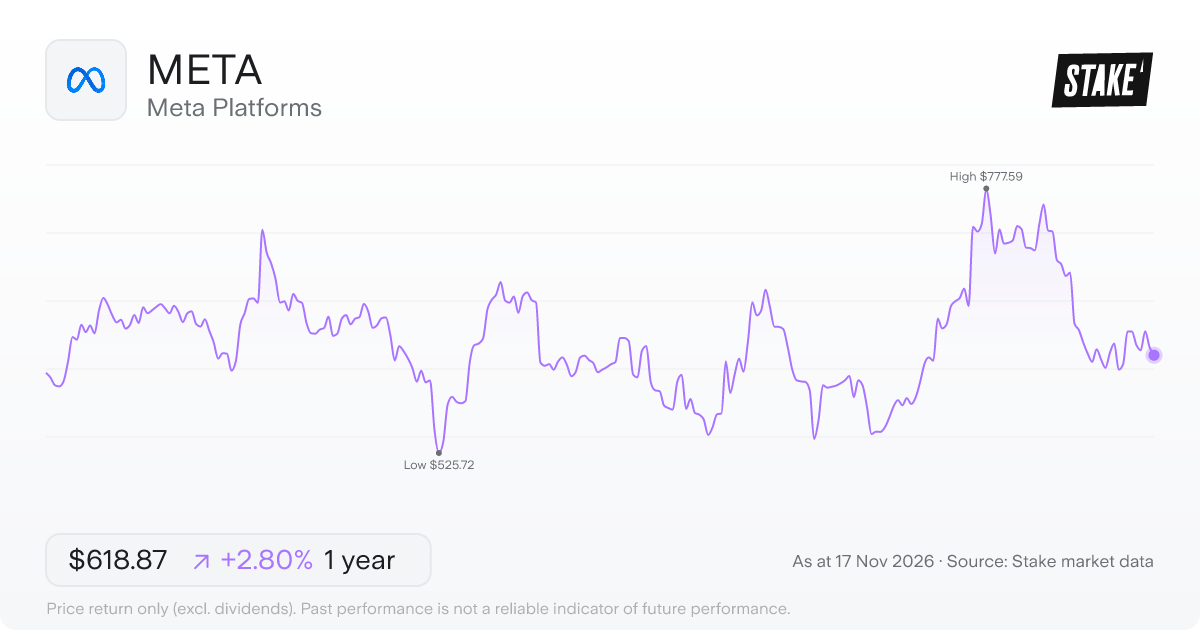
Price: US$618.87 · Daily: -1.2% · Market cap: US$1.63T · Sector: Technology · Industry: Software & IT
Meta Platforms ($META) runs Facebook, Instagram, WhatsApp, Messenger and Threads – the Family of Apps segment that connects billions of people through text, photos, video and messaging. AI is embedded in how those apps surface content, rank feeds and power advertising tools, with Mark Zuckerberg directing a workforce of 78,865 people across both that core business and the company's hardware ambitions.
The second segment, Reality Labs, covers Meta Quest VR headsets, mixed reality hardware and the Meta Horizon Store, where users access virtual content. That side of the business reflects $META's longer-term push into physical computing devices, alongside the software and social platforms that generate the bulk of its revenue today.
7. Tesla ($TSLA)
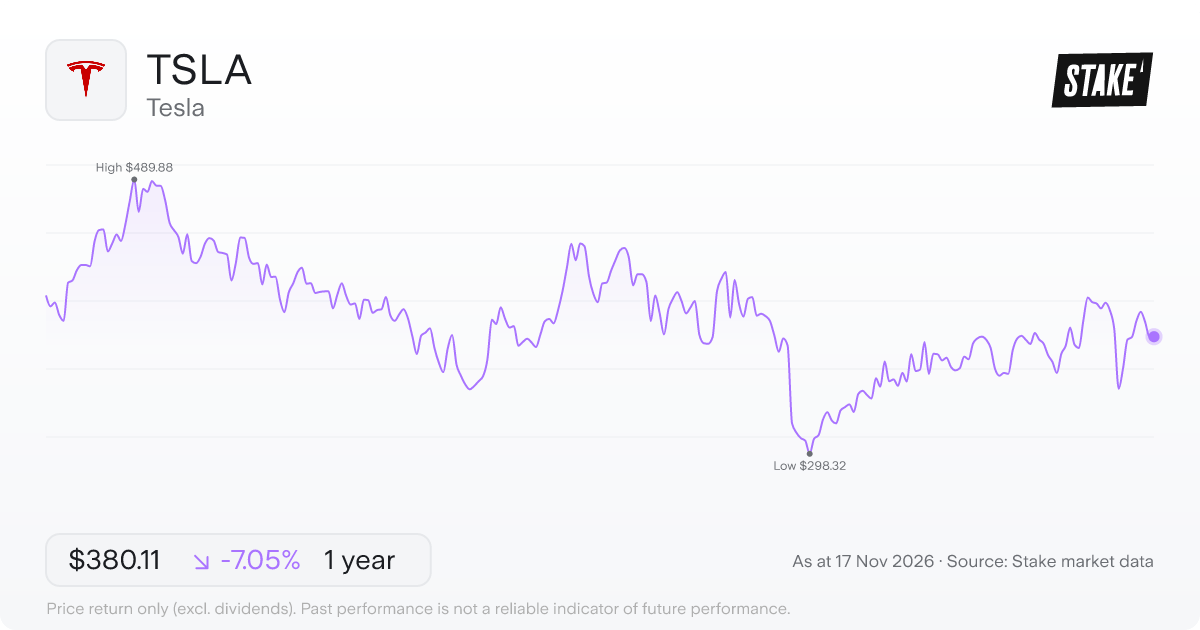
Price: US$380.11 · Daily: 0.10% · Market cap: US$1.50T · Sector: Consumer Discretionary · Industry: Cars & Auto Parts
Electric vehicles are the core business at Tesla, Inc. ($TSLA), which designs, manufactures and sells five consumer models – the Model 3, Model Y, Model S, Model X and Cybertruck – and also leases them. $TSLA's automotive segment extends beyond the cars themselves to cover services like paid supercharging, insurance and collisions, plus the sale of automotive regulatory credits. Its second segment is energy: solar generation systems alongside battery storage products, including the residential Powerwall and the utility-scale Megapack. Elon Musk serves as chief executive, overseeing a workforce of 134,785 people.
8. AMD ($AMD)
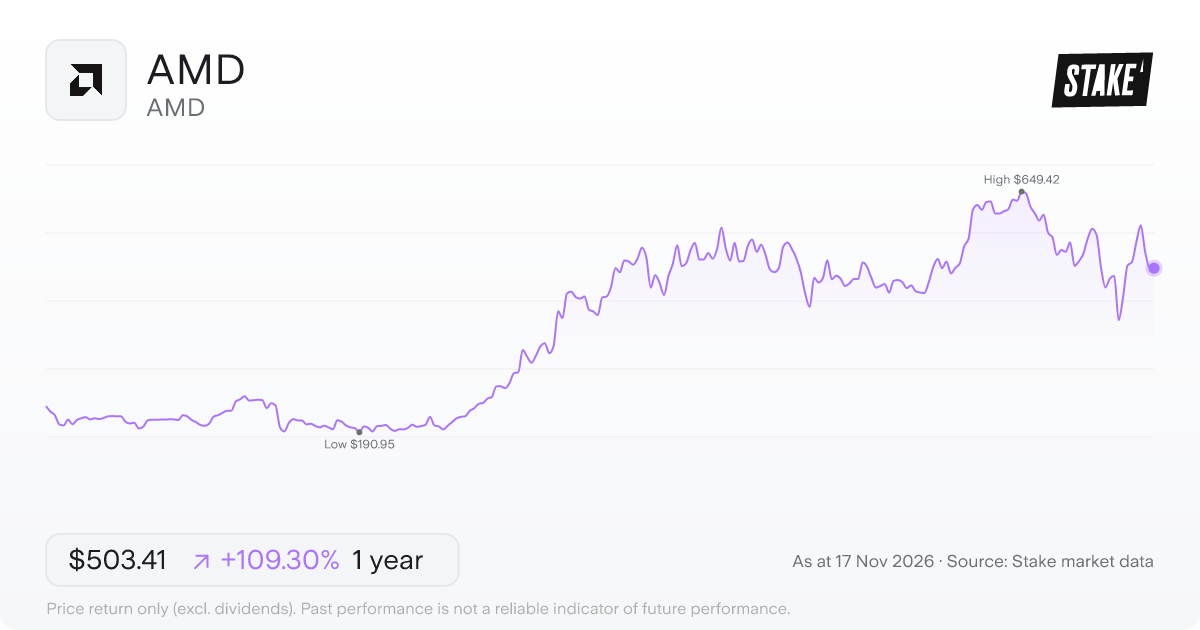
Price: US$503.41 · Daily: -0.2% · Market cap: US$827.06B · Sector: Technology · Industry: Semiconductors
Advanced Micro Devices ($AMD) designs and sells semiconductors across three business lines: data centre, client and gaming, and embedded. The data centre segment covers the products most tied to AI – including AI accelerators, server CPUs, GPUs and field-programmable gate arrays (FPGAs), which are chips that can be reconfigured after manufacture to suit specific workloads.
The client and gaming segment supplies the processors and graphics chips that go into consumer desktops and notebooks. The embedded segment extends that silicon further into industrial and adaptive applications through products like system-on-module chips and adaptive system-on-chip designs. Chief executive Lisa Su leads a company of around 31,000 employees, with products sold under the AMD trademark – including the EPYC server line and the Ryzen family of consumer processors.
9. Palantir Technologies ($PLTR)
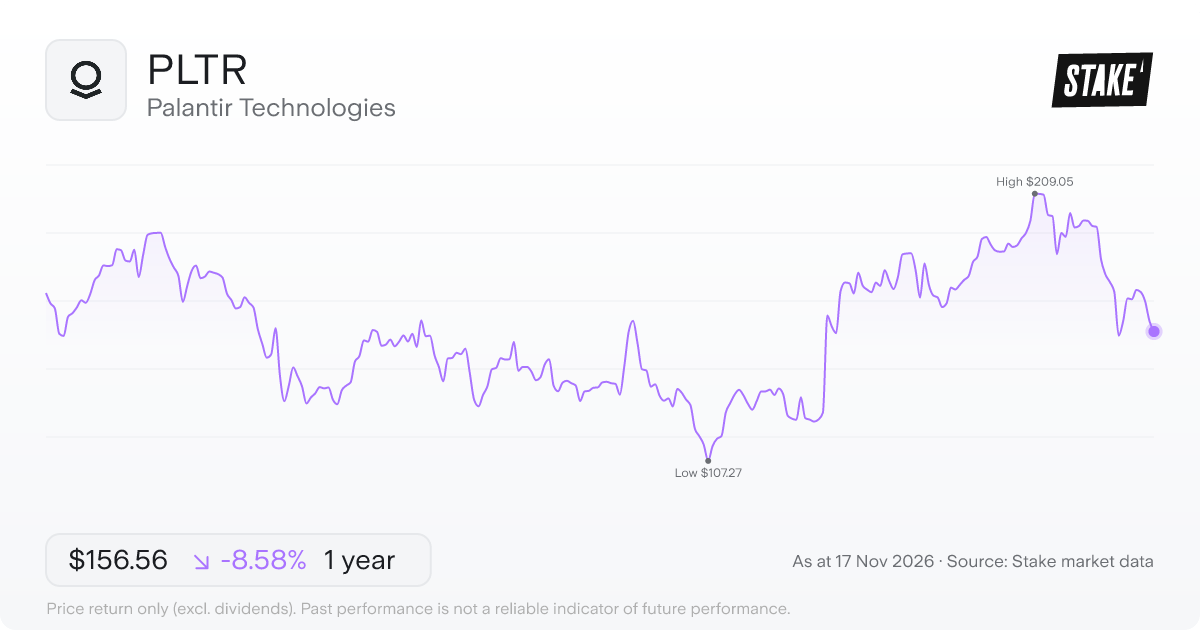
Price: US$156.56 · Daily: -2.4% · Market cap: US$386.46B · Sector: Technology · Industry: Software & IT
Palantir Technologies ($PLTR) builds software designed to help organisations find meaning in vast, complex datasets. Its roots are in counterterrorism – Gotham, its original platform, is built to surface patterns buried in signals intelligence and reports from confidential informants. That analytical capability now extends well beyond government work, through a suite of four platforms under Alexander Karp's leadership.
Foundry acts as a central operating system for an organisation's data, pulling disparate information into a single environment. Apollo sits underneath both Gotham and Foundry as a cloud-agnostic control layer, coordinating security updates and configuration changes to keep critical systems running continuously. The newest platform, AIP, is built to connect large language models and other AI tools to real organisational data – the company says it's designed to activate AI across any enterprise responsibly. $PLTR employs 4,429 people to maintain and develop all four.
10. SoundHound AI ($SOUN)
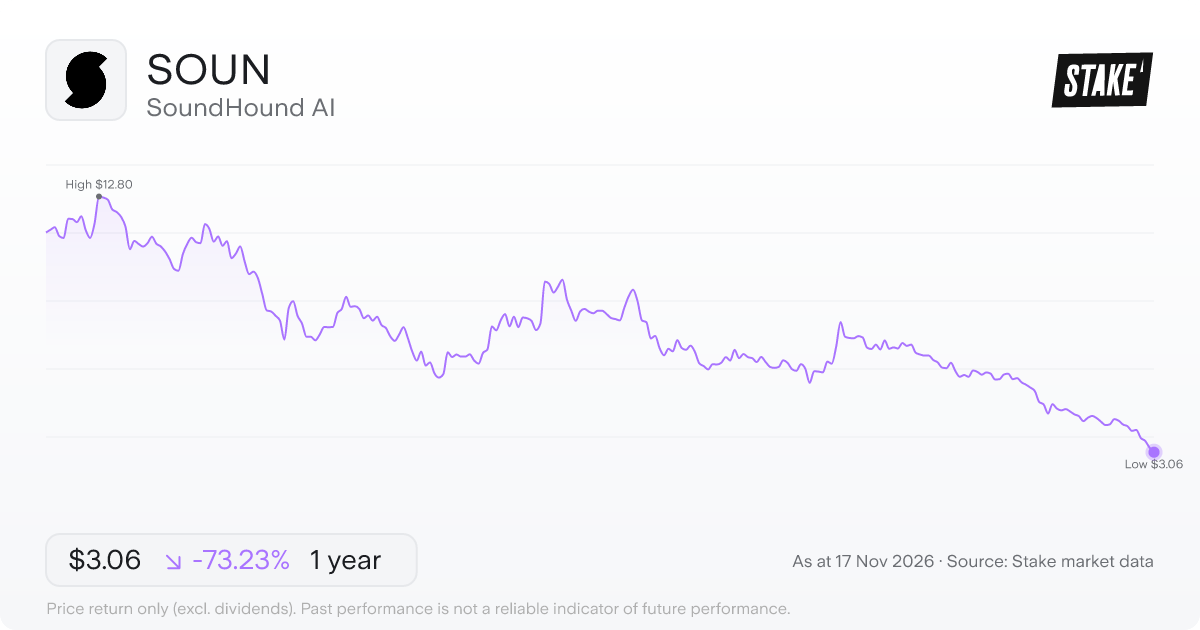
Price: US$3.06 · Daily: -5.3% · Market cap: US$1.58B · Sector: Technology · Industry: Software & IT
SoundHound AI ($SOUN) builds voice AI technology that businesses embed into their own products and customer-facing services. Drive-thru kiosks, smart TVs, in-vehicle systems and phone lines are among the channels the company targets. The technology is designed to handle natural, back-and-forth conversations in numerous languages. CEO Keyvan Mohajer leads a 954-person team working across automotive, television and customer service industries.
$SOUN's named products – Smart Answering, Smart Ordering and Dynamic Interaction – cover specific use cases like phone-based customer queries and restaurant ordering. OASYS, the company's agentic platform, is a self-learning system designed to let organisations build and deploy AI agents that complete tasks and transactions on behalf of customers and employees.
➡️ Top 9 robotics stocks to watch in 2026→
Common questions
How do I invest in AI stocks in New Zealand?
Every company in this list trades on a U.S. exchange, so you'll need a share trading platform that provides access to U.S. markets. You search by ticker, place an order, and the shares are held in your account. Some platforms let you queue orders outside U.S. trading hours; whether those fill immediately or wait until the market opens depends on the platform and order type.
What are the key risks of AI stocks?
Some of the key risks include intense competition – several companies in this list compete directly with each other for enterprise and consumer budgets – as well as regulatory scrutiny around AI development, data use and market concentration. For NZ investors, movement between the New Zealand dollar and the U.S. dollar affects both the cost of buying and the NZD value of any proceeds when shares are sold. Smaller, narrower businesses in the list carry more company-specific risk than the large, diversified platforms: less revenue diversity means less room to absorb a product misstep or a shift in customer demand.
How do chip companies in this list differ from software companies?
The hardware and software layers of AI are both represented here. $NVDA and $AMD design the processors – GPUs and AI accelerators – that run AI workloads, while $TSM operates the fabrication plants that physically manufacture chips designed by others. Software-focused names like $MSFT, $GOOGL, $PLTR and $SOUN build platforms and applications on top of that hardware, though $MSFT and $GOOGL also run the cloud infrastructure those applications rely on. $AAPL and $TSLA sit differently again – both embed AI into physical products rather than offering it as a standalone platform.
More resources
✅ Top 9 quantum computing stocks to watch in 2026→
Disclaimer
Past performance is not a reliable indicator of future performance. When you invest, your capital is at risk. You should consider your own investment objectives, financial situation, and particular needs before making an investment decision. The value of your investments can go down as well as up and you may receive back less than your original investment. As always, do your own research and consider seeking appropriate financial advice before investing.
This is not personal financial advice nor a recommendation to invest in the securities listed. Any advice provided by Stake is of general nature only and does not take into account your specific circumstances. Trading and volume data from the Stake investing platform is for reference purposes only, the investment choices of others may not be appropriate for your needs and is not a reliable indicator of performance.
Please refer to hellostake.com/pricing for the fees that apply. When you trade securities priced in another currency, currency conversion fees may apply and movements in the exchange rate may affect your returns.

Stake Desk
The freshest market insights
This article combines AI and human review from our analysts to bring you accurate, informative investing content at speed. For questions or suggestions, contact stakedesk@stake.com.au.
Subscribe
By subscribing, you agree to our Privacy Policy.