
Top 5 space stocks to watch in 2026
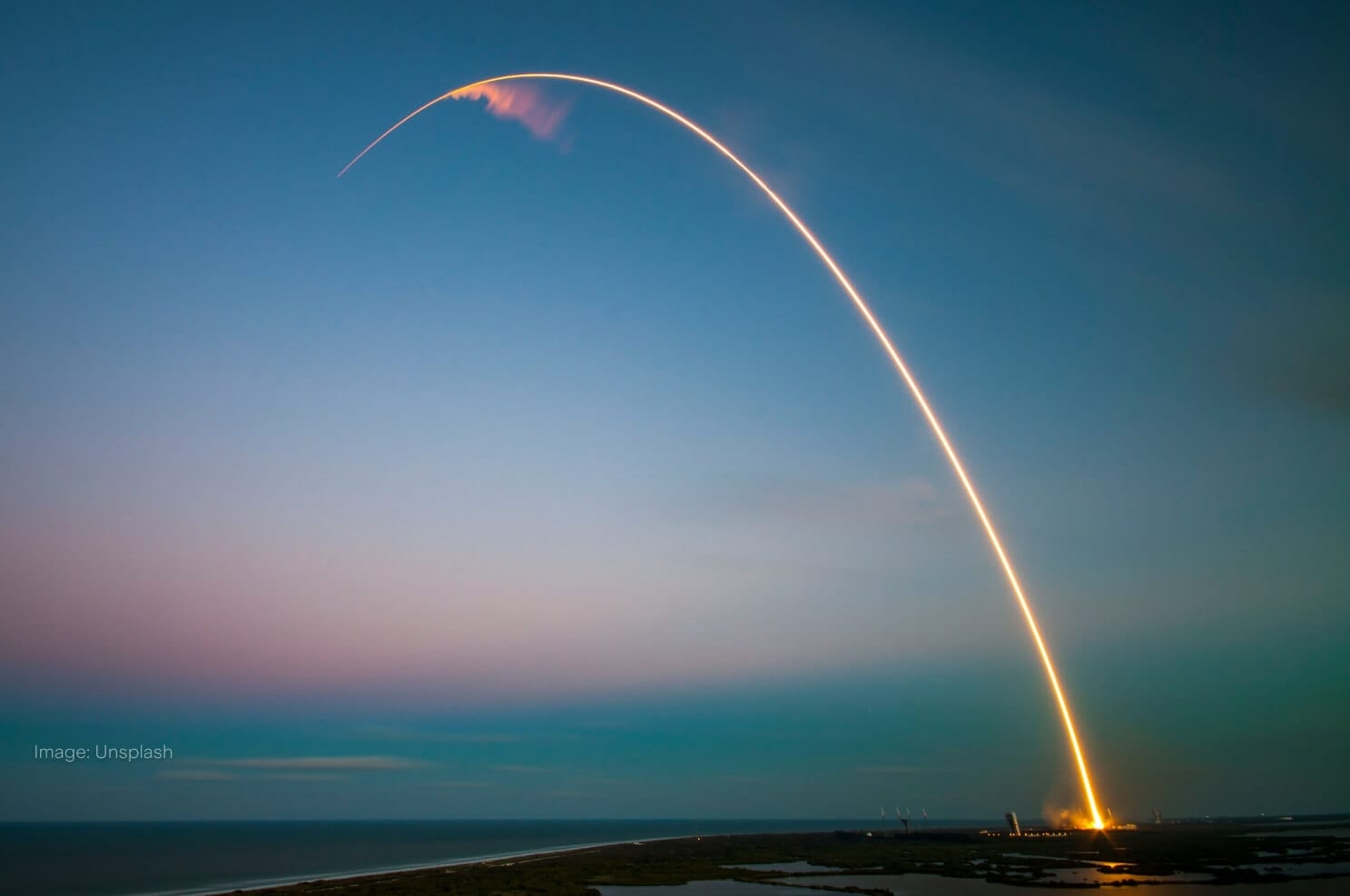
Satellite networks were built for military use before becoming the infrastructure for GPS and mobile connectivity. Several companies here build the launch vehicles and satellites that make up that infrastructure.
Space companies build the hardware that reaches orbit – rockets, satellites and spacecraft – and run the programs, networks and services that make use of them once they're there. On this list, Boeing Company ($BA) and Lockheed Martin ($LMT) each run space as one segment within broader aerospace and defence businesses, while Rocket Lab Corporation ($RKLB) focuses exclusively on launch services and spacecraft manufacture.
How we built this list: We selected these companies based on their industry and ordered them by market capitalisation. Prices are updated daily, and the list and supporting content are reviewed roughly every quarter. All data is sourced from Stake. This list isn't a recommendation and isn't ordered by suitability.
Company Name | Ticker | Share Price | Market Cap | In Watchlists |
|---|---|---|---|---|
Boeing | $189.82 | $152.32B | 12384 | |
Lockheed Martin | $510.12 | $116.93B | 11115 | |
Rocket Lab | $75.06 | $43.70B | 17510 | |
AST SpaceMobile | $63.12 | $22.74B | 7471 | |
Intuitive Machines | $15.06 | $3.27B | 3118 |
Past performance is not a reliable indicator of future performance.
Source: Stake market data. Figures in US$. Data updated as of 6 October 2026.
✅ Learn more: Top 10 defence stocks to watch in 2026→
1. Boeing ($BA)

Boeing (BA) share price over the last year: started at US$219.73, ended at US$189.82, a change of −13.6%. Range over the period: high US$252.15, low US$179.12. Source: Stake market data. Past performance is not a reliable indicator of future performance.
Price: US$189.82 · Daily: -1.5% · Market cap: US$152.32B · Sector: Industrials · Industry: Aerospace & Defence
Boeing Company ($BA) makes commercial jets, military aircraft and the systems that support both. Its Commercial Airplanes segment produces the 737 narrow-body and the 767, 777 and 787 wide-body jets, primarily for airlines around the world. The Defense, Space & Security segment researches, develops and produces manned and unmanned military aircraft, along with weapons systems for strike, surveillance and mobility missions. Chief executive Kelly Ortberg oversees all three divisions and $BA's 182,000-strong workforce.
The third segment, Global Services, supports commercial and defence customers well after a platform is delivered – covering supply chain management, maintenance, spare parts, pilot training and technical documentation. That ongoing services work means $BA generates revenue from sustaining what's already in operation, not only from building new aircraft or systems.
2. Lockheed Martin ($LMT)

Lockheed Martin (LMT) share price over the last year: started at US$514.24, ended at US$510.12, a change of −0.8%. Range over the period: high US$676.70, low US$439.19. Source: Stake market data. Past performance is not a reliable indicator of future performance.
Price: US$510.12 · Daily: 0.7% · Market cap: US$116.93B · Sector: Industrials · Industry: Aerospace & Defence
Lockheed Martin ($LMT) runs four business segments: Aeronautics, Missiles and Fire Control, Rotary and Mission Systems, and Space. Each covers a distinct part of the aerospace and defence world, from combat aircraft to helicopter systems to precision strike weapons.
The Space segment is what puts $LMT on this list. It develops and produces satellites, space transportation systems and strategic defence systems. Under CEO Jim Taiclet, the company employs around 123,000 people globally across all four segments.
Because Space is one segment within a much larger business, $LMT's share price reflects the full company's performance – Aeronautics and its other divisions carry significant weight alongside the space work. That mix means exposure to the space sector here comes bundled with a broader aerospace and defence business.
3. Rocket Lab ($RKLB)

Rocket Lab (RKLB) share price over the last year: started at US$58.50, ended at US$75.06, a change of +28.3%. Range over the period: high US$150.23, low US$39.48. Source: Stake market data. Past performance is not a reliable indicator of future performance.
Price: US$75.06 · Daily: 2.8% · Market cap: US$43.70B · Sector: Industrials · Industry: Aerospace & Defence
Rocket Lab Corporation ($RKLB) builds everything a satellite operator needs to get hardware into orbit and keep it running there. Its Launch Services segment handles dedicated and ride-share missions, while its Space Systems segment covers spacecraft design, component manufacture and on-orbit management.
The components $RKLB makes – reaction wheels, star trackers, solar solutions, radios, separation systems – go into spacecraft built by other operators as well as its own. Chief executive Peter Beck leads a team of 2,600 people across both sides of the business, making $RKLB one of the few companies in the sector that covers the full chain from launch vehicle to finished satellite.
4. AST SpaceMobile ($ASTS)

AST SpaceMobile (ASTS) share price over the last year: started at US$72.90, ended at US$63.12, a change of −13.4%. Range over the period: high US$133.09, low US$50.70. Source: Stake market data. Past performance is not a reliable indicator of future performance.
Price: US$63.12 · Daily: 8.0% · Market cap: US$22.74B · Sector: Technology · Industry: Telecom
AST SpaceMobile ($ASTS) is building a cellular broadband network in space, with the aim of connecting standard, unmodified mobile phones directly to satellites in low Earth orbit (LEO). The idea is that a phone already in your pocket could access broadband coverage even where no terrestrial cell tower reaches.
The network is designed around a constellation of BlueBird satellites. Abel Avellan leads the company, which employs 1,126 people across operations in India, Scotland, Spain and Israel. $ASTS has also been testing a BW3 test satellite, working with cellular service providers and government partners to refine what the SpaceMobile Service can do.
The company holds an intellectual property and patent portfolio it describes as central to the technology. Coverage is intended for both commercial and government applications – so the addressable use case goes well beyond consumer smartphones alone.
5. Intuitive Machines ($LUNR)

Intuitive Machines (LUNR) share price over the last year: started at US$11.98, ended at US$15.06, a change of +25.7%. Range over the period: high US$45.70, low US$8.05. Source: Stake market data. Past performance is not a reliable indicator of future performance.
Price: US$15.06 · Daily: 5.4% · Market cap: US$3.27B · Sector: Industrials · Industry: Aerospace & Defence
Intuitive Machines ($LUNR) builds spacecraft and runs the communications networks that keep them connected once they reach orbit. Those networks extend from low Earth orbit to cislunar space and deep space, linking assets for commercial, civil, and national security customers. $LUNR integrates deployed spacecraft into communications, navigation, command and control, and data relay networks designed to support persistent connectivity across those distances.
The company also offers Earth-to-space connectivity, hosted payload services, and precision navigation capabilities as part of an infrastructure-as-a-service model. According to the company, it has built over 300 spacecraft and delivered more than 260 kilograms of payload to the lunar surface. CEO Stephen Altemus leads a team of 525 people across those programs.
➡️ Top drone stocks to watch right now [2025]→
Common questions
How do I invest in space stocks in New Zealand?
All five companies in this list trade on U.S. exchanges, so you buy them through a share trading platform that provides access to U.S. markets. You search by ticker – $BA, $LMT, $RKLB, $ASTS or $LUNR – and place an order the same way you would for any U.S.-listed share. Some U.S.-listed ETFs also cover the aerospace and space sector, which can spread exposure across a broader group of companies through a single holding.
What are the key risks of space stocks?
Some of the key risks include government contract dependency – several companies here generate revenue from defence and civil space contracts that can be delayed, reduced or cancelled. Early-stage companies carry execution risk: satellite launches, constellation deployments and new spacecraft programmes can run over time or over budget. Regulatory hurdles, including launch licences, satellite frequency approvals and spectrum rights, can affect timelines in ways that are hard to predict. Because all five stocks are priced in USD, movements between the NZD and the USD affect both what a purchase costs and what proceeds are worth in New Zealand dollars.
How do the diversified aerospace companies here differ from the space-focused names?
Boeing and Lockheed Martin are large, diversified companies where space sits alongside commercial aviation, defence programmes and services. A setback in one segment can be partly offset by revenue from others. Rocket Lab, AST SpaceMobile and Intuitive Machines are more narrowly focused – their businesses are built around launch services, satellite infrastructure and space-based connectivity. That means their revenue is more directly tied to how their specific space programmes progress, with less of a cushion from other business lines.
More resources
✅ Top 9 robotics stocks to watch in 2026→
Disclaimer
Past performance is not a reliable indicator of future performance. When you invest, your capital is at risk. You should consider your own investment objectives, financial situation, and particular needs before making an investment decision. The value of your investments can go down as well as up and you may receive back less than your original investment. As always, do your own research and consider seeking appropriate financial advice before investing.
This is not personal financial advice nor a recommendation to invest in the securities listed. Any advice provided by Stake is of general nature only and does not take into account your specific circumstances. Trading and volume data from the Stake investing platform is for reference purposes only, the investment choices of others may not be appropriate for your needs and is not a reliable indicator of performance.
Please refer to hellostake.com/pricing for the fees that apply. When you trade securities priced in another currency, currency conversion fees may apply and movements in the exchange rate may affect your returns.

Stake Desk
The freshest market insights
This article combines AI and human review from our analysts to bring you accurate, informative investing content at speed. For questions or suggestions, contact stakedesk@stake.com.au.
Subscribe
By subscribing, you agree to our Privacy Policy.