
Top 10 defence stocks to watch in 2026
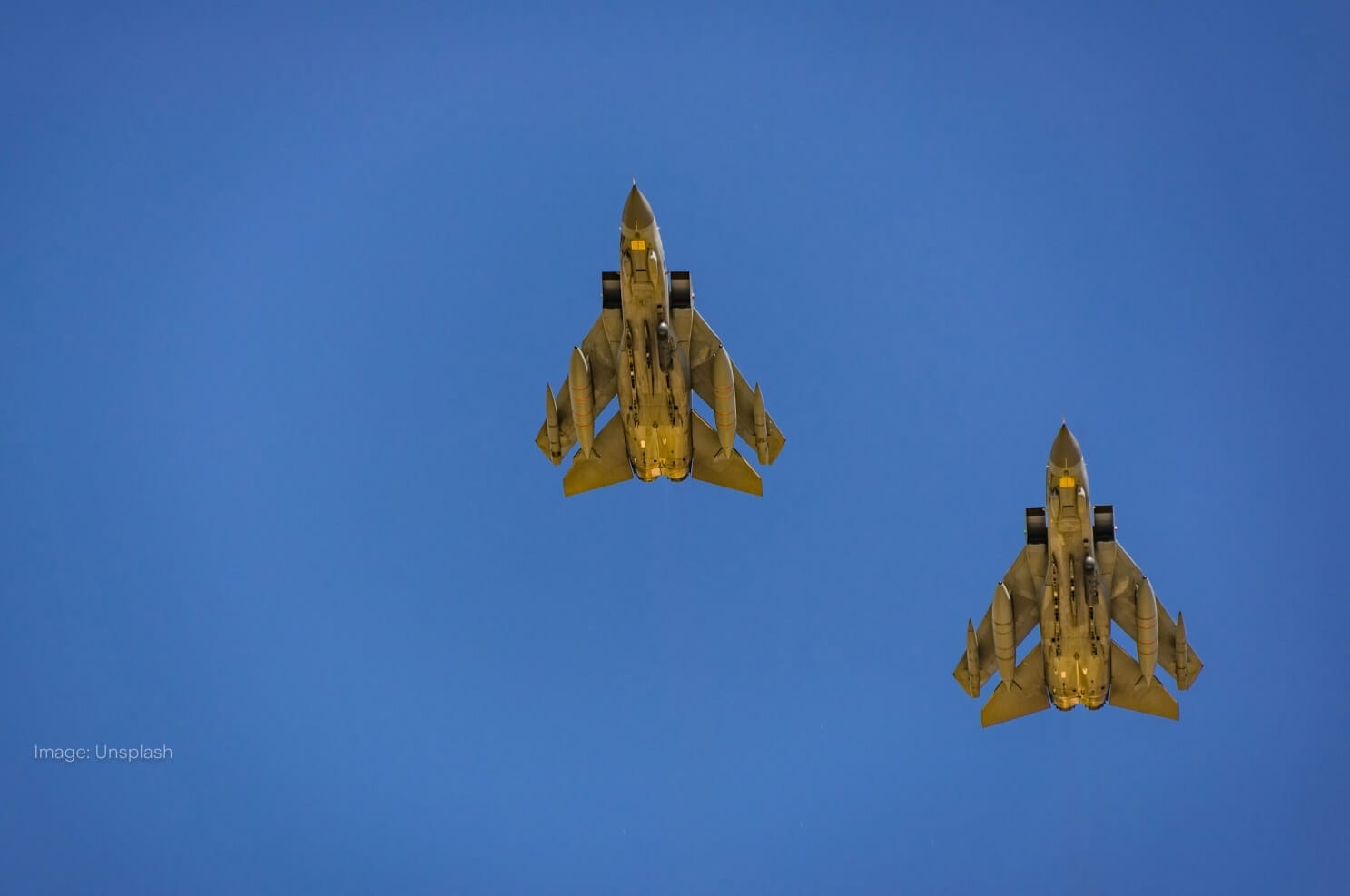
Defence revenue comes from government contracts, so budget decisions set these companies' fortunes. A cancelled programme hits earnings directly, more sharply for companies with fewer government customers.
Defence companies build and sustain military platforms – aircraft, missiles, submarines, radar systems – typically under long-term contracts with government customers. Nine of the ten stocks on this list are manufacturers of those kinds of systems; Leidos Holdings ($LDOS) focuses on IT infrastructure, software and cyber capabilities for defence and intelligence agencies.
How we built this list: We selected these companies based on their industry and ordered them by market capitalisation. Prices are updated daily, and the list and supporting content are reviewed roughly every quarter. All data is sourced from Stake. This list isn't a recommendation and isn't ordered by suitability.
Company Name | Ticker | Share Price | Market Cap | In Watchlists |
|---|---|---|---|---|
RTX | $183.29 | $248.43B | 5386 | |
Boeing | $189.82 | $152.32B | 12384 | |
Lockheed Martin | $510.12 | $116.93B | 11115 | |
General Dynamics | $331.33 | $89.75B | 2556 | |
Northrop Grumman | $483.11 | $67.64B | 4058 | |
TransDigm Group | $1,103.33 | $60.40B | 602 | |
L3Harris Technologies | $237.90 | $44.11B | 1581 | |
Curtiss-Wright | $553.35 | $19.97B | 157 | |
Leidos Holdings | $116.69 | $14.99B | 699 | |
Kratos Defense | $43.71 | $7.89B | 2841 |
Past performance is not a reliable indicator of future performance.
Source: Stake market data. Figures in US$. Data updated as of 6 October 2026.
✅ Learn more: Top 8 defence ETFs to watch in 2026→
1. RTX ($RTX)

RTX (RTX) share price over the last year: started at US$168.80, ended at US$183.29, a change of +8.6%. Range over the period: high US$225.49, low US$157.00. Source: Stake market data. Past performance is not a reliable indicator of future performance.
Price: US$183.29 · Daily: -0.6% · Market cap: US$248.43B · Sector: Industrials · Industry: Aerospace & Defence
RTX Corporation ($RTX) runs three distinct businesses under one roof: Collins Aerospace, Pratt & Whitney, and Raytheon. Collins Aerospace makes products and aftermarket services for civil and military aircraft, covering everything from cockpit systems to components used in commercial space operations. Pratt & Whitney supplies the engines that power commercial airliners, military jets, and business aircraft.
Raytheon is where $RTX gets into the harder-edged side of defence – integrated air and missile defence systems, smart weapons and threat-detection technology sold to the U.S. government and foreign customers. That combination of commercial aviation supply and military systems gives the company exposure to two very different demand cycles. Under chief executive Chris Calio, $RTX employs around 180,000 people worldwide.
2. Boeing ($BA)

Boeing (BA) share price over the last year: started at US$219.73, ended at US$189.82, a change of −13.6%. Range over the period: high US$252.15, low US$179.12. Source: Stake market data. Past performance is not a reliable indicator of future performance.
Price: US$189.82 · Daily: -1.5% · Market cap: US$152.32B · Sector: Industrials · Industry: Aerospace & Defence
Boeing ($BA) builds the aircraft and weapons systems that governments and airlines depend on. Its commercial arm produces the 737 narrow-body and the 767, 777 and 787 wide-body jets for airlines worldwide. Its defence division researches, develops and produces manned and unmanned military aircraft and weapons systems covering strike, surveillance and mobility missions. The third segment – global services – supports both sides of the business with maintenance, upgrades, spare parts, pilot training and supply chain management.
CEO Kelly Ortberg leads a workforce of 182,000 people. That services arm matters because long-term support contracts tend to run well beyond the original platform sale, keeping $BA tied to its customers across the life of an aircraft or weapons system.
3. Lockheed Martin ($LMT)

Lockheed Martin (LMT) share price over the last year: started at US$514.24, ended at US$510.12, a change of −0.8%. Range over the period: high US$676.70, low US$439.19. Source: Stake market data. Past performance is not a reliable indicator of future performance.
Price: US$510.12 · Daily: 0.7% · Market cap: US$116.93B · Sector: Industrials · Industry: Aerospace & Defence
Lockheed Martin ($LMT) covers almost every corner of modern defence hardware. Its Aeronautics segment builds and sustains advanced military aircraft, including combat jets and unmanned vehicles. The Missiles and Fire Control division produces air and missile defence systems alongside precision strike weapons, while the Rotary and Mission Systems arm handles military and commercial helicopters as well as sea and land-based missile defence.
The Space segment adds another dimension entirely, working on satellites, space transportation systems and strategic strike capabilities. With 123,000 employees and Jim Taiclet as chief executive, $LMT operates at a scale that few defence companies match across so many distinct platform types.
4. General Dynamics ($GD)

General Dynamics (GD) share price over the last year: started at US$346.50, ended at US$331.33, a change of −4.4%. Range over the period: high US$395.97, low US$312.53. Source: Stake market data. Past performance is not a reliable indicator of future performance.
Price: US$331.33 · Daily: -0.1% · Market cap: US$89.75B · Sector: Industrials · Industry: Aerospace & Defence
General Dynamics ($GD) covers more ground than most defence companies. Its Marine Systems segment designs and builds nuclear-powered submarines for the U.S. Navy, while Combat Systems produces wheeled and tracked vehicles, weapons and munitions for land forces worldwide. The Aerospace segment runs a separate lane entirely – manufacturing business jets and providing aircraft completion and repair services.
The Technologies segment rounds out the business, delivering IT services, software and products to military, intelligence and federal civilian agencies. Phebe Novakovic leads the company, which employs around 117,000 people across these four divisions.
5. Northrop Grumman ($NOC)

Northrop Grumman (NOC) share price over the last year: started at US$618.52, ended at US$483.11, a change of −21.9%. Range over the period: high US$768.02, low US$476.11. Source: Stake market data. Past performance is not a reliable indicator of future performance.
Price: US$483.11 · Daily: 1.5% · Market cap: US$67.64B · Sector: Industrials · Industry: Aerospace & Defence
Northrop Grumman ($NOC) builds some of the most complex hardware in modern defence – military aircraft, strategic missiles, missile defence systems, and space platforms. Its four segments cover the full lifecycle: designing and producing the systems, then sustaining and modernising them over decades-long programmes. The U.S. Department of Defense and intelligence community are the primary customers, with international governments making up a smaller share of revenues.
Under chief executive Kathy Warden, $NOC employs around 95,000 people. Space Systems is one of the more distinctive parts of the business, delivering end-to-end launch and mission capabilities that go beyond what a typical aerospace manufacturer handles.
6. TransDigm Group ($TDG)

TransDigm Group (TDG) share price over the last year: started at US$1,291.74, ended at US$1,103.33, a change of −14.6%. Range over the period: high US$1,450.00, low US$1,076.01. Source: Stake market data. Past performance is not a reliable indicator of future performance.
Price: US$1,103.33 · Daily: 1.0% · Market cap: US$60.40B · Sector: Industrials · Industry: Aerospace & Defence
TransDigm Group ($TDG) manufactures the components inside an aircraft – ignition systems, actuators, specialised pumps, power conditioning devices and cargo handling systems. The company says its parts go into nearly all commercial and military aircraft in service, covering both commercial and defence platforms. $TDG organises its business across three segments – Power & Control, Airframe and Non-aviation – with 16,500 employees under chief executive Mike Lisman.
7. L3Harris Technologies ($LHX)

L3Harris Technologies (LHX) share price over the last year: started at US$303.01, ended at US$237.90, a change of −21.5%. Range over the period: high US$378.48, low US$236.47. Source: Stake market data. Past performance is not a reliable indicator of future performance.
Price: US$237.90 · Daily: 0.4% · Market cap: US$44.11B · Sector: Industrials · Industry: Aerospace & Defence
L3Harris Technologies ($LHX) connects military and national security operations across five domains – space, air, land, sea and cyber – through four distinct business segments. Its Space & Airborne Systems arm integrates full mission solutions for space and airborne platforms, while the Integrated Mission Systems segment covers intelligence, surveillance and reconnaissance capabilities, electronic attack, autonomy and targeting.
The Communications Systems segment supplies warfighters with tools designed to operate in contested environments where signal interference is a real constraint. Through Aerojet Rocketdyne, $LHX also provides propulsion and armament products to the U.S. Department of Defense, NASA and other aerospace and defence prime contractors – adding a manufacturing dimension that sits alongside its systems integration work. Sam Mehta leads the company, which employs around 45,000 people.
8. Curtiss-Wright ($CW)

Curtiss-Wright (CW) share price over the last year: started at US$554.06, ended at US$553.35, a change of −0.1%. Range over the period: high US$792.77, low US$532.36. Source: Stake market data. Past performance is not a reliable indicator of future performance.
Price: US$553.35 · Daily: 2.3% · Market cap: US$19.97B · Sector: Industrials · Industry: Aerospace & Defence
Curtiss-Wright Corporation ($CW) builds engineered components and systems for some of the more demanding applications in defence and industry – think main coolant pumps, seals and valves for naval platforms, alongside electronics for defence customers and products serving commercial aerospace. The company runs three segments: Aerospace & Industrial, Defense Electronics, and Naval & Power, the last of which also reaches into the power and process markets.
Kevin Rayment leads the company's roughly 9,100 employees. Beyond defence contracts, $CW has a foothold in commercial power and industrial markets, which gives it revenue streams outside purely military spending.
9. Leidos Holdings ($LDOS)

Leidos Holdings (LDOS) share price over the last year: started at US$198.04, ended at US$116.69, a change of −41.1%. Range over the period: high US$199.55, low US$100.00. Source: Stake market data. Past performance is not a reliable indicator of future performance.
Price: US$116.69 · Daily: -2.3% · Market cap: US$14.99B · Sector: Technology · Industry: Software & IT
Leidos Holdings ($LDOS) concentrates on software, IT infrastructure and cyber capabilities rather than the missiles and aircraft platforms that dominate much of defence contracting. Its 47,000 employees serve defence, intelligence, health and homeland security agencies across four business segments.
The Intelligence & Digital segment works inside classified environments, building technical solutions for distributed mission networks and full-spectrum cyber operations. The Health segment handles IT modernisation, software development and programme implementation for government health and research programmes.
Through its Homeland segment, $LDOS covers air traffic management, airports and borders, security equipment and commercial energy engineering. The Defense segment moves closer to traditional hardware – developing space, aerial, surface and sub-surface systems, both manned and unmanned – under chief executive Thomas Bell.
10. Kratos Defense ($KTOS)

Kratos Defense (KTOS) share price over the last year: started at US$100.25, ended at US$43.71, a change of −56.4%. Range over the period: high US$130.72, low US$42.02. Source: Stake market data. Past performance is not a reliable indicator of future performance.
Price: US$43.71 · Daily: 4.0% · Market cap: US$7.89B · Sector: Industrials · Industry: Aerospace & Defence
Kratos Defense & Security Solutions ($KTOS) makes hardware and software for military and national security programs, operating through two distinct segments. The government solutions arm covers microwave electronic products, satellite and cyber systems, turbine technologies, and command-and-control infrastructure – a category the defence industry calls C5ISR (command, control, communications, computing, combat, intelligence, surveillance and reconnaissance). Its unmanned systems arm develops aerial, ground and seaborne drones together with the communications networks needed to direct them.
Customers across both segments are almost entirely government: the Department of Defense (DoD), intelligence agencies and classified bodies. CEO Eric Demarco leads a workforce of 4,300 people across the two segments.
➡️ Top 5 space stocks to watch in 2026→
Common questions
How do I invest in defence stocks in New Zealand?
Every stock in this list trades on U.S. exchanges, so you'd access them through a share trading platform that offers U.S. market access. You search by ticker – $RTX, $LMT, $KTOS and so on – and place an order the same way you would for any listed share. Some platforms serving New Zealand investors provide this access directly.
What are the key risks of defence stocks?
Some of the key risks include government budget dependency, contract concentration, programme cancellation risk and currency exposure. Most of these companies derive the bulk of their revenue from government contracts, so shifts in defence spending – whether from policy changes, budget cuts or political cycles – flow directly to their revenues. A cancelled programme or lost contract can hit earnings hard, particularly for businesses with a narrower customer base. Because these stocks are priced in USD, movements between the NZD and USD affect both what you pay to buy shares and what sale proceeds are worth in New Zealand dollars.
What's the difference between defence primes and specialist suppliers?
Large integrated contractors – often called primes – design, build and sustain complete platforms: aircraft, submarines, missile systems, satellites. Specialist suppliers focus on a narrower part of the chain, whether that's components, sub-systems or services. This list includes both: $LMT and $NOC sit firmly in the prime category, while $TDG concentrates on engineered components that go into commercial and military aircraft alike, and $KTOS focuses on unmanned systems. $LDOS is a different shape again – its business centres on IT services, software and digital intelligence for defence agencies rather than physical platforms.
More resources
✅ Top drone stocks to watch right now [2025]→
Disclaimer
Past performance is not a reliable indicator of future performance. When you invest, your capital is at risk. You should consider your own investment objectives, financial situation, and particular needs before making an investment decision. The value of your investments can go down as well as up and you may receive back less than your original investment. As always, do your own research and consider seeking appropriate financial advice before investing.
This is not personal financial advice nor a recommendation to invest in the securities listed. Any advice provided by Stake is of general nature only and does not take into account your specific circumstances. Trading and volume data from the Stake investing platform is for reference purposes only, the investment choices of others may not be appropriate for your needs and is not a reliable indicator of performance.
Please refer to hellostake.com/pricing for the fees that apply. When you trade securities priced in another currency, currency conversion fees may apply and movements in the exchange rate may affect your returns.

Stake Desk
The freshest market insights
This article combines AI and human review from our analysts to bring you accurate, informative investing content at speed. For questions or suggestions, contact stakedesk@stake.com.au.
Subscribe
By subscribing, you agree to our Privacy Policy.