
Top 12 nuclear energy stocks to watch in 2026
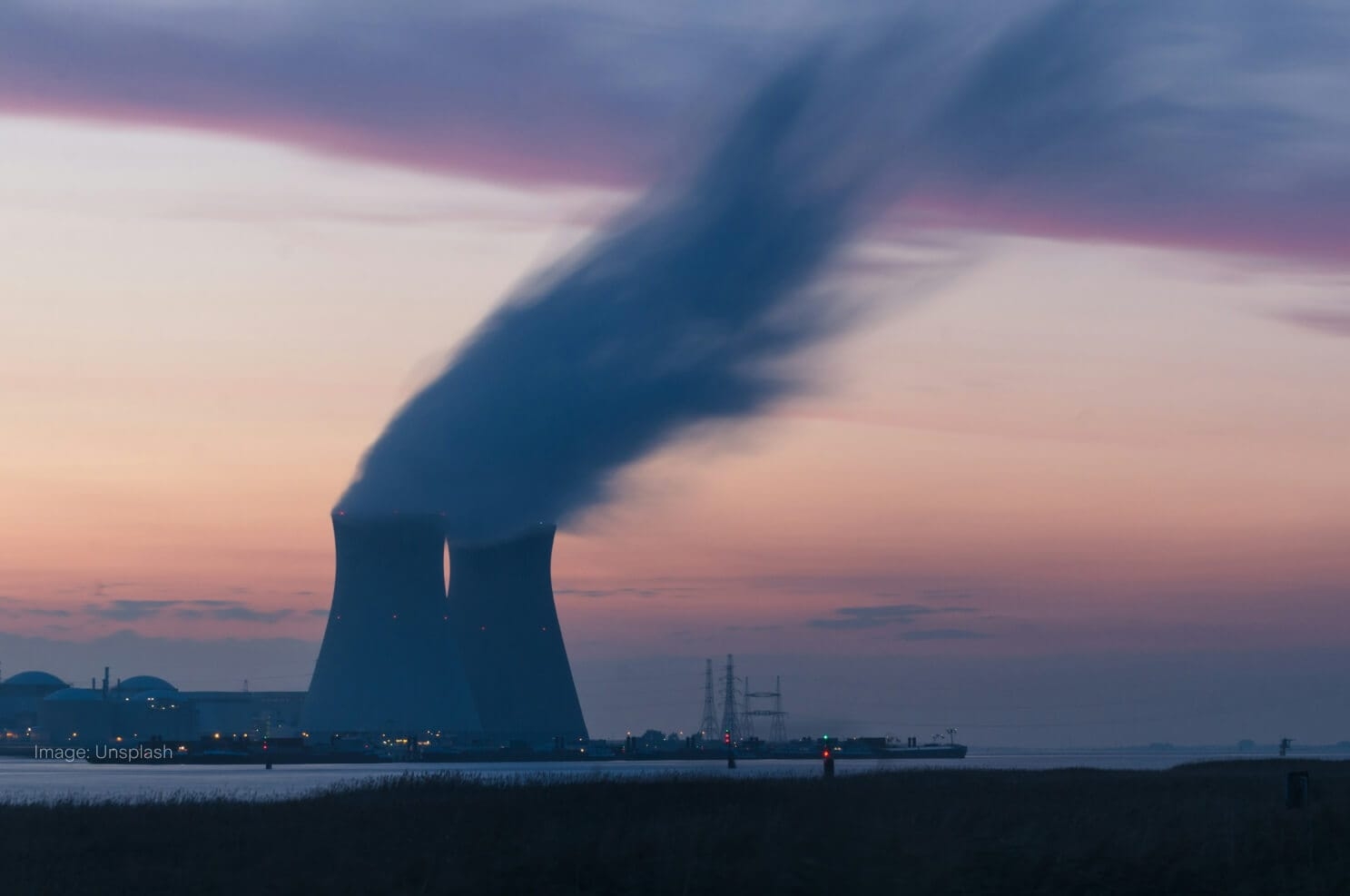
Nuclear plants run on uranium, so the fuel price moves through every layer of the supply chain. Miners and fuel suppliers sell it while utilities buy it.
Nuclear power plants use uranium as fuel, producing heat to drive turbines and generate electricity without burning fossil fuels. The 12 U.S.-listed stocks here include uranium miners like Cameco ($CCJ) and Uranium Energy ($UEC), utilities that operate nuclear fleets, and reactor technology developers like NuScale Power ($SMR).
How we built this list: We selected these companies based on their industry and ordered them by market capitalisation. Prices are updated daily, and the list and supporting content are reviewed roughly every quarter. All data is sourced from Stake. This list isn't a recommendation and isn't ordered by suitability.
Company Name | Ticker | Share Price | Market Cap | In Watchlists |
|---|---|---|---|---|
GE Vernova | $1,029.21 | $263.67B | 3247 | |
NextEra Energy | $77.88 | $159.12B | 4923 | |
Constellation Energy | $300.40 | $94.82B | 4604 | |
Cameco | $93.02 | $54.36B | 4341 | |
Dominion Energy | $62.00 | $53.67B | 464 | |
BWX Technologies | $145.70 | $12.40B | 1398 | |
Brookfield Renewable Partners | $29.42 | $12.08B | 2019 | |
Uranium Energy | $10.11 | $4.63B | 3447 | |
Energy Fuels | $11.26 | $4.07B | 2731 | |
NuScale Power | $8.02 | $3.30B | 4321 | |
Centrus Energy | $153.88 | $2.89B | 1921 | |
Nano Nuclear | $16.49 | $832.9M | 1529 |
Past performance is not a reliable indicator of future performance.
Source: Stake market data. Figures in US$. Data updated as of 6 October 2026.
✅ Learn more: Top 5 nuclear energy ETFs to watch in 2026→
1. GE Vernova ($GEV)

GE Vernova (GEV) share price over the last year: started at US$603.22, ended at US$1,029.21, a change of +70.6%. Range over the period: high US$1,174.86, low US$547.96. Source: Stake market data. Past performance is not a reliable indicator of future performance.
Price: US$1,029.21 · Daily: 4.0% · Market cap: US$263.67B · Sector: Utilities · Industry: Electric & IPPs
GE Vernova ($GEV) sits at the intersection of electricity generation and the infrastructure that moves power from plant to plug. Its Power segment designs, manufactures and services gas, nuclear, hydro and steam technologies – the kinds of dispatchable plants that keep the grid stable when the wind isn't blowing. Nuclear is one part of that broader generation portfolio, alongside the hardware and services that utilities rely on to keep existing plants running.
The company's reach doesn't stop at generation. $GEV's Electrification segment covers grid solutions, power conversion, storage and software for moving electricity from point of generation to point of consumption. Its Wind segment adds onshore and offshore turbine manufacturing to the mix, making $GEV one of the few companies in this article with meaningful exposure across multiple clean-power technologies rather than uranium alone. Scott Strazik leads a workforce of 75,000 people across these businesses.
2. NextEra Energy ($NEE)

NextEra Energy (NEE) share price over the last year: started at US$82.11, ended at US$77.88, a change of −5.2%. Range over the period: high US$97.88, low US$75.49. Source: Stake market data. Past performance is not a reliable indicator of future performance.
Price: US$77.88 · Daily: 2.1% · Market cap: US$159.12B · Sector: Utilities · Industry: Electric & IPPs
Florida Power & Light Company is the regulated utility arm of NextEra Energy ($NEE), handling generation, transmission and distribution across Florida. FPL holds around 35,052 megawatts of net generating capacity, more than 91,000 circuit miles of transmission and distribution lines, and 921 substations. Nuclear generation is part of that Florida portfolio, which is why $NEE appears in this list alongside uranium miners and reactor developers.
The other side of the business is NEER – NextEra Energy Resources and NextEra Energy Transmission – which develops and operates generation facilities in wholesale markets across the U.S. and Canada. NEER's assets cover battery storage, natural gas pipelines and renewable fuels, along with rate-regulated transmission across North America. John Ketchum leads the company, which employs 17,400 people across both the regulated utility and wholesale generation operations.
3. Constellation Energy ($CEG)

Constellation Energy (CEG) share price over the last year: started at US$364.10, ended at US$300.40, a change of −17.5%. Range over the period: high US$403.95, low US$236.50. Source: Stake market data. Past performance is not a reliable indicator of future performance.
Price: US$300.40 · Daily: 12.2% · Market cap: US$94.82B · Sector: Utilities · Industry: Electric & IPPs
Constellation Energy ($CEG) sits at the intersection of nuclear power and broader clean energy supply. The company operates roughly 55 gigawatts of generating capacity across nuclear, hydro, wind, solar and natural gas facilities – enough to power the equivalent of 27 million homes, according to the company. That output accounts for about 10% of the nation's clean energy production.
Under CEO Joe Dominguez, $CEG's 15,291 employees run an integrated operation that sells electricity, natural gas and related products to a wide range of buyers – from distribution utilities and municipalities to commercial, industrial and residential customers. Its footprint covers several regional power markets, including Mid-Atlantic, Midwest, New York and ERCOT.
4. Cameco ($CCJ)

Cameco (CCJ) share price over the last year: started at US$85.31, ended at US$93.02, a change of +9.0%. Range over the period: high US$134.09, low US$79.44. Source: Stake market data. Past performance is not a reliable indicator of future performance.
Price: US$93.02 · Daily: 6.3% · Market cap: US$54.36B · Sector: Energy · Industry: Uranium
Cameco Corporation ($CCJ) mines and sells uranium concentrate, with two operating mines – Cigar Lake and McArthur River – and a mill at Key Lake. Its fuel services arm takes that concentrate further, refining and converting it into the forms nuclear plants actually load into reactors.
The third piece is Westinghouse, an equity-accounted investment in a company that manufactures reactor technology and supplies outage services, engineering support, and components to commercial utilities and government agencies worldwide. Together the segments cover much of the nuclear fuel chain, from ore in the ground to the reactor door.
5. Dominion Energy ($D)

Dominion Energy (D) share price over the last year: started at US$61.50, ended at US$62.00, a change of +0.8%. Range over the period: high US$71.69, low US$57.08. Source: Stake market data. Past performance is not a reliable indicator of future performance.
Price: US$62.00 · Daily: 1.6% · Market cap: US$53.67B · Sector: Utilities · Industry: Electric & IPPs
Dominion Energy ($D) runs regulated electricity networks across Virginia, North Carolina and South Carolina, serving around 3.6 million homes and businesses. On the gas side, it distributes regulated natural gas to more than 500,000 customers in South Carolina. $D also develops and operates regulated offshore wind and solar projects, and produces carbon-free electricity in New England. Robert Blue leads the company's 15,200 employees across regulated transmission, distribution and generation operations.
6. BWX Technologies ($BWXT)

BWX Technologies (BWXT) share price over the last year: started at US$191.38, ended at US$145.70, a change of −23.9%. Range over the period: high US$238.42, low US$134.35. Source: Stake market data. Past performance is not a reliable indicator of future performance.
Price: US$145.70 · Daily: 7.6% · Market cap: US$12.40B · Sector: Industrials · Industry: Aerospace & Defence
BWX Technologies ($BWXT) sits in a corner of the nuclear industry that doesn't get much attention: the manufacturing side. The company builds naval nuclear reactors and their fuel for the U.S. Naval Nuclear Propulsion Program, supplying submarines and aircraft carriers. That work sits within its Government Operations segment, which also covers precision fuel-bearing components ranging from a few grams to hundreds of tons.
Its Commercial Operations segment takes a different angle, producing nuclear steam generators, heat exchangers, pressure vessels, and other reactor components for civilian power plants. $BWXT also processes special nuclear materials, delivers environmental site restoration services, and works in advanced alloy manufacturing. With around 10,400 employees and Rex Geveden as CEO, the company operates across both the defence and commercial nuclear supply chains.
7. Brookfield Renewable Partners ($BEP)

Brookfield Renewable Partners (BEP) share price over the last year: started at US$27.40, ended at US$29.42, a change of +7.4%. Range over the period: high US$37.31, low US$26.29. Source: Stake market data. Past performance is not a reliable indicator of future performance.
Price: US$29.42 · Daily: 4.3% · Market cap: US$12.08B · Sector: Utilities · Industry: Electric & IPPs
Brookfield Renewable Partners ($BEP) runs one of the broader clean power operations around, with hydroelectric, wind, utility-scale solar, storage and distributed generation assets across North America, South America, Europe and Asia-Pacific. The company says its total installed capacity sits at approximately 46,200 megawatts, with a development pipeline of roughly 200,000 megawatts.
Its nuclear connection sits inside the sustainable solutions segment, which the company describes as covering nuclear services alongside carbon capture, recycling, biomass and electro fuels. Connor Teskey leads the business, which employs around 5,870 people across its operations.
8. Uranium Energy ($UEC)

Uranium Energy (UEC) share price over the last year: started at US$13.05, ended at US$10.11, a change of −22.5%. Range over the period: high US$20.14, low US$9.04. Source: Stake market data. Past performance is not a reliable indicator of future performance.
Price: US$10.11 · Daily: 8.1% · Market cap: US$4.63B · Sector: Energy · Industry: Uranium
Uranium Energy Corp ($UEC) focuses on uranium mining and processing across the U.S., Canada and Paraguay. Its principal projects sit in Wyoming, Texas and Saskatchewan, with named mines including the Palangana Mine and Christensen Ranch Mine, both operating via in-situ recovery (ISR) – a method that extracts uranium from underground by pumping solution through the ore body rather than conventional open-pit digging.
The company holds two extraction-ready ISR hub-and-spoke platforms in South Texas and Wyoming, anchored by fully licensed processing plants at Hobson and Irigaray. Through its subsidiary, United States Uranium Refining & Conversion Corp, $UEC is also building out domestic refining and conversion capabilities – the steps that turn raw uranium into fuel usable by nuclear power plants. With 171 employees, it runs a relatively tight operation across a broad project portfolio.
9. Energy Fuels ($UUUU)

Energy Fuels (UUUU) share price over the last year: started at US$16.91, ended at US$11.26, a change of −33.4%. Range over the period: high US$27.72, low US$10.71. Source: Stake market data. Past performance is not a reliable indicator of future performance.
Price: US$11.26 · Daily: 4.1% · Market cap: US$4.07B · Sector: Energy · Industry: Uranium
Energy Fuels ($UUUU) does more than mine uranium. The company describes itself as a critical materials business, pulling uranium, rare earth elements, vanadium, heavy mineral sands and medical isotopes from its operations across the western U.S.
The rare earth side of the business runs through a metals plant in Ochang, South Korea, where $UUUU processes neodymium-iron-boron alloys – the kind used in electric motors and wind turbines. That puts the company across two of the materials most tied to clean energy infrastructure, not just one.
10. NuScale Power ($SMR)

NuScale Power (SMR) share price over the last year: started at US$41.94, ended at US$8.02, a change of −80.9%. Range over the period: high US$53.43, low US$7.59. Source: Stake market data. Past performance is not a reliable indicator of future performance.
Price: US$8.02 · Daily: 4.4% · Market cap: US$3.30B · Sector: Utilities · Industry: Electric & IPPs
NuScale Power ($SMR) designs and licenses a proprietary small modular reactor – a pressurised water reactor that produces around 77 megawatts of electricity per unit. The design is built to scale: customers can configure up to 12 modules in a single array, reaching a combined output of 924 megawatts.
With 428 employees, $SMR operates as a technology and licensing business rather than a plant operator. It aims to support customers across the full project lifecycle, from licensing and training through to fuel supply and program management, serving governments, utilities, state-owned enterprises and technology and industrial companies seeking carbon-free power.
11. Centrus Energy ($LEU)

Centrus Energy (LEU) share price over the last year: started at US$356.28, ended at US$153.88, a change of −56.8%. Range over the period: high US$436.00, low US$138.18. Source: Stake market data. Past performance is not a reliable indicator of future performance.
Price: US$153.88 · Daily: 8.8% · Market cap: US$2.89B · Sector: Energy · Industry: Uranium
Centrus Energy Corp. ($LEU) sits at a specific point in the nuclear supply chain: it supplies the fuel that goes into reactors, rather than building or operating them. Its core business is low-enriched uranium (LEU), the fissile material that commercial utilities need to keep nuclear power plants running. $LEU sources LEU through a network of suppliers and sells it primarily to those utility customers.
The second part of the business, its Technical Solutions segment, goes a step further. It produces high assay low-enriched uranium – known as HALEU – which is the fuel type required by many next-generation and advanced reactor designs. That work serves both the U.S. government and private sector customers, and sits alongside other advanced manufacturing and technical services. With around 300 employees, led by CEO Amir Vexler, $LEU is a relatively compact operation for the role it plays in the nuclear fuel cycle.
12. Nano Nuclear ($NNE)

Nano Nuclear (NNE) share price over the last year: started at US$53.63, ended at US$16.49, a change of −69.3%. Range over the period: high US$56.63, low US$14.88. Source: Stake market data. Past performance is not a reliable indicator of future performance.
Price: US$16.49 · Daily: 6.3% · Market cap: US$832.9M · Sector: Utilities · Industry: Electric & IPPs
Nano Nuclear Energy ($NNE) is working on multiple parts of the nuclear supply chain at once. Its reactor arm is developing the KRONOS MMR Energy System, a microreactor the company says is designed to serve both small- and large-scale power needs. With just 36 employees under chief executive James Walker, $NNE is firmly at the development stage rather than the operational one.
Beyond the reactor itself, $NNE runs a fuel processing business aimed at building a domestic supply chain for low-enriched uranium (LEU) and high-assay low-enriched uranium (HALEU) – the fuel grades that advanced reactors require. A separate transportation arm and a nuclear consultation services unit round out the portfolio. The subsidiary structure, which includes entities like HALEU Energy Fuel Inc. and Advanced Fuel Transportation Inc., reflects the company's ambition to control multiple steps of the nuclear fuel cycle rather than focus on any single piece.
➡️ Top 5 space stocks to watch in 2026→
Common questions
How do I invest in nuclear energy stocks in New Zealand?
All 12 stocks in this list trade on U.S. exchanges, so you'd buy them through a share trading platform with access to U.S. markets. You search by ticker or company name, place an order in USD, and shares settle in your account like any other U.S. stock. Some platforms also support fractional shares, which lets you access higher-priced names without buying a whole share.
What are the key risks of nuclear energy stocks?
Some of the key risks include regulatory hurdles, uranium price volatility, technology execution risk and currency exposure. Nuclear is among the most heavily regulated industries anywhere – new reactor designs, mining projects and fuel facilities need regulatory sign-off before they can operate, and that process can be slow or fail. Companies at an early development stage may generate little or no revenue while working toward commercialisation, making their prospects sensitive to funding availability and timeline delays. Movements between the NZD and USD affect what any purchase costs and what sale proceeds are worth in New Zealand dollars.
What are the different types of companies in this list?
The 12 names here cover at least three distinct business models. Some mine and process uranium – the fuel itself – and sell it to power generators. Others are utilities or power producers that operate nuclear generation assets, often alongside wind, solar or gas. A third group develops nuclear technology: reactor components, advanced fuel systems, or next-generation reactor designs. Revenue drivers and risk profiles differ considerably across these groups, even though they all connect to the nuclear energy theme.
What are small modular reactors?
A small modular reactor (SMR) is a nuclear reactor designed to generate electricity at a fraction of the output of a conventional plant, with a smaller footprint intended to reduce construction complexity and cost. Two companies in this list – NuScale Power and Nano Nuclear – focus specifically on SMR and microreactor technology, rather than operating existing conventional reactors. Neither has reached commercial-scale operation, so they carry meaningful technology, regulatory and funding risk at this stage of development.
More resources
✅ Top drone stocks to watch right now [2025]→
Disclaimer
Past performance is not a reliable indicator of future performance. When you invest, your capital is at risk. You should consider your own investment objectives, financial situation, and particular needs before making an investment decision. The value of your investments can go down as well as up and you may receive back less than your original investment. As always, do your own research and consider seeking appropriate financial advice before investing.
This is not personal financial advice nor a recommendation to invest in the securities listed. Any advice provided by Stake is of general nature only and does not take into account your specific circumstances. Trading and volume data from the Stake investing platform is for reference purposes only, the investment choices of others may not be appropriate for your needs and is not a reliable indicator of performance.
Please refer to hellostake.com/pricing for the fees that apply. When you trade securities priced in another currency, currency conversion fees may apply and movements in the exchange rate may affect your returns.

Stake Desk
The freshest market insights
This article combines AI and human review from our analysts to bring you accurate, informative investing content at speed. For questions or suggestions, contact stakedesk@stake.com.au.
Subscribe
By subscribing, you agree to our Privacy Policy.