
Under the Spotlight: SK Hynix ($SKHY)
.png&w=3840&q=95)
AI memory is booming, Nvidia is buying and SK Hynix has arrived on the Nasdaq.
ICYMI: Do your own research and make your own decisions. This article drills down on a specific company, however, it is not a recommendation to invest in the company and should not be taken as financial advice. Got a stock you want covered? Tell us here.
South Korean memory giant SK Hynix ($SKHY) has made its Wall Street debut, raising US$26.5B in the largest US listing by a foreign company. The offering was reportedly seven times oversubscribed before its American depositary shares were priced at US$149.
Shares jumped 12.8% above the offer price to close at $168.01 on their first day of trading on the Nasdaq under the ticker $SKHY.
It's a remarkable entrance for a company that, until recently, was better known to chip analysts than retail investors. In 2023, a brutal memory downturn pushed SK Hynix to a 7.7T won operating loss.
Today, it's the world’s leading producer of high-bandwidth memory, or HBM, one of the most important components inside AI processors. Its Korea-listed shares have surged around 630% over the past year. In June, it briefly knocked Samsung off the top spot as South Korea’s most valuable listed company.
Let’s put it Under the Spotlight.
.png)
Core memory
The AI data centre boom has pushed supplies of NAND and DRAM into shortage, playing directly into SK Hynix’s hands.
NAND flash provides long-term storage in products such as solid-state drives. DRAM is the short-term working memory used across smartphones, computers and data centres, and accounts for around 78% of SK Hynix’s revenue.
The real prize is HBM, a specialised type of DRAM that stacks memory chips vertically. This allows huge amounts of data to move quickly between the memory and processor, which is essential when training and running large AI models.
SK Hynix helped pioneer the technology and now controls more than half of the global HBM market by revenue. That puts it well ahead of rivals Samsung and Micron ($MU), although both are spending heavily to catch up.
The payoff is already showing up in the numbers. In the latest quarter, SK Hynix reported record revenue of 52.6T won (US$35.9B), up 198% from a year earlier. Operating profit reached 37.6T won (US$25.7B), giving it a margin of almost 72%.
That is an extraordinary margin for a memory chipmaker, an industry historically better known for price wars than bumper profits.
.png)
Nvidia supply chain
Much of that success is tied to Nvidia ($NVDA), which is both SK Hynix’s biggest customer and its most important development partner.
Its U.S. filing showed that its largest customer contributed 23.9% of revenue in 2025. The company is not named, but it is widely understood to be Nvidia.
In June, the pair announced a multiyear partnership to develop memory for Nvidia’s next generation of AI systems. Analysts expect SK Hynix to supply about 70% of the HBM4 used in Nvidia’s Vera Rubin platform.
That closeness is a major advantage. Memory is qualified alongside new processors, making suppliers difficult to replace at short notice. It is also a concentration risk. A slowdown in Nvidia’s sales or a shift towards Samsung or Micron could quickly hit SK Hynix’s earnings.
Doubling down
SK Hynix is betting heavily that AI memory demand has much further to run.
Its biggest near-term commitment is a 100T won (~US$66B) NAND production fab and packaging facility in Cheongju, an industrial city outside of Seoul. The fabrication plant is set to enter production in 2029 and packaging plant by 2027.
It's also building four fabs in Yongin, with completion targeted for 2033, and buying around US$8B of advanced lithography equipment from ASML.
Its first U.S. facility, a US$4B HBM packaging and research plant in Indiana, is expected to open by the end of 2028. Packaging is one of the biggest bottlenecks in HBM production, so the plant should add capacity while bringing SK Hynix closer to U.S. customers.
Memory wars
SK Hynix’s lead in HBM is real, but competition is intensifying.
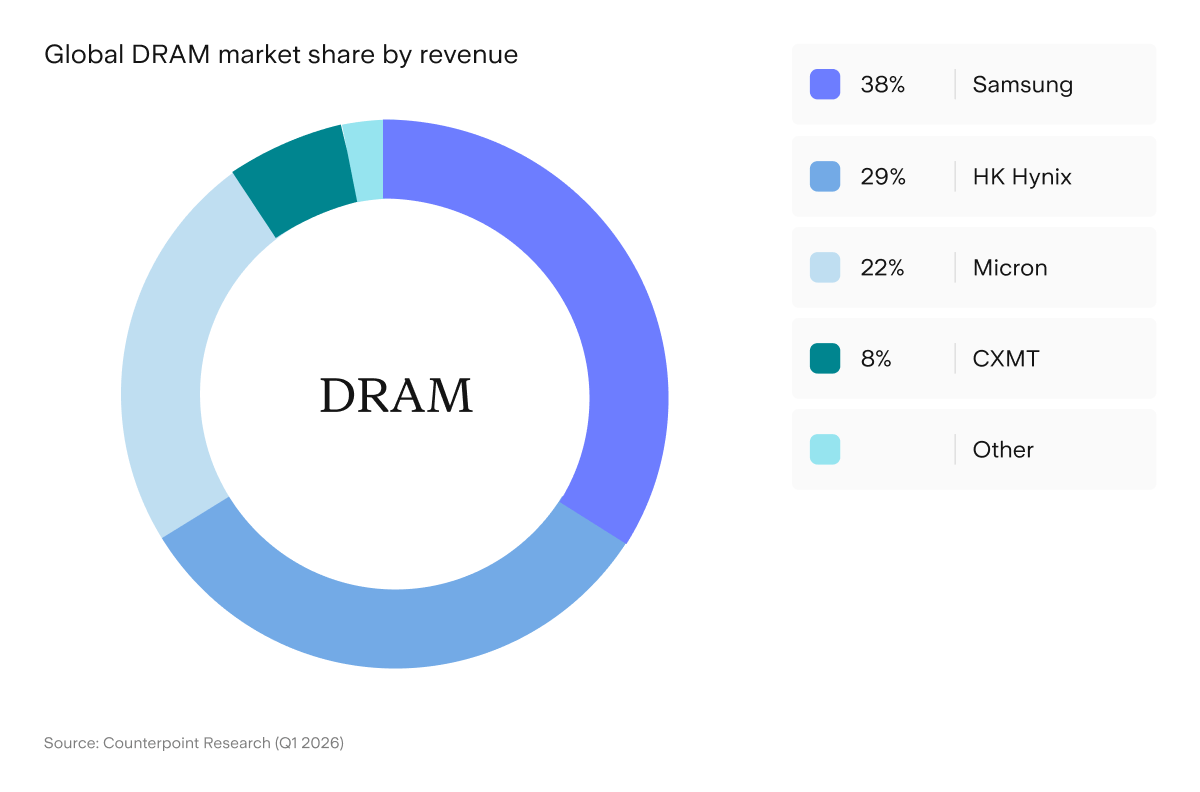
Across the broader DRAM market, its revenue share has fallen from 36% in the first quarter of 2025 to 29% a year later. Samsung moved in the opposite direction, lifting its share from 34% to 38% and reclaiming the top spot.
Samsung is also gaining ground in HBM, while Micron is fighting to hold its place as the third major supplier. Nvidia and other chip designers have good reason to support multiple manufacturers rather than depend on one.
The bigger risk is that memory shortages tend to sow the seeds of the next glut. High prices encourage SK Hynix and its rivals to build more capacity, but fabs take years to complete. If that new supply arrives after demand has slowed, the market can quickly swing back into oversupply, pushing down chip prices, margins and profits.
SK Hynix’s HBM technology gives it some protection, but it does not make the company immune to the memory cycle.
Buy or sell?
The bull case is easy to see. SK Hynix leads the most profitable part of the memory market, has a deep relationship with Nvidia and now gives international investors a much simpler way to buy in via Wall St.
Its entire 2026 output of DRAM, HBM and NAND was already sold by late 2025, giving it unusual pricing power and solid visibility over near-term revenue.
But investors are arriving after a rise of more than 600%, record profits and one of the most sought-after listings in history. Plenty of good news has already made its way into the price.
The company may still look cheap against current earnings, but cyclical stocks often look cheapest when profits are near their peak. A slowdown in AI spending, stronger competition or a fresh wave of memory supply could change the numbers quickly.
For investors who wanted SK Hynix exposure but could not easily buy Korean shares, $SKHY solves the access problem. Whether it solves the timing problem is another matter.
This not financial advice nor a recommendation to invest in the securities listed. The information presented is intended to be of a factual nature only. Past performance and forecasts are not a reliable indicator of future performance. The value of your investments can go down as well as up and you may receive back less than your original investment. The author of this article and other employees of Stakeshop Pty Ltd may hold positions or have financial interests in the company (or companies) discussed above. Stakeshop Pty Ltd does not accept any liability for any decisions you may make if you consider and/or use any of the information contained in this article. As always, do your own research and consider seeking financial, legal and taxation advice before investing. This email is subject to our Disclaimers, Terms and Conditions and Privacy Policy. If you are not the intended recipient of this communication, you are not authorised to read, disclose, reproduce, disseminate or otherwise use this information. While we have taken precautions to ensure that no viruses are present in this email, you should rely on your own virus checking systems and processes. You can contact us at support@hellostake.com.

Senior Markets Commentator
Kylie Purcell is an investments analyst and finance journalist with over a decade of experience covering global markets, investment products and digital assets. Her commentary has been featured in publications including the Australian Financial Review, Yahoo Finance and The Motley Fool. She has a Masters Degree in International Journalism from Cardiff University and a Certificate of Securities and Managed Investments (RG146).
Subscribe
By subscribing, you agree to our Privacy Policy.
.jpg&w=3840&q=95)
_(1).png&w=3840&q=95)