
Under the Spotlight: Roundhill Memory ETF ($DRAM)
_(1).png&w=3840&q=95)
Suddenly the world can't get enough memory. Now there's an ETF for that, and it's collected over US$6B since April. We put $DRAM under the spotlight.
ICYMI: Do your own research and make your own decisions. This article drills down on a specific company, however, it is not a recommendation to invest in the company and should not be taken as financial advice. Got a stock you want covered? Tell us here.
If you’re a regular reader of our Wrap emails, you’ll know memory stocks have been clocking some serious gains over the last six months.
For years, memory chips were the quiet achievers inside laptops, smartphones and servers. Then AI came along, demanded enormous amounts of fast memory, and turned a once-overlooked corner of the chip market into one of the hottest trades in tech.
There’s now an ETF for that. The Roundhill Memory ETF ($DRAM) has had one of the more remarkable debuts in recent ETF history. Since listing on 2 April 2026, it’s pulled in more than US$6B and become one of the most traded securities on Stake.
It means investors bullish on the theme can now trade a pure-play memory ETF, without getting dragged down by tired mega-caps, like Nvidia ($NVDA). That might sound like a stretch, but consider this: DRAM has gained 90% since its launch only last month. The broader Global X AI and tech ETF ($AIQ), has returned just 21% so far this year.
Let’s put $DRAM under the spotlight.
Memory block
It’s hard to believe that only a couple of years ago, analysts were talking about a memory glut. Now the industry is dealing with critical shortages, expected to last until late 2027.
The most recent earnings season showed just how sharply demand is outstripping supply.
Memory chipmaker Micron ($MU) delivered 196% revenue growth in Q1 2026. SanDisk ($SNDK) reported revenue up 251% from a year earlier, while South Korea’s Samsung and SK Hynix also saw record-breaking results, with the latter on track to join the US$1T+ market cap club.
.png)
The reversal comes down to the needs of AI. Graphics processors (GPUs) do the heavy lifting in training and running large models. But AI also needs somewhere to hold and move all that data at speed. Dynamic random access memory (DRAM), high-bandwidth memory (HBM) and NAND flash are the memory chips that do just that. All three are in short supply.Some in the industry, such as SK Group chairman Chey Tae-won, predict the supply bottleneck could last until 2030.
The shortage has been compounded by the Middle East conflict, which has disrupted raw materials like copper and resin. Research firm Gartner expects combined DRAM and solid-state drive (SSD) prices to rise 130% by the end of 2026.
What's inside $DRAM
Memory is made by very few companies, as reflected by $DRAM's shortlist of 14 holdings.
Together, the top three names – SK Hynix (28.15%), Micron Technology (27.16%), and Samsung Electronics (19.67%) – make up close to three-quarters of the fund, followed by Kioxia Holdings 5.91%, Sandisk (5.08%) and Seagate Technology (4.53%).
SK Hynix, Micron and Samsung dominate standard DRAM and are all major players in HBM, the faster memory chip purpose-built to sit inside AI accelerators. SK Hynix alone commands a 57% global market share of HBM and 32% share of DRAM.
Kioxia, Sandisk and Western Digital ($WDC) have stronger exposure to NAND flash, the storage technology used in solid-state drives, phones and data centres.
The fine print
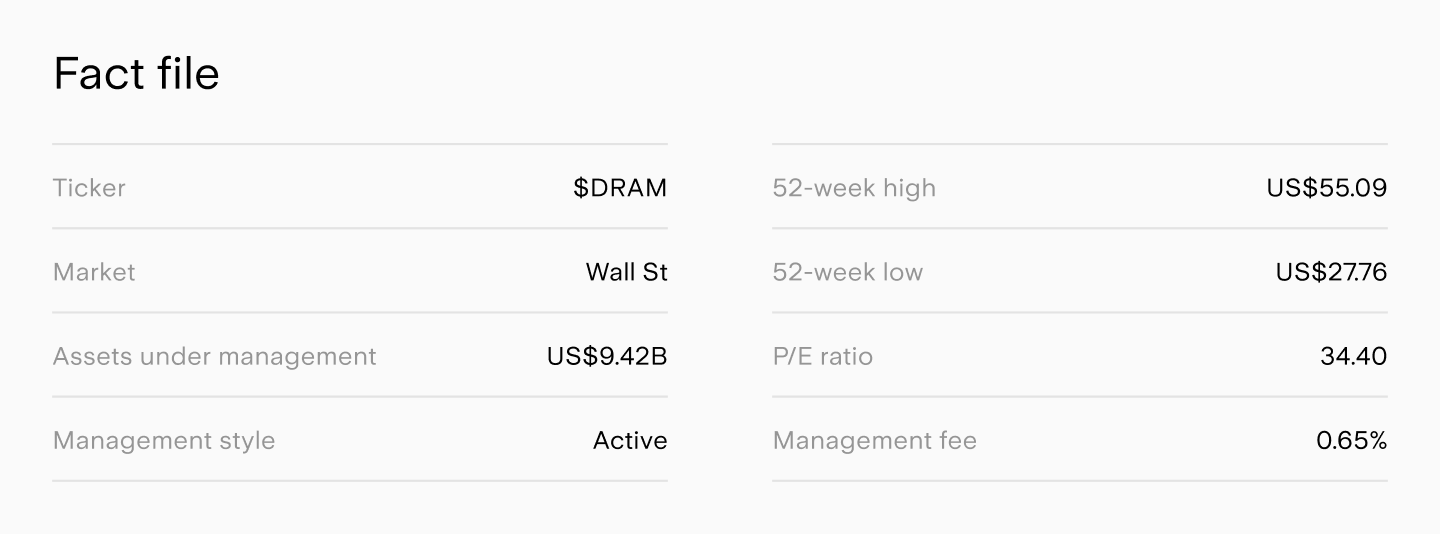
DRAM is actively managed and charges a 0.65% annual management fee. That’s higher than many broad semiconductor ETFs, but also fairly typical of a specialised product with a small basket of global companies.
The fund doesn’t track any traditional index. The fund managers at Roundhill selects and sizes the holdings and can use total-return swaps to manage exposure. That gives the fund flexibility, but it also means investors are relying on the manager's decisions rather than a passive index.
Per the fund manager’s strategy, companies must make at least 50% of revenue from memory products to be included, and at least 80% of the portfolio must be equities or instruments like swaps or forward contracts.
One consideration is DRAM’s short history. Roundhill is not exactly a new name, the firm says it has launched more than 100 ETFs since 2018 and was behind $MAGS, the first Magnificent Seven ETF. But thematic ETFs live and die by their timing, and with just weeks of trading history, investors are backing a theme and a manager, rather than a proven track record for this specific fund.
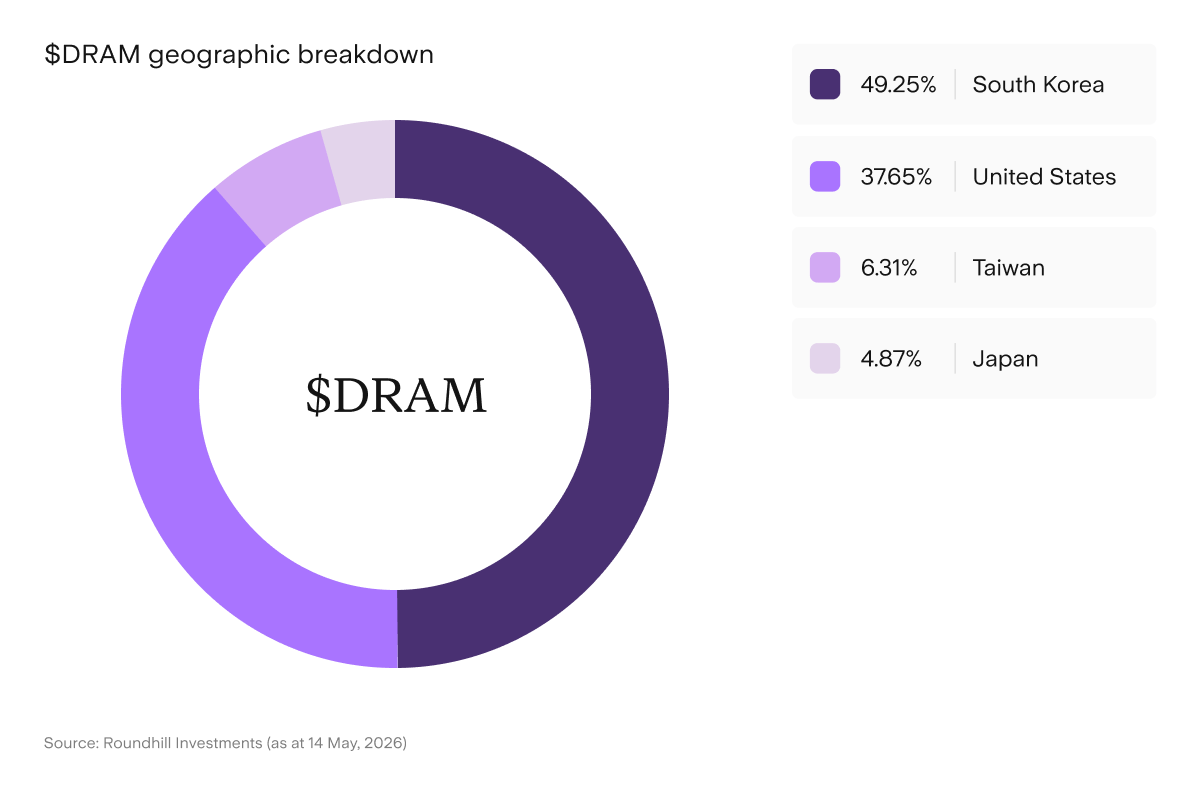
The other risk is concentration. DRAM is heavily exposed to a small group of companies, one sector and a handful of geographies. Memory has always been a cyclical industry, even if AI has made the current cycle look unusually glamorous.
Is it a buy?
DRAM is one of the cleanest ways to invest in the memory theme. It offers exposure to companies sitting at the centre of the AI infrastructure boom, including stocks that are not always easy to access individually.
But it’s a high-conviction thematic ETF, rather than a core portfolio holding. The same concentration that has powered its early returns can cut the other way. After a near-doubling in a matter of weeks, a lot of good news may already be priced in.
For investors who believe memory will continue to be AI’s bottleneck, $DRAM gives you a neat way to play the theme. For everyone else, it is worth remembering that when a trade gets this hot this quickly, the drama is rarely over.
This is not financial advice nor a recommendation to invest in the securities listed. The information presented is intended to be of a factual nature only. Past performance is not a reliable indicator of future performance. The author of this article and other employees of Stakeshop Pty Ltd may hold positions or have financial interests in the company (or companies) discussed above. As always, do your own research and consider seeking financial, legal and taxation advice before investing.

Senior Markets Commentator
Kylie Purcell is an investments analyst and finance journalist with over a decade of experience covering global markets, investment products and digital assets. Her commentary has been featured in publications including the Australian Financial Review, Yahoo Finance and The Motley Fool. She has a Masters Degree in International Journalism from Cardiff University and a Certificate of Securities and Managed Investments (RG146).
Subscribe
By subscribing, you agree to our Privacy Policy.
.jpg&w=3840&q=95)

.png&w=3840&q=95)