
Top 10 healthcare ETFs to watch in 2026

You know these companies by the pill bottle and the hospital wristband. Most track a U.S. healthcare index, while one covers global markets and another is actively managed.
Healthcare ETFs hold shares in companies that develop drugs, build medical devices, run insurance networks or operate hospital systems – the businesses behind modern medicine. The ten funds here range from broad U.S. healthcare index trackers to subsector plays in biotech and pharma, with the ARK Genomic Revolution ETF ($ARKG) the only actively managed option among them.
How we built this list: We selected these funds based on their industry or investment category and ordered them by assets under management. Prices are updated daily, and the list and supporting content are reviewed roughly every quarter. All data is sourced from Stake. This list isn't a recommendation and isn't ordered by suitability.
ETF Name | Ticker | Share Price | AUM | Expense Ratio | In Watchlists |
|---|---|---|---|---|---|
State Street Health Care Select Sector SPDR ETF | $171.98 | $44.31B | 0.08% | 1443 | |
Vanguard Health Care ETF | $320.67 | $19.09B | 0.09% | 1345 | |
State Street SPDR S&P Biotech ETF | $151.40 | $10.30B | 0.35% | 1118 | |
iShares Biotechnology ETF | $204.30 | $10.82B | 0.44% | 915 | |
iShares Global Healthcare ETF | $103.73 | $4.36B | 0.38% | 389 | |
iShares US Healthcare ETF | $72.54 | $4.18B | 0.37% | 165 | |
Fidelity MSCI Health Care Index ETF | $82.89 | $3.66B | 0.08% | 125 | |
ARK Genomic Revolution ETF | $49.43 | $2.13B | 0.75% | 7861 | |
VanEck Pharmaceutical ETF | $110.73 | $1.04B | 0.35% | 171 | |
Invesco S&P 500 Eql Wght Health Care ETF | $37.90 | $889.9M | 0.40% | 72 |
Past performance is not a reliable indicator of future performance.
Source: Stake market data. Figures in US$. Data updated as of 12 October 2026.
✅ Learn more: Top 8 ARK ETFs to watch in 2026→
Sign up in minutes and get access to a CHESS-sponsored platform, where you can explore Healthcare ETFs and more.
1. State Street Health Care Select Sector SPDR ETF ($XLV)
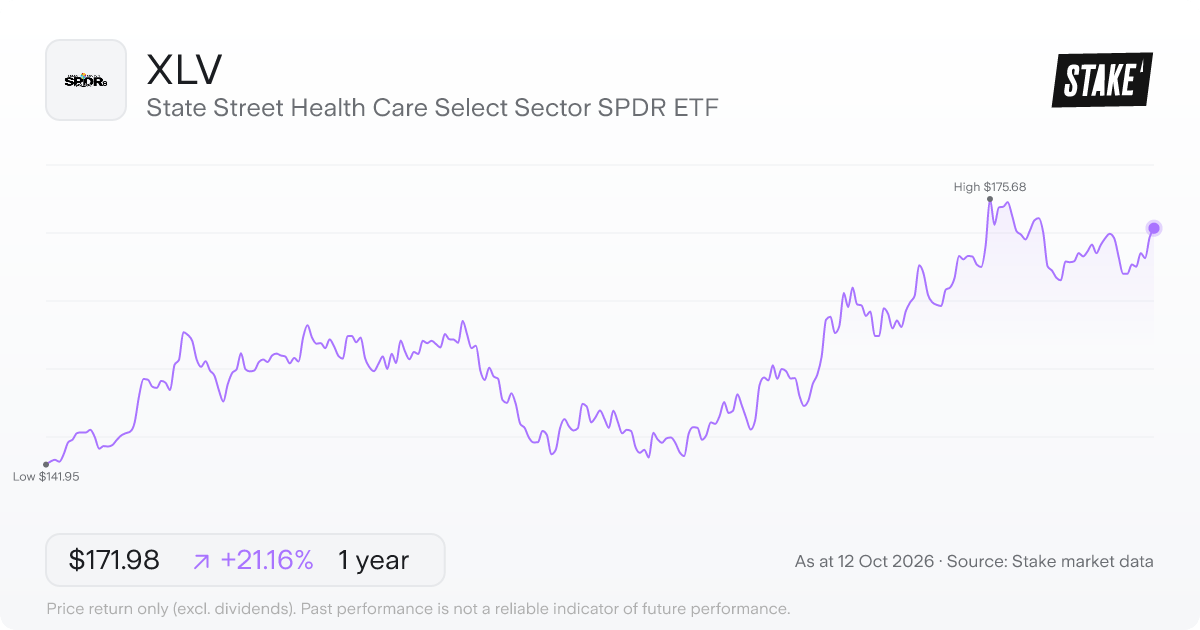
State Street Health Care Select Sector SPDR ETF (XLV) share price over the last year: started at US$144.12, ended at US$167.09, a change of +15.9%. Range over the period: high US$175.68, low US$141.95. Source: Stake market data. Past performance is not a reliable indicator of future performance.
Price: US$171.98 · Daily: 0.7% · AUM: US$44.31B · MER: 0.08%
State Street Health Care Select Sector SPDR ETF ($XLV) is designed to match the price and yield performance of the Health Care Select Sector Index. The index covers the companies that make up healthcare as a market segment – businesses developing pharmaceuticals, building medical devices, running health insurance networks and operating hospital systems. At least 95% of the fund's assets are held in the securities that make up that index under normal market conditions.
Because $XLV follows an index rather than an active strategy, its holdings shift only when the index itself changes. Portfolio construction is driven by the index's rules, not a manager's decisions about individual companies.
2. Vanguard Health Care Index Fund ($VHT)
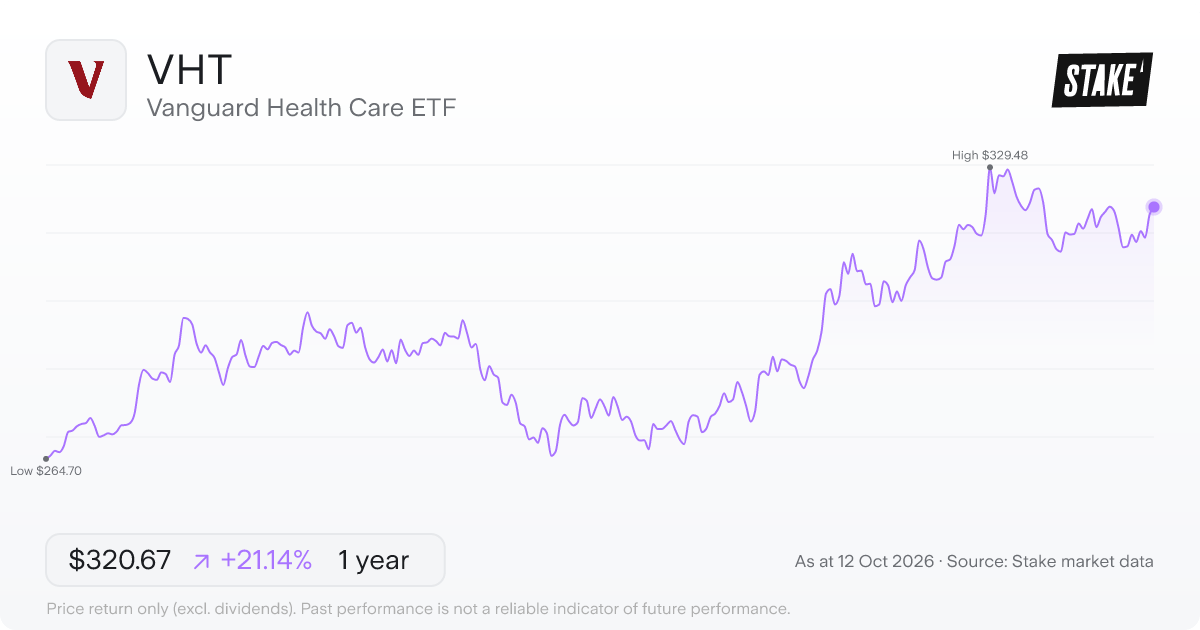
Vanguard Health Care ETF (VHT) share price over the last year: started at US$268.47, ended at US$312.88, a change of +16.5%. Range over the period: high US$329.48, low US$264.70. Source: Stake market data. Past performance is not a reliable indicator of future performance.
Price: US$320.67 · Daily: 0.5% · AUM: US$19.09B · MER: 0.09%
Vanguard Health Care Index Fund ($VHT) is built around the MSCI U.S. Investable Market Health Care Index, which covers U.S. healthcare companies across the size spectrum – large, mid and small. That breadth means $VHT holds more than just the household names in pharmaceuticals or insurance; it reaches into smaller companies that make up the lower rungs of the sector.
The fund is passively managed, so it aims to replicate the index rather than pick winners within it. That approach keeps it tied to the overall fortunes of U.S. healthcare, with no active tilt toward any particular subsector. Because the index covers the full market-cap range, returns can be shaped by movements in small-cap names as much as by the large players.
3. State Street SPDR S&P Biotech ETF ($XBI)
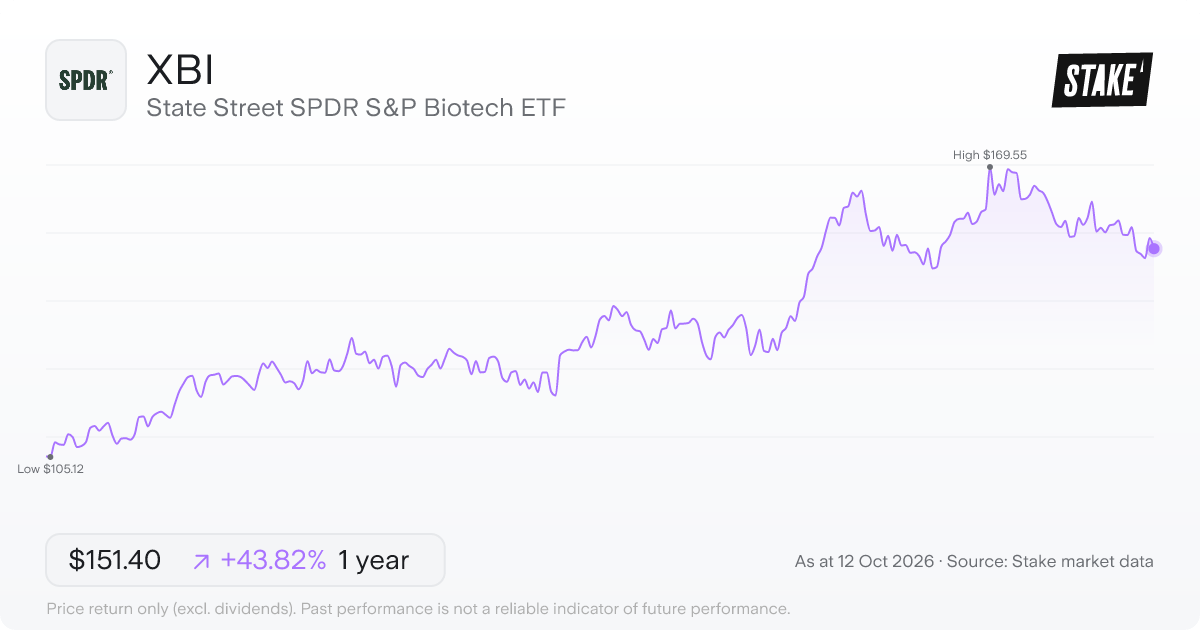
State Street SPDR S&P Biotech ETF (XBI) share price over the last year: started at US$103.64, ended at US$150.90, a change of +45.6%. Range over the period: high US$169.55, low US$103.64. Source: Stake market data. Past performance is not a reliable indicator of future performance.
Price: US$151.40 · Daily: -1.5% · AUM: US$10.30B · MER: 0.35%
The State Street SPDR S&P Biotech ETF ($XBI) is designed to track the S&P Biotechnology Select Industry Index, which draws from the biotechnology segment of a broad U.S. total market composite index. The fund uses a passive strategy, meaning it aims to mirror the index's total return rather than actively pick stocks within the sector.
Biotech companies are typically in the business of developing drugs, therapies and diagnostics – often years before those products reach patients or generate meaningful revenue. That makes $XBI a concentrated look at one of the more volatile corners of healthcare, where the pipeline of a single company can shift the index in meaningful ways.
4. iShares Biotechnology ETF ($IBB)
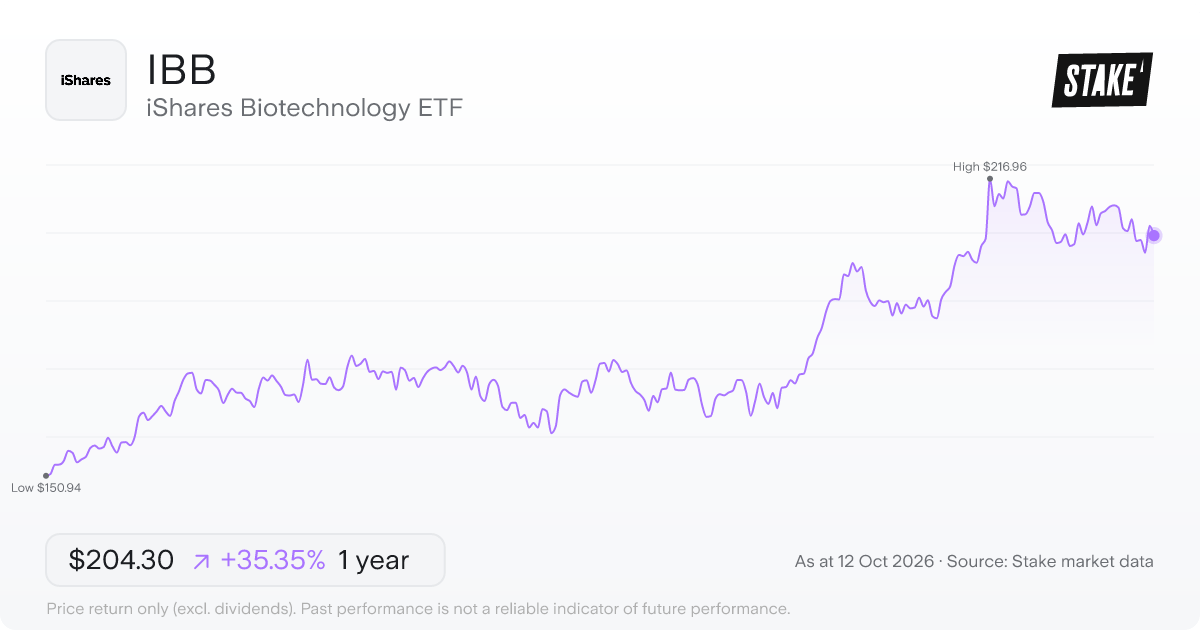
iShares Biotechnology ETF (IBB) share price over the last year: started at US$150.52, ended at US$203.10, a change of +34.9%. Range over the period: high US$216.96, low US$149.95. Source: Stake market data. Past performance is not a reliable indicator of future performance.
Price: US$204.30 · Daily: -1.1% · AUM: US$10.82B · MER: 0.44%
iShares Biotechnology ETF ($IBB) is designed to track the ICE Biotechnology Index, which covers U.S.-listed companies classified within the biotechnology industry group. That means the portfolio concentrates on drug discovery, gene therapy and similar biotech businesses rather than broader healthcare.
The fund aims to hold at least 90% of its assets in index securities, keeping it tightly aligned to the benchmark. Biotech is known for sharp swings – clinical trial results and regulatory decisions can move individual stocks significantly, and that volatility flows through to the fund.
5. iShares Global Healthcare ETF ($IXJ)
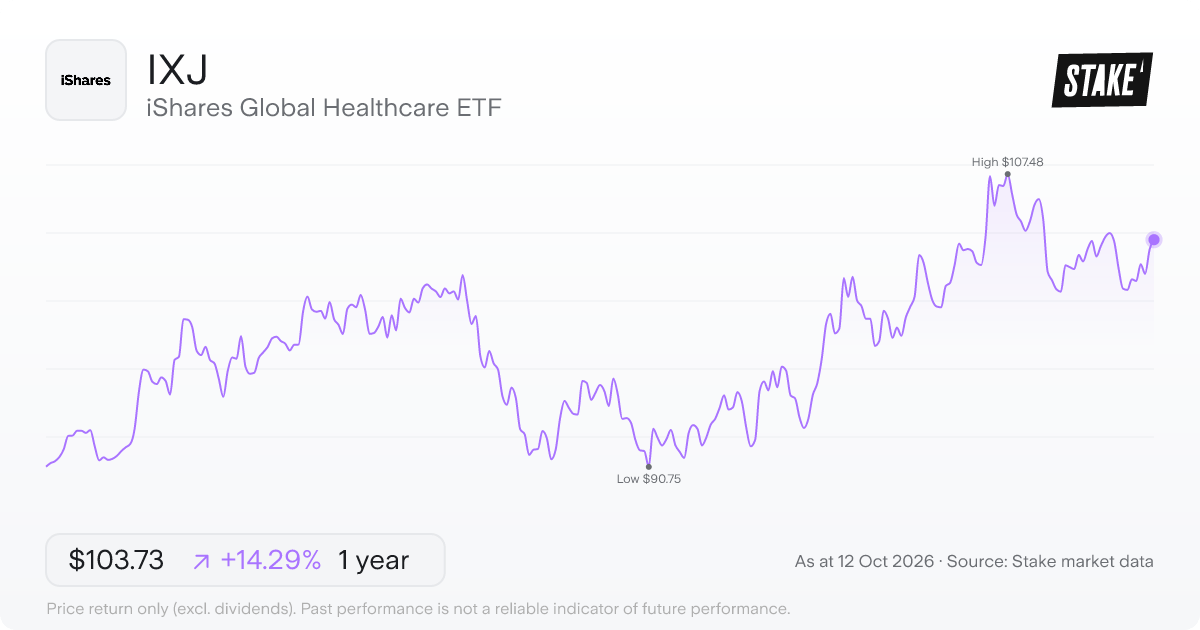
iShares Global Healthcare ETF (IXJ) share price over the last year: started at US$92.38, ended at US$101.37, a change of +9.7%. Range over the period: high US$107.48, low US$90.75. Source: Stake market data. Past performance is not a reliable indicator of future performance.
Price: US$103.73 · Daily: 0.5% · AUM: US$4.36B · MER: 0.38%
The S&P Global Healthcare Sector Index is carved from the S&P Global 1200 – one of the broader global equity benchmarks – and iShares Global Healthcare ETF ($IXJ) is designed to track it. S&P selects constituents based on their role in the healthcare economy and their importance to global markets. That mandate gives $IXJ a wide geographic scope within the sector, covering healthcare companies across the major markets that the S&P Global 1200 represents.
Join 1M+ on Stake
Effortless investing in U.S. shares & ETFs
6. iShares US Healthcare ETF ($IYH)
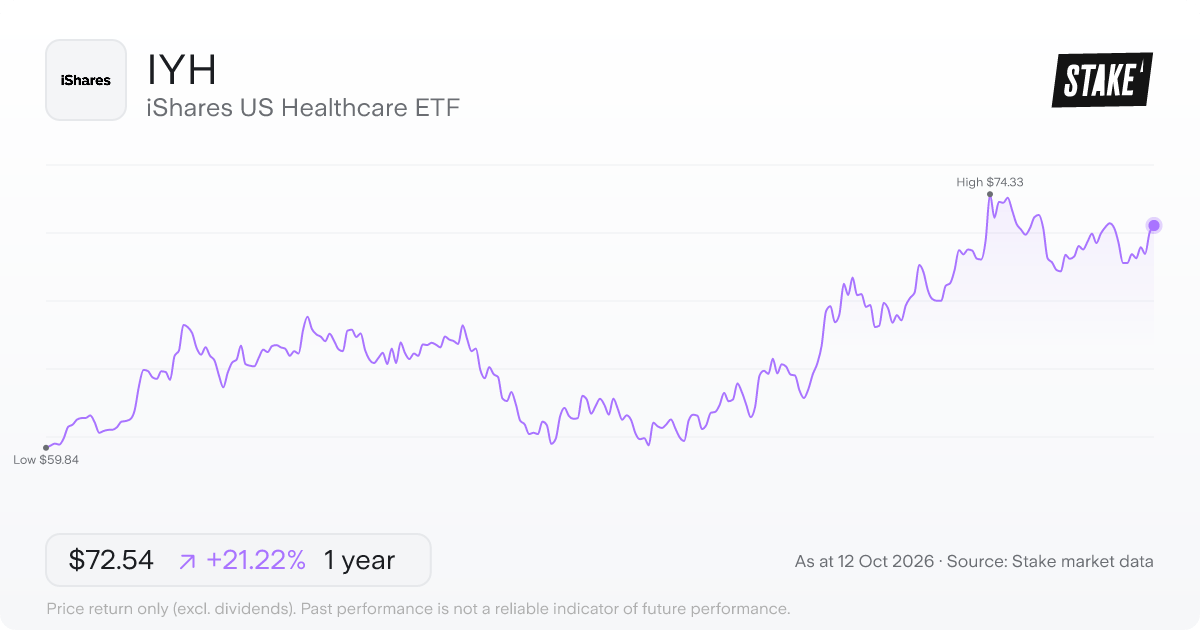
iShares US Healthcare ETF (IYH) share price over the last year: started at US$60.87, ended at US$70.67, a change of +16.1%. Range over the period: high US$74.33, low US$59.84. Source: Stake market data. Past performance is not a reliable indicator of future performance.
Price: US$72.54 · Daily: 0.6% · AUM: US$4.18B · MER: 0.37%
iShares US Healthcare ETF ($IYH) aims to track the Russell 1000 Health Care RIC 22.5/45 Capped Index, which measures the healthcare sector of the U.S. equity market. The fund is designed to hold the component securities of that index directly, covering companies across the full scope of U.S. healthcare – from drug developers and device makers to insurers and hospital operators.
The capped structure in the index name matters: individual holdings are subject to concentration limits, so no single company can dominate the portfolio. The fund's MER is 0.37%.
7. Fidelity MSCI Health Care Index ETF ($FHLC)
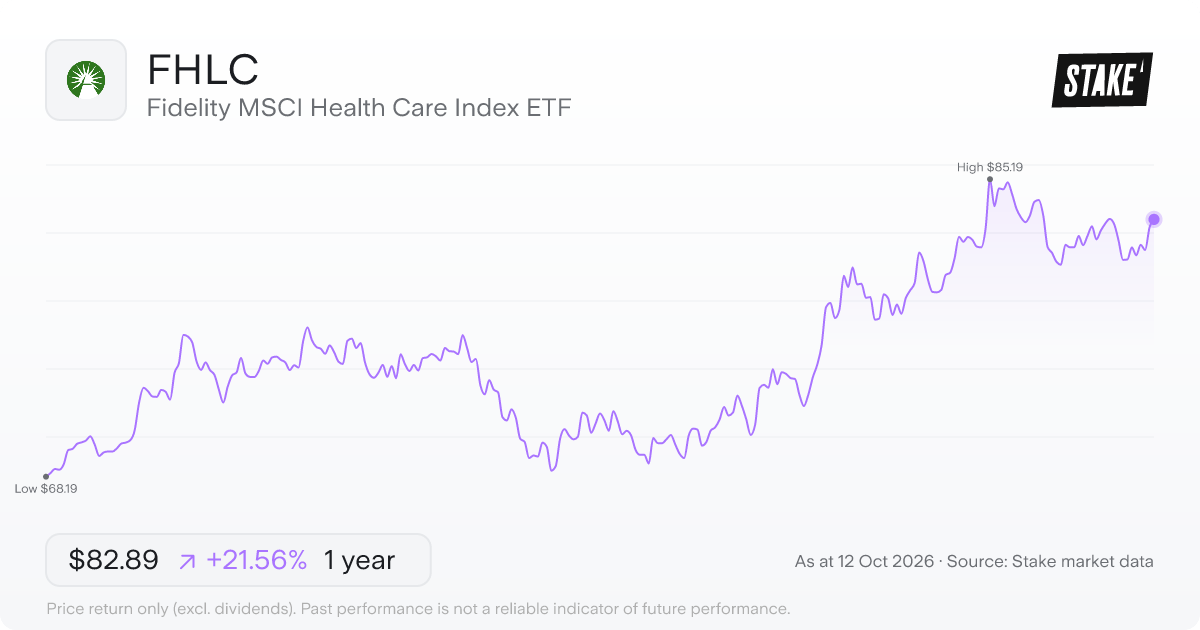
Fidelity MSCI Health Care Index ETF (FHLC) share price over the last year: started at US$69.11, ended at US$80.84, a change of +17.0%. Range over the period: high US$85.19, low US$68.19. Source: Stake market data. Past performance is not a reliable indicator of future performance.
Price: US$82.89 · Daily: 0.5% · AUM: US$3.66B · MER: 0.08%
Fidelity MSCI Health Care Index ETF ($FHLC) aims to match the performance of the MSCI USA IMI Health Care Index, a benchmark covering the health care sector across the U.S. equity market. The fund is designed to invest at least 80% of its assets in securities from that index. Its MER is 0.08%.
The index covers a broad cross-section of U.S. health care – from pharmaceutical developers and medical device makers to insurance networks and hospital operators. That breadth means the fund's performance is tied to the sector as a whole rather than any single subsector.
8. ARK Genomic Revolution ETF ($ARKG)
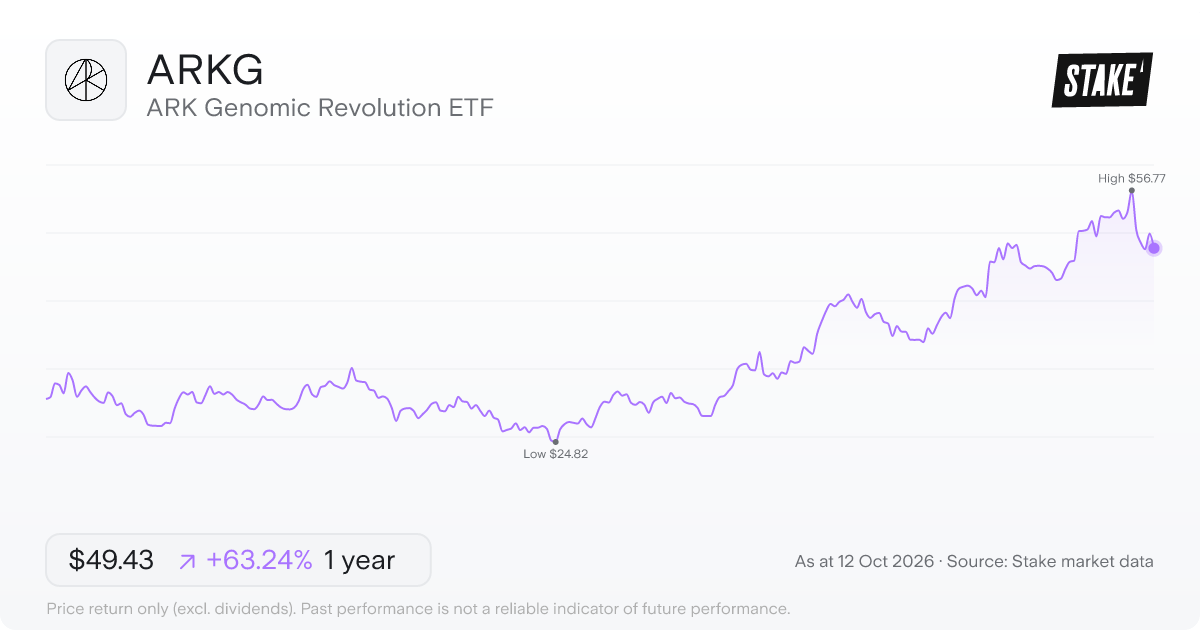
ARK Genomic Revolution ETF (ARKG) share price over the last year: started at US$30.38, ended at US$51.75, a change of +70.3%. Range over the period: high US$56.77, low US$24.82. Source: Stake market data. Past performance is not a reliable indicator of future performance.
Price: US$49.43 · Daily: -3.6% · AUM: US$2.13B · MER: 0.75%
ARK Genomic Revolution ETF ($ARKG) is actively managed, with a portfolio team selecting stocks rather than following an index. The fund's mandate covers companies the managers identify as driving advances in genomics and life sciences. Qualifying businesses can come from sectors including healthcare, information technology, materials, energy and consumer discretionary – so the portfolio isn't limited to pharmaceutical or medical device names alone.
9. VanEck Pharmaceutical ETF ($PPH)
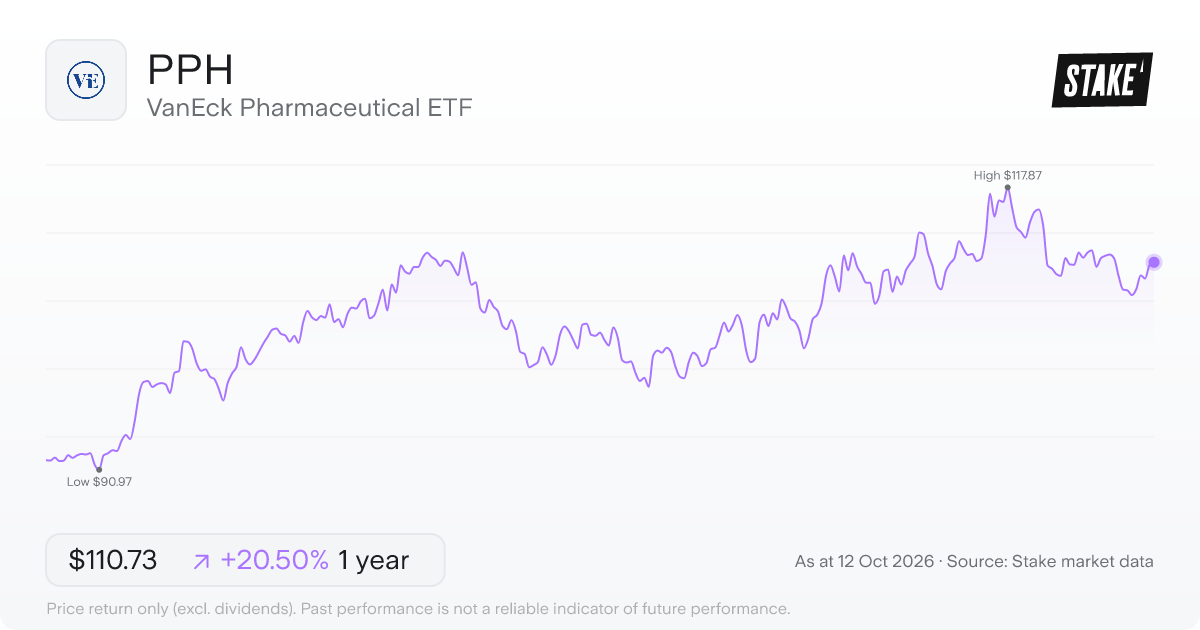
VanEck Pharmaceutical ETF (PPH) share price over the last year: started at US$93.72, ended at US$108.17, a change of +15.4%. Range over the period: high US$117.87, low US$90.97. Source: Stake market data. Past performance is not a reliable indicator of future performance.
Price: US$110.73 · Daily: 0.2% · AUM: US$1.04B · MER: 0.35%
The MVIS US Listed Pharmaceutical 25 Index holds common stocks of pharmaceutical companies listed in the U.S. VanEck Pharmaceutical ETF ($PPH) is designed to track that benchmark's price and yield performance as closely as possible before fees and expenses.
The fund aims to keep at least 80% of its assets in index securities. Pharmaceutical companies develop, manufacture and sell prescription drugs – so $PPH's exposure stays focused on that corner of healthcare. The index holds 25 stocks. That makes for a concentrated portfolio, with performance tied closely to a small group of companies rather than spread across a broader set of names.
10. Invesco S&P 500 Eql Wght Health Care ETF ($RSPH)
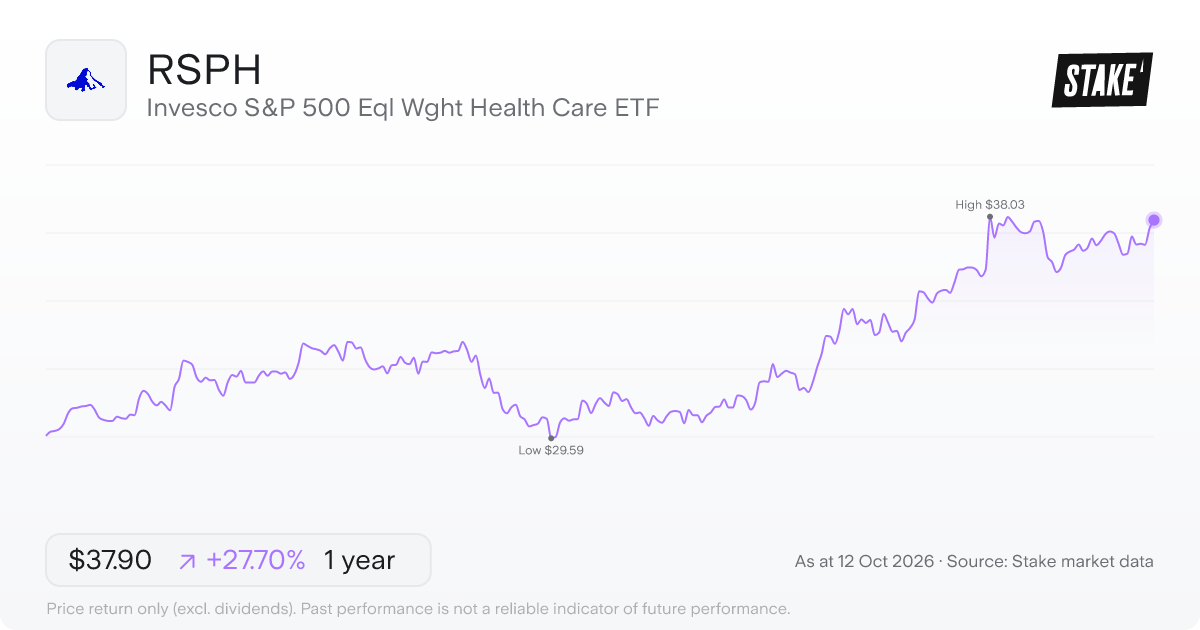
Invesco S&P 500 Eql Wght Health Care ETF (RSPH) share price over the last year: started at US$30.24, ended at US$36.97, a change of +22.3%. Range over the period: high US$38.03, low US$29.57. Source: Stake market data. Past performance is not a reliable indicator of future performance.
Price: US$37.90 · Daily: 0.8% · AUM: US$889.9M · MER: 0.40%
The Invesco S&P 500 Equal Weight Health Care ETF ($RSPH) aims to track the S&P 500 Equal Weight Health Care Index. The index covers healthcare companies within the S&P 500 and assigns each one a roughly equal portfolio share. Unlike a market-cap weighted fund, where the largest names tend to drive the overall return, equal weighting distributes influence more evenly. Smaller companies carry as much weight as the sector's biggest players.
Under normal circumstances, $RSPH is designed to invest at least 90% of its total assets in the index's securities, held in proportion to their index weightings. The index covers the full range of healthcare companies classified within the S&P 500.
Common questions
How do I invest in healthcare ETFs in Australia?
Every fund in this list trades on U.S. exchanges, so you'll need a share trading platform with access to U.S. markets. Once your account is set up, you search by ticker – $XLV, $VHT and the others – and buy shares the same way you would any U.S.-listed stock. Transactions settle in USD, so the AUD/USD exchange rate affects what you pay to buy in and what you receive when you sell.
What are the key risks of healthcare ETFs?
Currency exposure is a constant factor for Australian investors – all ten funds in this list are priced and settled in USD, so a rising Australian dollar reduces returns measured in AUD. Regulatory risk runs through the sector too: drug pricing legislation, government healthcare budgets, and approval decisions by bodies like the U.S. Food and Drug Administration can move individual holdings sharply. Biotech-focused funds carry an extra layer from clinical trial outcomes, where a single result can send a stock dramatically in either direction. Broader funds spread that exposure across the sector but remain sensitive to policy shifts that affect healthcare spending as a whole.
How do broad healthcare ETFs differ from biotech or pharma-focused ones?
Broad healthcare ETFs aim to reflect the full sector, holding companies across pharmaceuticals, medical devices, insurers and hospital services. Sub-sector funds concentrate on one corner of that space – biotechnology or pharmaceutical stocks, for instance – so their performance tends to hinge more on specific events like drug approvals, clinical trial results or patent timelines. This list also includes a fund that tracks a global healthcare index rather than a U.S.-only benchmark, and one that is actively managed, selecting holdings based on genomics and related technologies rather than following a passive index.
Disclaimer
Past performance is not a reliable indicator of future performance. When you invest, your capital is at risk. You should consider your own investment objectives, financial situation, and particular needs before making an investment decision. The value of your investments can go down as well as up and you may receive back less than your original investment. As always, do your own research and consider seeking appropriate financial advice before investing.
This is not personal financial advice nor a recommendation to invest in the securities listed. Any advice provided by Stake is of general nature only and does not take into account your specific circumstances. Trading and volume data from the Stake investing platform is for reference purposes only, the investment choices of others may not be appropriate for your needs and is not a reliable indicator of performance.
Please refer to hellostake.com/pricing for the fees that apply. When you trade securities priced in another currency, currency conversion fees may apply and movements in the exchange rate may affect your returns.

Stake Desk
The freshest market insights
This article combines AI and human review from our analysts to bring you accurate, informative investing content at speed. For questions or suggestions, contact stakedesk@stake.com.au.
Subscribe
By subscribing, you agree to our Privacy Policy.