
Anthropic pulled off the largest IPO in history. Now comes the hard part.
Anthropic ($ANT) gave us all a lesson in resilience this week.
An Nvidia ($NVDA) scandal, six straight losing sessions for the S&P 500 and Fed rate-hike talk couldn’t stop the frontier AI lab from the biggest IPO in history.
$ANT popped 17% on its Nasdaq debut, raising US$81.3B and ending the day with a US$1.8T valuation. How exactly does a five-year-old company become the AI trade’s main character?
Seems like it was part of Claude’s plan. The rise of Claude AI models and products helped Anthropic lock in US$33.24B in revenue for the nine months ended 30 September – a 1,200% rise from the same period last year.
So, Anthropic has surpassed rival OpenAI in revenue and valuation. And outdone SpaceX’s ($SPCX) blockbuster listing. But can it keep growing at a pace that justifies the price tag? Let’s put it Under the Spotlight.
Enter-prize
Anthropic took a different approach to competitors like OpenAI and Alphabet ($GOOGL). Instead of targeting consumers, it built product roadmaps centered around enterprises. That explains much of why its 74% of H1 2026 revenue came from customers paying over US$100,000 per year.
Around 79% of revenue is usage-based, meaning companies pay for the AI they use through the API. The average customer also spends around US$2.2M a year, which equates to US$26.1B across 11,900 customers.
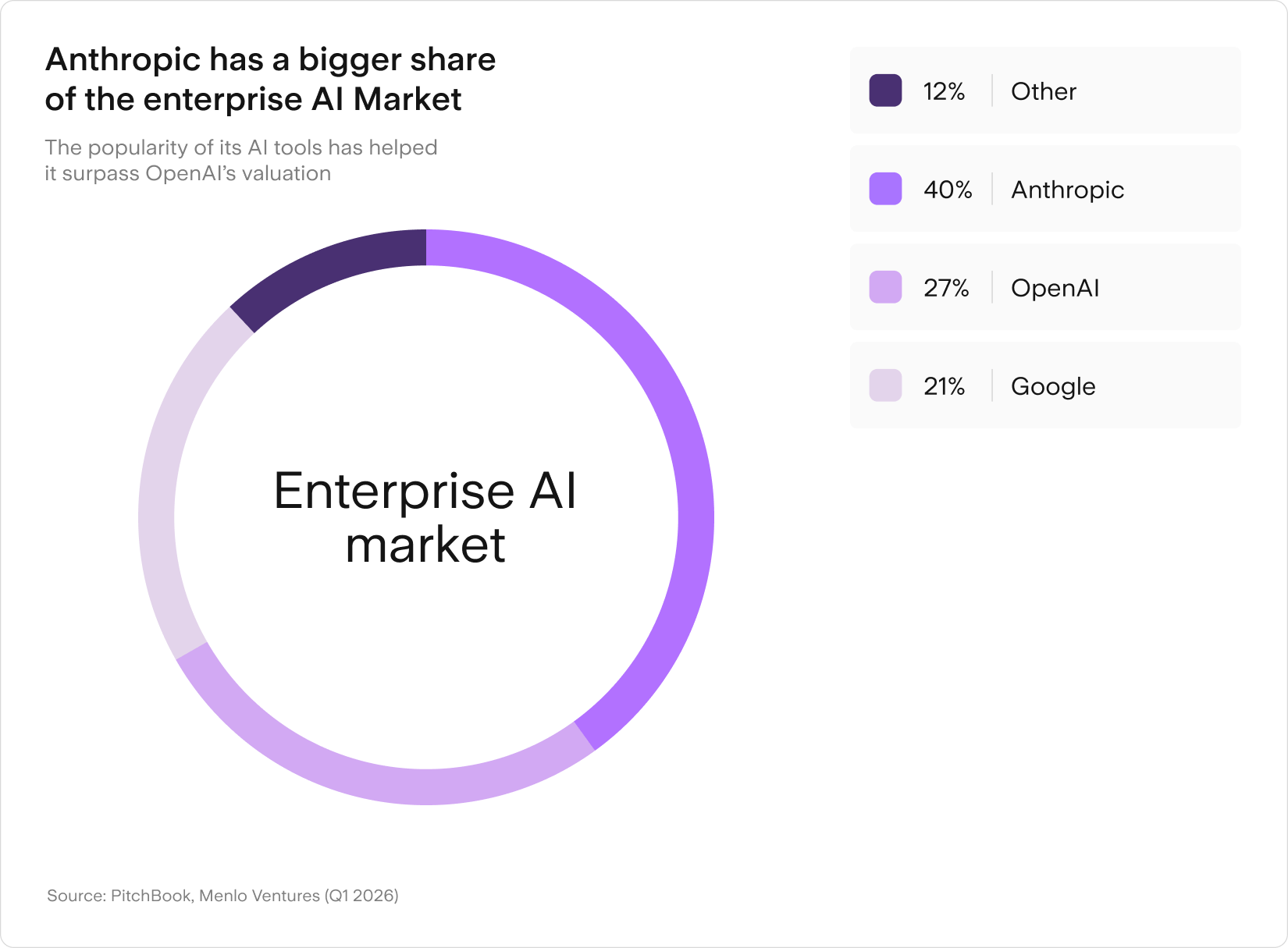
And Anthropic has reason to believe customers will be back for more, based on the 900% net revenue retention rate (NRR). Its share of the enterprise AI market has grown from 11% in 2023 to 40% today.
For investors, NRR remaining within above the 100% range and a growing high-value customer count will be the most important metrics to watch.
Fortune 5 hundred problems
Anthropic’s top five customers made up 36% of revenue in Q1 2026. By Q3, that concentration had dropped to 21%. But the risk of revenue tied to its anchor clients hasn’t disappeared: two customers represented a fifth of H1 2026 revenue.
Although Anthropic doesn’t name them in its S-1 filing, industry watchers have identified them as Microsoft ($MSFT) and SpaceX. The revenue it makes from the two are largely tied to Claude’s API, meaning Anthropic gets paid as SpaceX’s Cursor devs and Microsoft’s Copilot devs route a task through Claude.
Sounds great in theory, but devs are free to switch models when they like. So newer iterations of Claude will need to keep the edge over competitor models.
Then there are compute commitments, the variable revenue element that may never be realised. The biggest counterparties: Broadcom ($AVGO) at US$161B, SpaceX at US$120B, Alphabet at US$115B and Amazon ($AMZN) at US$110B.
Cache flow
In computing, a cache is a temporary storage layer that holds frequently used data for quicker access. Anthropic’s got the balance-sheet equivalent of that in cash reserves.
In its S-1 filing, Anthropic disclosed US$131.7B in cash, cash equivalents and short-term reserves. After its IPO, that stash is projected to exceed US$230B. This means Anthropic has more cash than Amazon and Nvidia combined. And it ranks third among non-bank U.S. companies, trailing only Berkshire Hathaway’s ($BRK.B).
Given that it plans to spend at least US$600B on compute in the next five to 10 years, that kind of runway is an important line item for Anthropic. And for prospective investors looking at the viability of the company meeting its long term objectives.
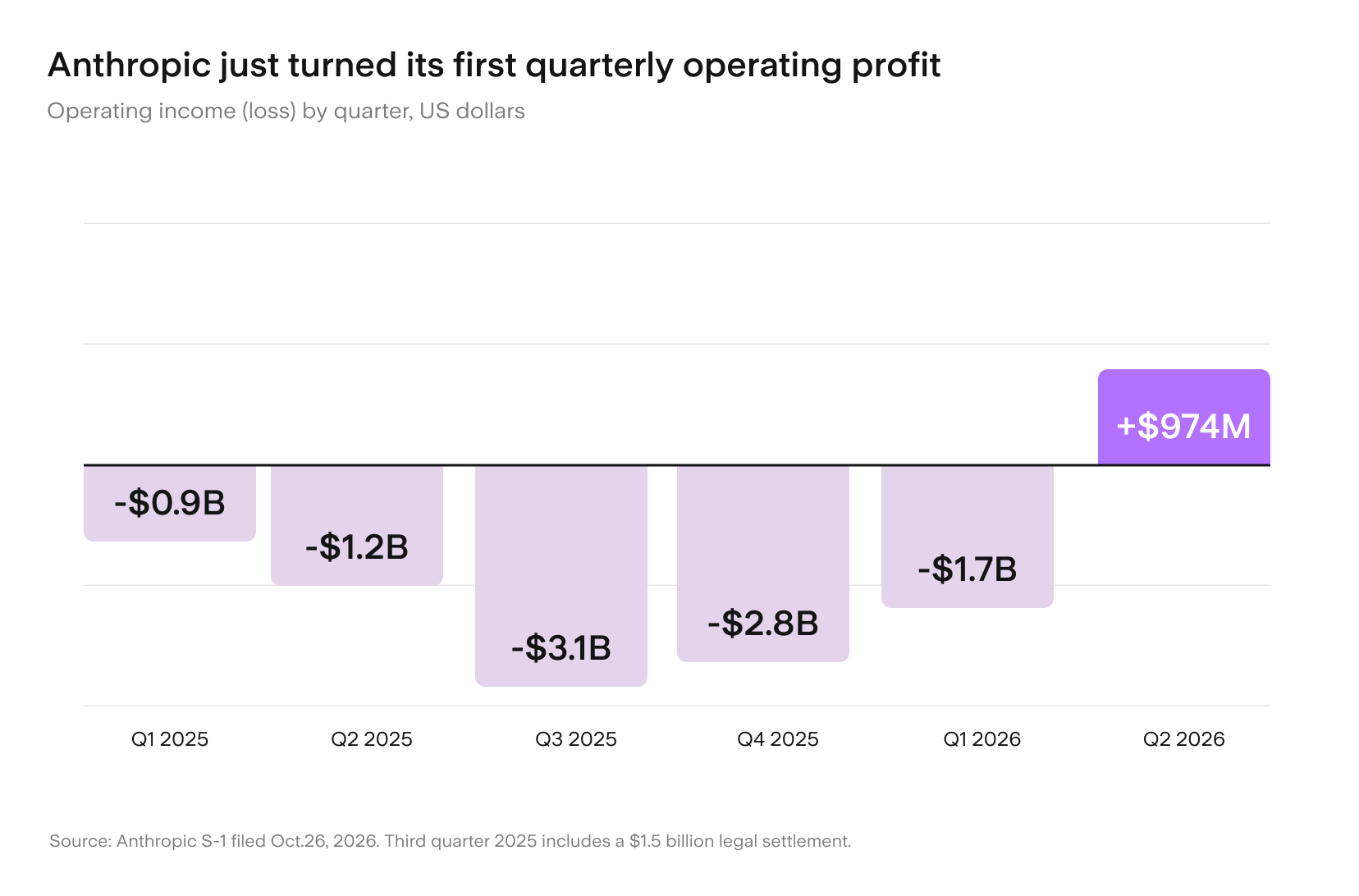
The high level of capex spend required can be a difficult number to grapple with since it weighs on bottom-line profitability. TLDR: it just looks bad that a company of this calibre is posting big operating losses.
But in Q2 2026, Anthropic posted US$974M in operating income on over US$11.5B in revenue. That’s no small feat for an AI company with massive capex commitments.
Buy or sell?
The market is pricing Anthropic as a company that has already won its category. Fair enough, it’s backed by remarkable growth of about 12x YoY, positive operating cash flow and over a US$200B cash buffer.
The risk is that roughly US$65B to US$150B a year of committed compute meets consumption revenue that can fall away.
Scenario | 2030 revenue | Net margin | P/E | Value today | Fully-diluted |
|---|---|---|---|---|---|
Bear | US$200B | 20% | 20x | US$0.5T | US$28 |
Base | US$400B | 30% | 25x | US$1.9T | US$105 |
Bull | S$700B | 35% | 30x | US$4.7T | US$258 |
To justify the US$1.8T valuation today with a 12% discount rate over four years, Anthropic needs to be worth about US$2.8T in 2030. At a 25x P/E, that requires about US$110B of net income. At a 30% net margin, that means about US$370B of revenue in 2030.
Getting there from where it is today depends on margins growing in a big way, even if Anthropic’s revenue growth rate slows. It’s a tall order, but given its current trajectory, it’s not out of the question.

Markets Analyst
Samy is a markets analyst at Stake, with seven years of experience in the world of investing, working across roles in private banking, venture capital and financial media. She has a Master’s degree in Finance and Data Analytics from The University of Sydney Business School.
Subscribe
By subscribing, you agree to our Privacy Policy.