Under the Spotlight: Pro Medicus ($PME)

The SaaSpocalypse flattened software stocks and knocked this ASX A-lister down by two-thirds. Is this the comeback or a stock running hot?
ICYMI: Do your own research and make your own decisions. This article drills down on a specific company, however, it's not a recommendation to invest in the company and should not be taken as financial advice. Got a stock you want covered? Tell us here.
Forget Apple or Tesla. If you’d invested $10,000 in Aussie med-tech firm Pro Medicus ($PME) a decade ago, it would be worth about $412,000 today.
That’s growth of about 45% per year, before dividends. Compared to an annual gain of just 5.8% for the ASX Healthcare sector and 8.2% for Tech and IT, there’s no wonder it’s the best performing S&P/ASX 200 company of the last decade.
The software sell-off (see SaaSpocalypse) earlier this year tested that. PME’s share price fell by two-thirds to $108.15 in February from its 52-week high and is still down 18% over 12 months, held back by fears of AI disruption.
The stock was also a top pick at FinFest 2026 by advisor Adam Dawes of Shaw and Partners during their ‘Buy or Sell’ segment, which helped spark our interest.
So, let’s put Pro Medicus Under the Spotlight.
First, the business
Pro Medicus was launched in 1983, when GP Dr Sam Hupert and technologist Anthony Hall built software for doctors, then radiology.
The defining moment was buying U.S. imaging firm Visage in 2008 for a distressed US$4.5M, a bargain that brought a quality technical team and U.S. sales.
Today Visage is PME’s core product, making up over 93% of total revenue in FY26 with nearly all of those sales coming from North America.
Its software lets hospital staff view large CT and MRI scans on screen by streaming images from a main server, rather than copying each scan, which can run to thousands of images, to local hard drives.
Importantly, major hospitals have so far been willing to pay for the service, with 11 of the 20 top U.S. hospitals using Visage.
How it's expanding
Asked to explain why Pro Medicus was one of his most bullish picks, Dawes pointed to the firm’s new contracts, which include smaller local hospitals.
‘This shows Pro Medicus isn't just relying on large hospital deals to drive growth. With three new community healthcare contracts already secured in FY27, the company continues to expand its customer base,’ Dawes told Stake.
Pro Medicus had a stellar FY26, landing 10 new contracts in FY26 worth $407M and renewing all six contracts up for renewal, worth $141M over five years.
Its small Europe footprint also has growth potential, with one new contract signed to Germany’s University Hospital Heidelberg, lifting European revenue 37% to $5.9M.
PME also released Visage 7 Reporting in Europe this year, an AI-supported tool that lets radiologists write reports without separate third-party software. North America follows in the first half of 2027.
Dollar signs
Many of those contracts have yet to go live, so this year’s results come mostly from earlier wins.
Revenue rose 23% to $261.7M in the year to June 2026, and at constant exchange rates, growth was 28%.
Reported profit more than doubled to $265.3M, helped by a $174.2M unrealised pre-tax gain on its stakes in 4DMedical ($4DX) and Echo IQ ($EIQ). Without the gain, profit was $143.3M, up 24%.
Its trajectory has been steady for years. Counting interest income, revenue nearly tripled in four years, from $94M in FY22, while profit more than tripled.
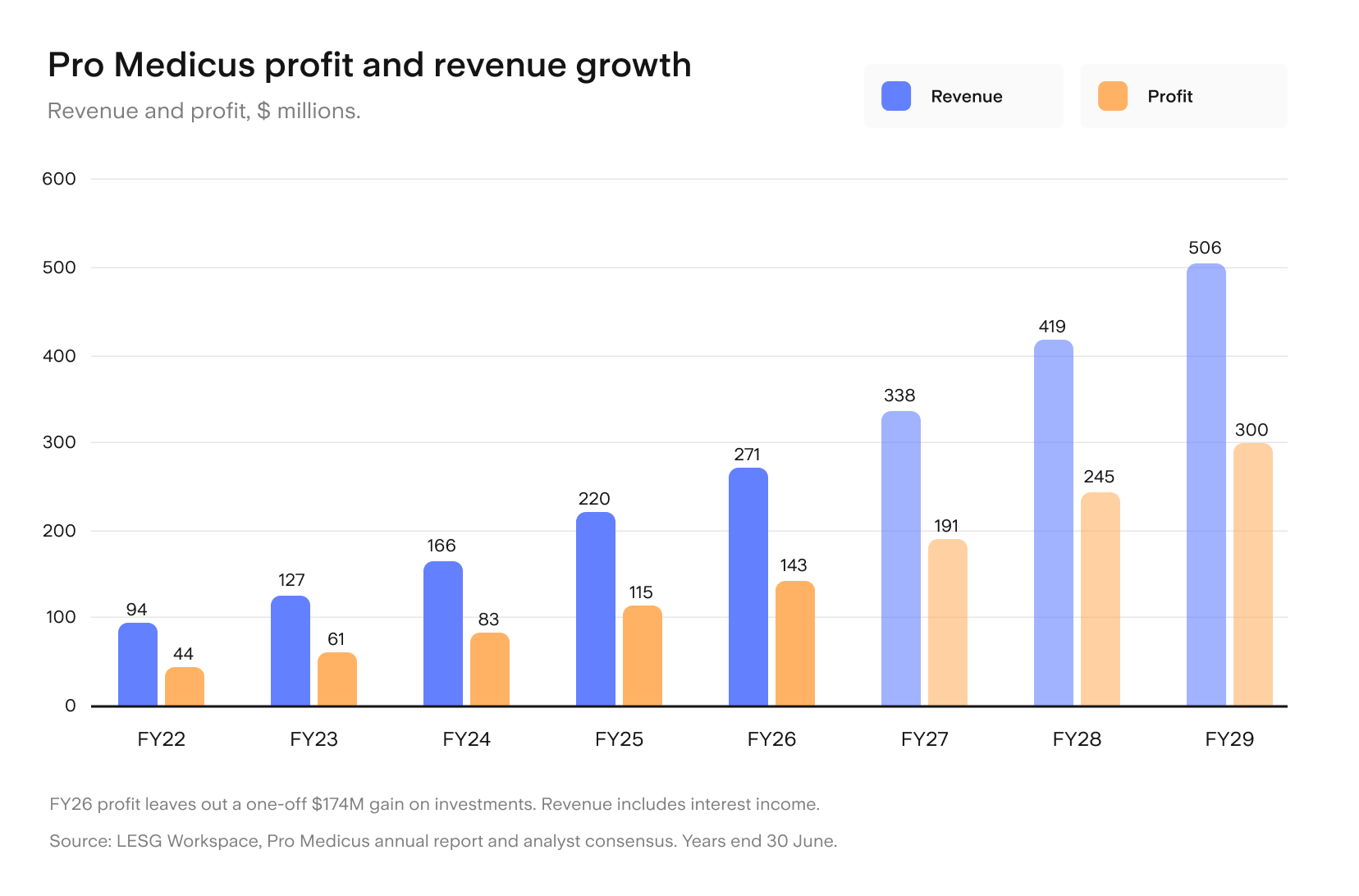
Analysts expect the pace to hold up. FY27 revenue is forecast at $338M, up 25%, and profit at $191M, up a third. By FY29 the forecasts reach revenue of $506M, according to analyst estimates compiled by LSEG.
Much of that is guaranteed. Contracts already signed lock in at least $1.34B of revenue over the next five years, up 41% from a year earlier.
Rivals honing in
Pro Medicus has an unusually strong profit margin, keeping about 75 cents of every revenue dollar as operating profit.
Its imaging rivals earn far less. Sectra, the Swedish imaging software maker, keeps 21%. GE HealthCare ($GEHC) makes 14% and Philips ($PHG) 9%. Other ASX-listed software companies like WiseTech Global ($WTC) and TechnologyOne ($TNE) earn less than half.
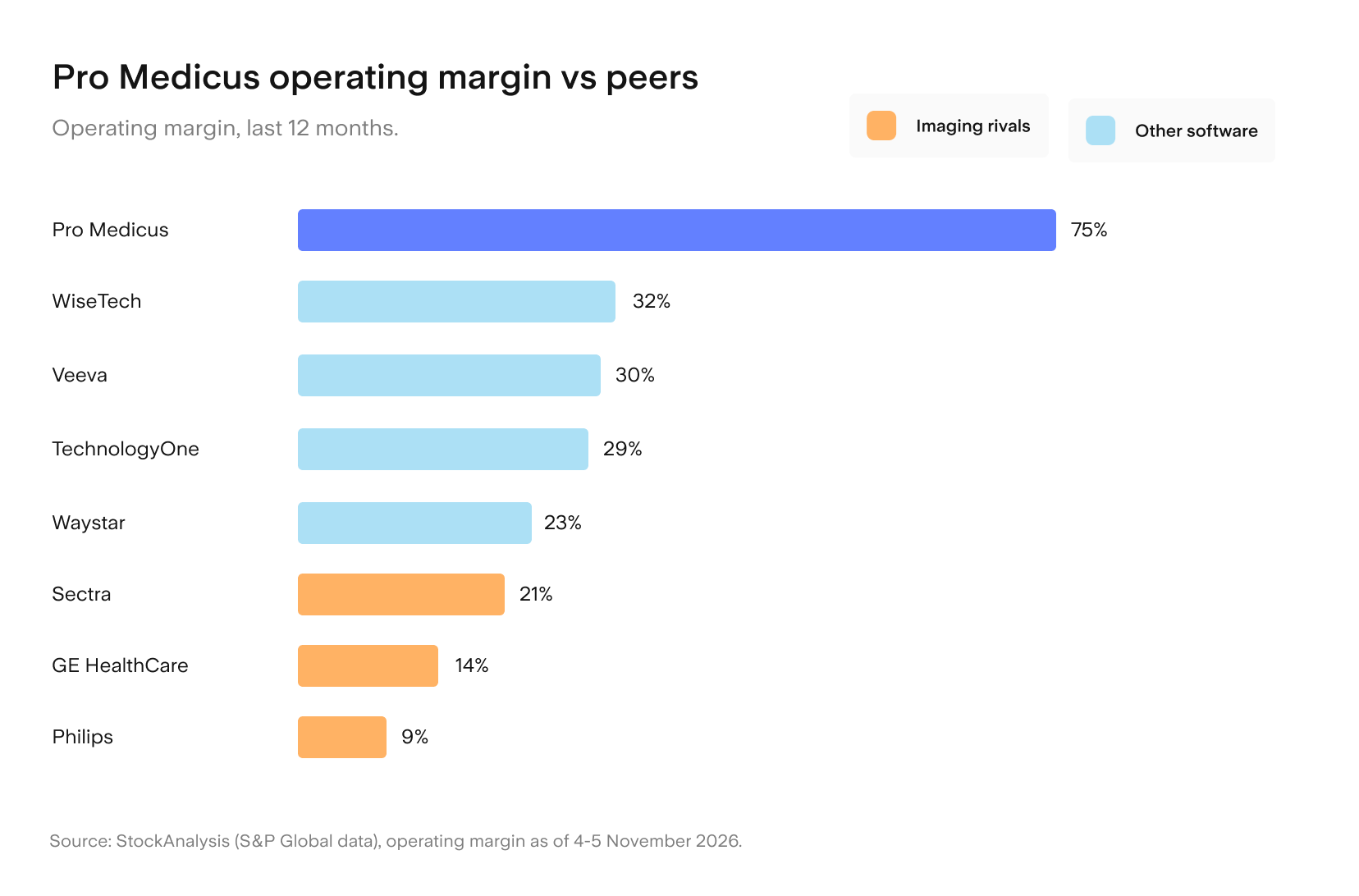
However, a margin that high attracts competition. Morningstar predicts rivals, helped by advances in AI, will close the gap over the long term.
It points to a 2025 survey by KLAS that suggests more hospitals were considering Sectra software over Pro Medicus, and that another rival Agfa Healthcare is gaining momentum.
The stock is also starting to look hot, trading at about 110 times expected FY27 earnings, with analysts forecasting an operating margin of about 78% by FY29, leaving little room for error.
The risks to watch
- AI could lower what hospitals will pay – Pro Medicus earns a fee per scan, so the risk is rivals developed using AI could bring new competition and lower prices.
- Revenue is lumpy – it starts when a site goes live, not when the contract is signed.
- Currency risk – around 90% of revenue is in U.S. dollars, so a strong Australian dollar cuts reported earnings (it cost about $12M of revenue this year).
- Valuation leaves little room for a miss – analysts already forecast margins near 78% and 22% yearly growth, and the current share price relies on both.
Buy or sell?
Pro Medicus ($PME) has had an awesome track record. It’s the top performer on the S&P/ASX 200 over the last decade and forecasts suggest there’s more growth to come.
And it has the means to keep going: it has no debt, $252.3M in cash, and it’s already backing AI, including up to $20M for Echo IQ, an ASX-listed heart-scan AI company whose software it plans to resell.
But some of that growth looks priced in. LSEG’s average 12-month target is $212.93, not far above the latest price, with nine of 14 analysts rating it a buy, and none a sell.
Whether Pro Medicus is a buy comes down to whether the AI scare was a warning or an overreaction. The contracts so far point to an overreaction, though a price near analysts’ targets leaves little room for a slip.
This is not financial advice nor a recommendation to invest in the securities listed. The information presented is intended to be of a factual nature only. Past performance is not a reliable indicator of future performance. The author of this article and other employees of Stakeshop Pty Ltd may hold positions or have financial interests in the company (or companies) discussed above. As always, do your own research and consider seeking financial, legal and taxation advice before investing.

Senior Markets Commentator
Kylie Purcell is an investments analyst and finance journalist with over a decade of experience covering global markets, investment products and digital assets. Her commentary has been featured in publications including the Australian Financial Review, Yahoo Finance and The Motley Fool. She has a Masters Degree in International Journalism from Cardiff University and a Certificate of Securities and Managed Investments (RG146).
Subscribe
By subscribing, you agree to our Privacy Policy.